





This article appeared in the February 2022 issue of Resource Recycling. Subscribe today for access to all print content.
In the 1990s, the U.S. EPA encouraged recycling market development as a tactic to promote positive environmental behaviors. By using recycled materials and diverting from landfill, recyclers and manufacturers help reduce raw material consumption and lower the impact of products.
Now, as more companies set voluntary recycling goals and interest in creating circular economies grows, ensuring we have the systems in place to establish or improve local recycling market development centers is even more necessary. In 2020, AMERIPEN formed a unique task force comprising representatives from state recycling market development centers to explore ways that the packaging industry and government agencies can best collaborate to advance the recovery and reuse of packaging in the United States.
The task force identified a wide range of approaches used by states based on their individual situations, and it also found no documented best practices exist for the development of state recycling market development programs.
As a result, AMERIPEN hired consulting firm Resource Recycling Systems (RRS) to study successful programs and determine strategies for states to begin the process of lobbying for, funding and setting up a recycling market development center. Our new report, “Best Practices for State Recycling Market Development Centers,” is the culmination of that research with additional input from the task force and other technical experts.
Study participants
The research team reviewed a diverse set of programs with various approaches to leadership, funding and more.
For example, two regional nonprofit associations – the Northeast Recycling Council (NERC) and the Southeast Recycling Development Council (SERDC) – support multiple state efforts for market development but are independently funded. In South Carolina, the program is housed within the Department of Commerce, and a 14-member council advises on growing the state’s recycling industry and end markets by making annual recommendations to the governor and General Assembly.
In Minnesota and Michigan, both programs are under the states’ environmental agencies – however, Michigan currently contracts much of its market development investment efforts through a third party, NextCycle Michigan. This incubator program is designed to generate funds via sponsorship and facilitation of public-private partnerships. NextCycle’s programming correlates to the state’s recycling supply chain and end market goals; selected teams receive technical support and subject matter expertise as they compete for awards.
Pennsylvania’s Recycling Markets Center (RMC) is another example of a highly individualized approach. It is housed within an academic institute but receives the majority of its funding from the state. The RMC is organized and operates as a nonprofit 501c(3) corporation, making it accountable to its board and sponsors. Like NextCycle, the program’s business support focuses on setting up a business and taking the first steps toward developing a business model.
 Setting up and getting funding
Our guide recognizes and provides a variety of options for consideration depending on the local context. It expands on four primary topics.
The first is how to establish an initiative. Building political will is essential to creating the formal framework for market development centers. To do so, collaboration from a wide range of stakeholders is needed. In particular, the presence of local industry expertise is crucial to articulate the challenges and opportunities that recycling market development provides. Likewise, using data to explain how these programs affect job creation, labor income, capital investment, economic output, and tax revenue has proven to be highly effective at generating support from a range of stakeholders across the industry – and across the aisles inside statehouses.
Once the political will is created, options have been studied and a clear vision has emerged, an important next step is to formally establish the center in statute. Cooperation between the state’s environmental and commerce agencies is important for balancing recycling system expertise with business development knowledge.
The next priority area is funding. Financing a market development center’s implementation and ongoing operations can be an obstacle for programs. Because market development can take time to achieve meaningful results, a best practice is for the state to fund the essential operational elements, including staffing and overhead, for the initial five to 10 years. New programs also should budget for additional start-up costs, such as marketing and website development, and baseline research, which will guide strategic decision-making in the future.
Some programs take fundraising one step further by diversifying beyond state-allocated money. This includes federal funding and private-sector sources such as grants, sponsorships and fee for service. Here, too, the packaging industry can participate – either through direct engagement, commitments to purchase recycled content, or advocacy for more recycling funds to be used for recycling market development.
The role of the center also extends to businesses themselves by providing them clear and easily accessible funding support. For example, centers in Michigan, California and Minnesota include budgets for grants and low- or no-interest revolving loans to local recycling businesses. In states where direct funding is restricted, such as Washington and South Carolina, effective centers point businesses to other financial resources.
Operations and programming
The third area of focus is operations. Our research revealed that successful centers use a variety of models for organizing how work is directed, staffed and governed.
The two best approaches for organizational leaders are either a state agency – typically the environmental agency and/or the department of commerce – or an independent third party. Both have value and bring different strengths to the table.
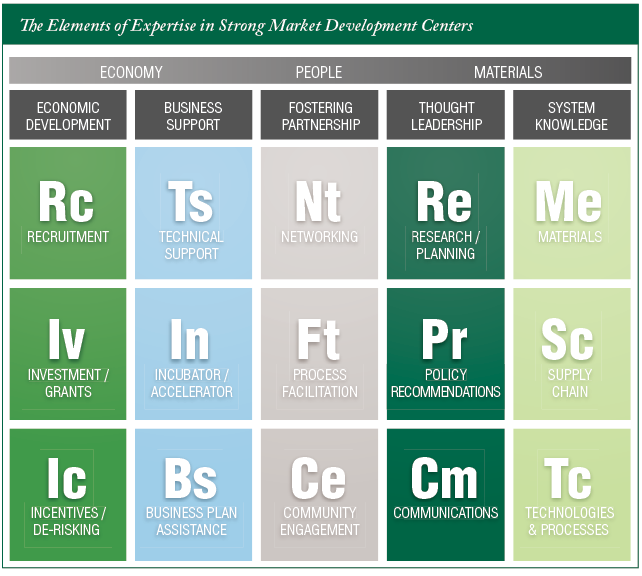
Most of the centers we researched have two to seven full-time staff, depending on the size of the state and the scope of the program. The staffers at each center should have an understanding of several key disciplines in materials management, business, finance, economic development and behavioral science.
Furthermore, the center should have an advisory committee or group of consultants that can complement those skills with strong facilitation and collaboration abilities.
Finally, there is the critical question of programming. While centers can address a number of different objectives, the most productive ones target four or five programming elements and rely on collaborative networks to support the remainder.
Successful centers also demonstrate clear relationships between their efforts and larger goals, such as climate change and environmental justice, and they work with other industries to create a convincing case.
The program in California, for example, aligns circular economy strategies with low carbon strategies by funding recycling infrastructure grants using credits generated through the state’s greenhouse gas cap and trade system. Similarly, programs in Michigan and Washington have broadened support from local organizations by communicating the potential for expanding access to recycling and related business support to historically underrepresented communities.
Engagement opportunities
Managing a recycling market center requires an understanding of business development, state policymaking and the recycling industry. In the past, many program managers were learning through trial and error, and managers in more established programs were often serving as informal mentors to new programs.
But now formalized networks are established, such as the AMERIPEN task force, the regional networks recently launched by the EPA, and nonprofit associations SERDC and NERC. Together, these groups can help advance an increased understanding of these programs and support their growth.
As a trade association representing the entire packaging industry value chain, AMERIPEN believes expanding state market development centers can be instrumental in expanding recycling opportunities for packaging and reducing environmental impact. We encourage readers to learn more about these programs and for recycling market development professionals to participate in our task force by reaching out to AMERIPEN directly.
Dan Felton is executive director of AMERIPEN – the American Institute for Packaging and the Environment. The association represents the U.S. packaging value chain by providing policymakers with fact-based, material-neutral, scientific information. Felton can be contacted at danf@ameripen.org.
This article appeared in the February 2022 issue of Resource Recycling. Subscribe today for access to all print content.