










This article originally appeared in the September 2018 issue of Resource Recycling. Subscribe today for access to all print content.
Most stories on battery waste these days focus on the inherent dangers of the material, including some significant safety incidents tied to lithium-based batteries. That’s an important issue, but it’s not the only battery management reality in need of attention.
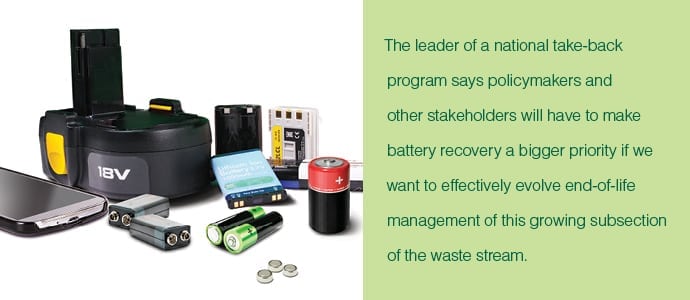
An arguably bigger talking point is the fact that batteries are a growing portion of the waste stream, with more than 500 million pounds of consumer batteries expected to be available for recycling by 2020, based on the 2016 “U.S. Consumer Battery Sales & Available Collection” report commissioned by Call2Recycle. Even with this growth, batteries are becoming increasingly difficult to collect and recycle at end-of-life.
Battery recycling was spawned from two imperatives: keeping certain toxic metals (namely lead, cadmium and mercury) out of the normal waste stream and finding a suitable source for a material that could be used to manufacture new batteries.
Recycling of lead acid batteries (those found in automobiles) flourishes because manufacturers seek the material as a source to make new battery products, and in the 1980s and ‘90s, several states enacted laws to formalize these processes.
During that same time period, rechargeable batteries used in consumer devices became more popular. The organization I lead, Call2Recycle, Inc. – formerly known as the Rechargeable Battery Recycling Corporation (RBRC) – was created in 1994 as a means to capture the cadmium used in rechargeable nickel cadmium batteries.
While lead acid battery recycling continues to be successful, there is far less of a toxic-material-management need to recycle consumer batteries due to their varying contents. Cadmium is being phased out of the consumer battery market, replaced primarily by lithium-ion batteries, which don’t contain toxic material. The new driving force: consumer interest and engagement in eco-friendly practices.
Unfortunately, those forces currently do not seem to be strong enough in the U.S. to overcome a variety of factors that are making battery recovery more challenging. We’ve hit a pivotal moment where strong strategy and leadership are needed if we want to ensure the batteries fueling society’s growing array of electronic products are kept out of the waste stream.
Shortcomings in policy and infrastructure
As mentioned above, part of the effort in the 1980s and ‘90s to manage toxic batteries (specifically lead and cadmium-based products) involved the passage of state laws mandating collection and recycling. Such policies typically obligated manufacturers to create, manage and finance these processes.
Since then, very few states have continued this regulatory action, with some exceptions. New York enacted a law in 2011 requiring that manufacturers handle rechargeable chemistries, and Vermont passed legislation in 2015 mandating the collection and recycling of primary (single-use) batteries (the law excludes batteries contained or sold with a product).
California, which bans batteries from landfills, has come close several times to enacting a product stewardship law. On several occasions, the California State Legislature has actively considered obligating manufacturers to finance a recycling scheme, but these attempts haven’t resulted in any new laws.
Aside from these developments, there’s been very little regulatory imperative in the U.S. to collect and recycle consumer batteries over the past two decades. On a macro scale, U.S. state laws don’t encourage recycling of consumer batteries. While studies show that consumers believe batteries should be recycled, it remains a voluntary behavior.
Another factor influencing outcomes is inconsistent messaging from environmental groups, manufacturers and government agencies on consumer battery recycling. Some government agencies direct consumers to dispose of primary batteries into the regular waste stream instead of recycling them. Often, stakeholders will try to communicate the fact it is more important to properly recycle rechargeable batteries versus their single-use counterparts. This is generally difficult to accomplish since single-use batteries look and act quite similarly to rechargeable batteries. These mixed messages can pose a challenge in terms of increasing battery recycling rates.
With a lack of government leadership and little consistency on communication, it’s not surprising there is sparse infrastructure to support battery recycling domestically. There are only three companies that process primary batteries in the U.S. What’s more, those operations are located in the Midwest and Southeast, not proximate to the population centers on the East and West Coasts that have shown the highest propensity for recycling in general. Meanwhile, although there are a couple of companies in the Midwest that will treat lithium-ion batteries, there is no final processor of lithium-ion batteries in the U.S.
The lack of domestic battery processing increases the costs of recycling, deterring even the most avid environmentalists from recycling consumer batteries. To increase consumer battery recycling, a more robust processing infrastructure is needed.
Compare these previous issues with electronic waste. Twenty-five states have passed laws requiring manufacturers to manage electronic waste disposal. This fact serves as a clear signal to residents and businesses that electronics ought to be diverted from the normal waste stream and recycled to the extent possible. And, accordingly, there are scores of e-scrap processors throughout the U.S. While the material used in electronics are less and less toxic, the imperative to recycle them has not waned. Programs to manage this waste stream are myriad and growing.
Challenges amid change
Recent technological advances have also complicated battery recycling, particularly regarding lithium-ion batteries.
Due to the electrolyte used to maximize their power, lithium-ion batteries are potentially dangerous. The media has provided extensive coverage of battery safety incidents. Samsung Galaxy mobile devices, hoverboards and e-cigarettes have all shown to have some design issues with batteries. The battery products also require special handling for recycling and disposal – materials recovery facilities, garbage trucks and delivery vehicles have been damaged or destroyed by fires caused by lithium-ion batteries.
To mitigate this, programs like Call2Recycle have imposed safety requirements on those seeking to transport batteries for recycling. These safeguards – mirroring regulations promulgated by the U.S. Department of Transportation – require time and effort by the generator, and this has in some cases further limited battery recycling opportunities.
The Call2Recycle program, for instance, recently added additional safety training requirements for participating collection sites. In the wake of this change, 2,000 collection sites have opted not to complete the training and therefore have left the program. Inevitably, this impacts our collection network.
Additionally, the rise in lithium-ion technology is changing the mechanics of how consumers interact with batteries – especially at end-of-life.
Lithium-ion batteries are being designed to be ever more integrated into the devices they power. Smart phones, tablets, readers and other devices have flourished – almost none of them are powered by batteries that are designed to be removed by consumers. The more integrated batteries are into the products they power, the more likely that they will be disposed of with that host product, making the separate recycling of those batteries much, much more difficult to ensure.
Also, lithium-ion batteries with a high energy density have recently been shown they can be repurposed. This is particularly true for electric vehicle (EV) batteries, which are prized at end-of-life for their usefulness in being reused as uninterrupted power supplies (UPS). UPS can be used for consumer and commercial applications such as computer servers, security and lighting. This extends the life of the battery – which is generally environmentally positive – but it also makes it more difficult to capture for recycling when it finally does reach end-of-life, particularly when a battery’s second life occurs overseas (as is often the case).
The changing face of retail is another influence that is making it harder to recover batteries of all kinds. Collection efforts in this sector have traditionally depended on return to “retail” recycling. Today, however, consumers are increasingly leveraging the internet to purchase products, a shift that has caused many brick-and-mortar players such as Circuit City, Radio Shack and Sears to close shop completely or significantly reduce their overall footprint. There isn’t a clear mechanism to support return to retail when the retailer is an internet site.
Consistent with all this, Call2Recycle’s battery collection results in the U.S. have plateaued. Without some emerging leadership, changes in state product stewardship laws or a turnaround in the rhetoric surrounding waste, disposal and recycling, it will be almost impossible to significantly increase consumer battery recycling in the near future.
The future of battery recycling
Yet there is hope for the future of battery recycling. No matter how much product stewardship laws increase in their breadth and rigor, what is really needed most is a fundamental and significant change in attitude amongst consumers, moving away from a “disposal” culture to a “zero waste” mentality.
Call2Recycle has routinely surveyed consumers on their attitudes toward recycling, documenting the profiles of consumers most likely to recycle batteries. Recent survey insights from Nielsen, while not conclusive, illustrate a growing awareness amongst millennials that recycling and the environment are extremely important issues. A change in behavior fueled by this generation can help Americans begin to approach the recycling rates we see overseas.
Huge advances in recycling, including growth in consumer battery recycling, requires a different mindset in the U.S., starting with the senior political leadership and spreading across the culture and infrastructure from coast to coast. Through these influences, there is an opportunity to create real change.
Until then, Call2Recycle will continue its mission of optimizing consumer battery collections and spreading awareness of battery recycling to sustain our environment.
Carl Smith is CEO and president of Call2Recycle, Inc. He can be contacted at [email protected]. To learn more about Call2Recycle, Inc., visit Call2Recycle.org.