





This story originally appeared in the August 2016 issue of Resource Recycling.
Subscribe today for access to all print content.
Contamination, residue, trash – whatever you call it, the issue is clear. Material quality remains a thorn in the side of recycling facilities and, increasingly, of communities. With commodity prices still straining operating margins at materials recovery facilities, the problem has become even more urgent.
Recently, two North Carolina communities took a deeper dive into what it takes to get better recyclables. Their strategies and the results of implementation can help guide others looking for ways to garner cleaner material from their programs.
The cost of contamination
Commodity prices and MRF profitability have rightfully prompted an industry-wide focus around material quality. The Recycling and Materials Management Section of the North Carolina Department of Environmental Quality (DEQ) recently surveyed North Carolina MRFs to better understand costs these facilities face when dealing with non-recyclable materials. Contamination causes cost increases in a variety of ways, including increased hauling and disposing of residue, greater equipment downtime and even the downgrading of saleable commodities.
North Carolina MRFs handle around 483,000 tons annually. It’s estimated these facilities are seeing around a 15 percent contamination rate. If we take those figures and apply an industry-average hauling and tipping fee, we see the cost to MRFs for hauling and disposing of residue is more than $5 million annually.
That means a MRF handling 50,000 tons per year would experience costs on the order of $400,000 to $500,000 from contamination, reducing the facility’s overall blended-value calculation and its ability to possibly share revenues with supplying communities. Stopping to clean and repair equipment adds other expenses. In all, contamination appears to cost facilities around $10 to $15 per ton of throughput, according to North Carolina DEQ research. Conservatively, North Carolina MRFs are collectively facing a $7 million price tag to deal with residues each year.
Cutting contamination rates from 15 percent to 10 percent in our example means a MRF would save $175,000 or more per year just on avoided disposal costs. Such improvements would clearly benefit both the MRFs and the community recycling programs that rely on them.
So what’s the best way to start cutting those contamination rates and boost the economic situation of programs? First, coordinators must understand how contamination occurs in the first place. It’s clear many residents feel recycling operations can take in garden hoses or any packaging containing plastic or metal, especially plastic bags. These things often find their way into the system through the “good recyclers,” enthusiastic but unaware of the consequences of their throw-it-all-in habits. The other major source of contamination seems to be an entirely different type of household: those that use a bin or recycling cart as a trash can.
Dividing contamination sources into just two groups may be oversimplifying the issue, but creating the division can be helpful in determining how to respond. Tactics for addressing contamination should vary depending on the type of contaminator. More communities, prompted by changing MRF contract terms, are starting to think about targeted messaging and enforcement for more direct results. Whether delivered with humor or through fines, we are finally sending a message that will continue to benefit the recycling industry long after market prices improve. That message is simple: We won’t collect trash.
Cary keeps it loose
Case studies from two North Carolina municipalities help to highlight how local programs can effectively get the message out to residents.
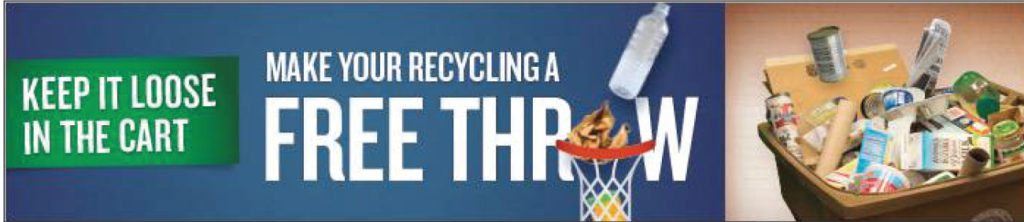
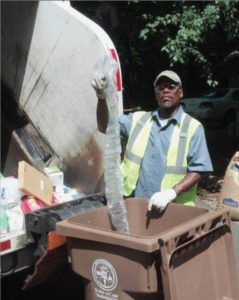
The first comes from The Town of Cary, the seventh-largest municipality in North Carolina. The municipality received notification in 2015 from its MRF that its contamination had increased significantly. Cary worked with the MRF to audit incoming loads and found that the primary contaminants were bagged recyclables, plastic bags and film. In response, Cary launched its “Make It a Free Throw” public education campaign urging residents to “Keep It Loose in the Cart.” The campaign included a massive effort to get a look at material in the recycling carts of every one of the municipality’s 47,500 recycling customers. Over 12 weeks, trained staff evaluated cart materials tipped into rear-loader trucks. Non-compliant materials were put back in carts and an educational cart hanger was left, explaining why some of the materials had not been collected. As Cary staff surveyed, they kept lines of communication with the public wide open, sending frequent reminders about Cary Recycles program guidelines.
The message started to get out, and the number of educational cart hangers that had to be distributed declined steadily, from a high of 1,400 per week to around 500 per week. The cart survey data confirmed earlier observations at the MRF and revealed that 34 percent of the violations involved plastic bags/film and 30 percent were for items placed in bags.
This guided the next phase of Cary’s outreach. Through news releases, newsletters, rebranding of educational materials, media interviews and social media posts including a popular YouTube video, Cary was capturing the attention of customers. Web traffic to recycling pages increased by 31 percent and calls and emails to customer service spiked as customers requested more information about what was in, what was out and why.
During this project, Cary changed MRF providers and now receives residue rates that are aggregated with those of other communities. Therefore, tracking the town’s individual rate has been challenging. Nevertheless, the MRF has indicated residue rates have dropped and are at an average of 12 percent. The town continues the “Keep It Loose in the Cart” campaign with a focus on education, including an updated cart hanger, and it plans to conduct a smaller, randomized cart survey to check material quality.
Greensboro gets granular
Another example of contamination progress can be seen in the City of Greensboro, a large metropolitan area centrally located in the state. It is markedly different from Cary in terms of size and demographics, but it also found itself facing a serious contamination problem, with residue rates approaching 21 percent. Greensboro was an early adopter of curbside carts, boasting the state’s first single-stream recycling collection program and many other progressive diversion programs.
Greensboro staff started by taking a magnifying glass to all aspects of the program, including labeling on carts, the effectiveness of education materials and the impact of inspectors. The City also conducted a survey to gauge residents’ recycling awareness and attitudes. Furthermore, a detailed analysis of route collection and community demographic data was performed to determine if there was a relationship between contamination, participation and community stress factors (such as high crime and litter) as indicated by the municipality’s Planning Department. Interestingly, Greensboro found a correlation between high-stressed areas and areas of low participation and high contamination, as did a 2014 North Carolina DEQ project in Clinton, N.C.
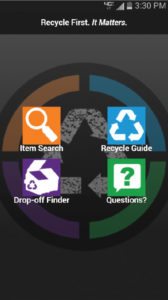
Greensboro overhauled its education materials with a new Recycle First campaign, organizing recyclables into easy-to-understand categories, using images of accepted materials, and featuring concise examples of unaccepted items. The City delivered the campaign through direct mail, billboards and new signage at drop-offs. It also developed a smartphone app that features a searchable database for quick answers about recyclability.
The campaign was effective, reducing contamination by two percentage points and increasing participation in the curbside program from 63 percent to 68 percent, a jump not seen in many years.
Greensboro staff then focused on a beyond-education method that blends direct customer feedback with enforcement, when necessary. With several inspector positions cut, the City found itself with one inspector to cover 82,000 households. Undaunted, Greensboro explored a new system using hopper cameras installed in trucks and a software system called Mobile 311 to essentially turn every driver into an inspector that can collect data with a push of a button. Just like that, the City went from inspecting 5 percent of households annually to having the ability to fully monitor every cart.
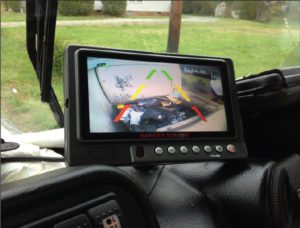
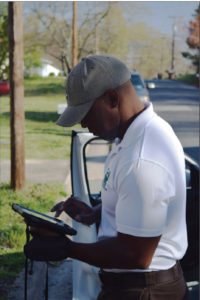
Earlier this year, Greensboro and its MRF partner, ReCommunity, tested the Mobile 311 application for a six-month pilot. Using earlier data to focus on the most problematic routes, staff used the GIS-enabled software to record households that put out carts containing contamination. The customizable software allows for categorization based on severity of contamination, and it can focus on specific issues, like bagged recyclables. During the pilot, Greensboro skipped 1,342 carts because they were severely contaminated, documented 1,669 additional carts with contamination, and recorded 6,248 instances of bagged recyclables.
The system lets Greensboro track repeat offenders, prioritize households or areas that need the most intervention, and allows for the simultaneous use of multiple strategies depending on the type of violation. For instance, the City can send a letter to a resident that has been bagging recyclables and explain to the individual why this an issue. Meanwhile, an inspector can conduct a face-to-face interaction with a household that has put out severely contaminated loads several times. The data can make a case for removal of service or possible fines if violations remain uncorrected. Incentive programs can also be developed. Indeed, as the City ramps up to a full launch, it is looking into all of these options and will start to use Mobile 311 to provide customers direct feedback later this year.
How to start moving forward
The aforementioned municipal efforts are certainly inspiring, but it’s also true not all recycling coordinators have access to the resources needed for large-scale audits or shiny new outreach campaigns. And not all have the support of managers and elected officials. However, everyone can and should start to take steps to lower contamination.
We can already see commonalities in efforts that are leading to higher material quality. Clear and consistent messaging using cross-branded, high-quality graphics reduces public confusion about recycling. Prioritizing the top three to five things causing the most problems at the MRF and educating about them prominently with images makes a difference. Several groups offer free, open-source content that can be customized and used, including Recycle More NC, The Recycling Partnership and ACC’s Recycle Your Plastics campaign.
Direct customer feedback is also showing major promise. Communities are using “oops” tags alongside enforcement and staff training to create a front-line response. They also use different strategies for different sources of contamination: positive explanations to the overzealous recyclers and enforcement with the bin abusers.
In addition, all programs can make noteworthy progress on quality by doing something about plastic bags. Recall that in Cary, 64 percent of the contamination found in the survey involved plastic film, and in Greensboro’s pilot, 67 percent of the recorded violations were for bagged recyclables.
Of course, plastic bags and film are also highly recyclable with consistent markets hungry for more clean material. And there is much film “beyond bags” to be recycled. This creates a tricky message to try to convey to the public: We want your bags, just not at the curb, please. Initiatives like the Sustainable Packaging Coalition’s How2Recycle label can help this messaging, pointing people to retail recycling options instead of household carts.
In North Carolina, a focus on film is a key strategy to improve material quality at MRFs. All campaign outreach now incorporates a prominent icon asking residents not to bag recyclables, and plastic bags are at the top of the “not accepted” list. North Carolina has also partnered with WRAP (Wrap Recycling Action Program) and Mecklenburg County (the second-most populated county in North Carolina) for a project intended to increase plastic bag and film recycling at retail outlets. The initiative is slated to launch this fall.
Better positioned for bad markets
Even if by sheer magic commodities prices rebounded to the glory days of 2011, we would be wise not relax our push to collect high-quality recyclables from the public. If there is a silver lining to the current hard times, it could be that the industry is taking steps to ensure better material and a less painful situation the next time prices go south.
For now, it’s time to put contamination back in Pandora’s box – or her plastic bag.
Heather Cashwell is a staffer in the North Carolina Department of Environmental Quality Materials Management and Recycling Section. She can be contacted at heather.cashwell@ncdenr.gov. For more information on the case studies described in this story, go to recyclemorenc.org, greensboro-nc.gov/recycle, or townofcary.org (search “Cary recycles”).