




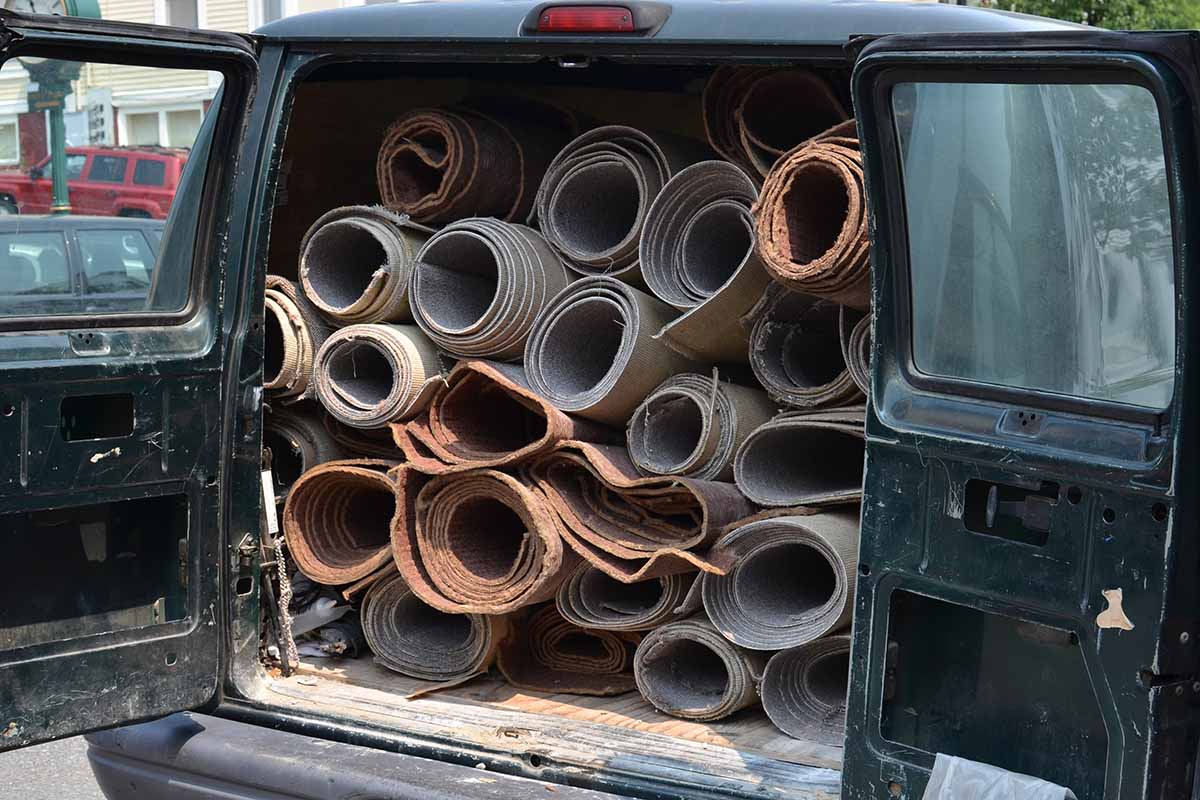
Carpet America Recovery Effort (CARE) submitted its annual report to CalRecycle earlier this month, and the numbers show a rise in California’s carpet recycling rate for the sixth year in a row.
The report, “California Carpet Stewardship Program’s 2025 Annual Report,” found the recycling rate for carpet reached 37% in 2025.
“Since the passage of the state’s first carpet stewardship law in 2010, CARE has built a solid framework to collect, transport, reuse, recycle and process post-consumer carpet across the state, improving environmental outcomes and advancing a circular economy for carpet,” the nonprofit group added.
The program collected 78.5 million pounds of carpet, which is enough to cover more than 3,000 football fields. And 86% of that collected carpet was recycled.
Some 3.5 million pounds of carpet was sent for reuse, more than four times the amount in 2021.
The program also added 15 new drop-off sites for used carpet, making a total of 174 public drop-off sites at the end of 2025. CARE also awarded $1.77 million in new grant funds in 2025, for a range of activities, including capital improvement, product testing and innovation and design grants.
CARE Executive Director and CEO Bob Peoples told Resource Recycling that California’s carpet recycling rate has been steadily increasing. Back in 2014 it sat at 4%. But the latest report “shows amazing improvement in a very tough market,” he said.
Challenging market
“There’s very little demand for our materials in the marketplace today, and there are huge uncertainties in the global economy impacting all recycling centers,” said Peoples, who called carpet recycling “complex.” He pointed to a global loss of recycling capacity for plastics in recent years due to closures, delays and cancellations of projects.
“I view this as all driven by a perfect storm of cheap, oversupplied virgin plastics from international markets and high regional energy costs,” he said.
In particular, market conditions have been particularly difficult since Q3 of last year, said Peoples. Although CARE reached its target recycling rate in 2025, the organization is seeing numbers four points behind their 2026 target of 41%.
“We can’t move recycled output if nobody in the marketplace wants to buy our materials, despite the massive subsidies that we pay to try to facilitate that,” said Peoples.
Since the inception of California’s carpet recycling program, CARE has paid out $222 million in subsidies, a majority of it going to California-based recyclers and another $80 million to fund program costs and administrative fees, Peoples said.
He added that he is concerned that as EPR programs for packaging and textiles ramp up in California over the next few years, those much bigger sources of plastics will compete for the same limited markets for recycled content with carpet.
Collections
Heidi Sanborn, CEO of the National Stewardship Action Council, called CARE’s latest report “a significant improvement.” But she said “it’s not nearly where I believe it should have been by now. I think they could have, without too much more effort, been closer to 50% by now.”
Sanborn criticized CARE’s collection system, saying “You can’t recycle what you don’t collect.” She said there still aren’t nearly enough carpet collection sites in the state, despite the recent additions. In contrast, the state’s paint recycling program, which started about the same time as the carpet program, has 800 year-round drop-off sites.
Peoples said the statute requires that CARE add more carpet drop-off sites over time. For years, the organization has had sites in all 58 California counties, and the law requires an increasing number each year based on population (it started at one site per 500,000 people but has been steadily dropping). He noted that it can cost three times more to run a drop-off site in a rural area versus an urban one, because of transportation costs and longer storage fees (because the bins take longer to fill up with carpet).
Peoples said the high cost of diesel fuel right now is hammering his budget and disincentivizing contractors from recycling carpet.
He added that he would like to see more shared drop-off sites for carpet, textiles and packaging as those programs ramp up, to make it convenient for residents and save taxpayers money.
As it stands, the vast majority of the carpet CARE collects comes from installers doing a rip-out and installation of new carpet. “A pretty small percentage of people actually rip out their own carpet and take it to a landfill or to a drop-off site,” said Peoples.
The organization tries to make it convenient for those installers with the placement of drop-off locations at or near carpet retailers, or at carpet distribution hubs.
But Sanborn said she would like to see CARE directly reimburse haulers for picking up carpet, the way the state’s mattress recycling program works. Right now, CARE pays for the collection containers and pays for the transportation to a recycler. Some of the drop-off sites take carpet for free, some charge a discounted tipping fee and some charge standard tipping fees. However, that has to change in the near future, Peoples said, as the law requires collection sites to soon accept all carpet for free.
“We’re going through an analysis of what that’s going to cost and how do we manage that in the future,” said Peoples.
Sanborn also criticized CARE’s educational efforts, saying they haven’t done a good enough job getting contractors and the public on board with the program. She suggested more focus groups would help make sure the messages are connecting. Peoples countered that his group has done focus groups.
The road ahead
Looking toward the future, Peoples said he is excited about the chance to work with California regulators to develop the new guidelines for AB 863, and possibly AB 904, if that bill is signed by Gov. Gavin Newsom. AB 863, which was signed into law on Sept. 27, 2024, sets a carpet-to-carpet recycled content mandate of 5% by 2028, mandates sorting at an approved collection site by 2029, establishes reimbursement for those collection sites and tweaks the state’s recycling rate formula. It also requires a visual mark to identify synthetic materials by 2027 for more effective sorting, adds four more stakeholders to the current CARE board, starts a carpet installer apprenticeship program grant system and increases penalties for failing to meet mandates.
AB 904 includes a number of provisions, including establishing a voting governing board over carpet stewardship organizations, recycled content goals, product stamping with materials information, expansion of collection sites, new reporting dates and funding for the apprenticeship grant program on carpet recycling and installation.
Peoples added that part of his group’s mission is to “work with the carpet industry to help design for recyclability and help build that circular economy.” Those efforts take time, he said.
Sanborn said CARE could do a better job setting up a new system of eco-modulated fees to encourage greener carpet design. “Their differentials are not big enough,” she said.
As for the bigger picture, carpet is declining in popularity, said Sanborn, as people opt for other flooring options that are easier to clean. Still, there is a lot of material out there to dispose of, and there will be for some time. For next steps, Sanborn would like to see more unified action around all types of flooring, particularly laminate, which is recycled at low levels.
In January 2027, CARE will celebrate its 25th anniversary, which it is marking with a conference in May. The program has been a pioneer in circularity for the state, said Peoples, and he has seen many lessons learned.
“The world has a plastics waste problem, and until society decides they want to find a solution, and pay for that solution, progress is going to be pretty slow,” said Peoples.
Sanborn said, “We put people going all the way around the moon. Don’t tell me we can’t figure out how to recycle carpet at a much higher level.”