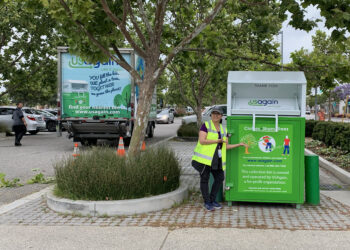

















Extended producer responsibility for packaging in Oregon is officially implemented, with the first dollars from producer fees flowing out to the communities most in need as of July 1.
Kim Holmes, Oregon executive director for producer responsibility organization Circular Action Alliance, told Resource Recycling that the implementation is an exciting moment for the team, both in-state and nationally.
“All eyes will be on Oregon, and I think our team has done a really good job preparing for implementation, making sure that we have all of our core functional areas ready to go,” she said. “We feel really good about where we’re at with the launch.”
Oregon, which passed EPR for packaging in 2021, is the first of the seven U.S. states that have passed such laws to reach this stage. It approved a plan from CAA in February. Holmes noted that the “approval of the plan itself was a huge milestone for the team.”
“It really was a culmination of hard work from many organizations and partners that are going to be working with us through implementation,” she said, including the Oregon Department of Environmental Quality (DEQ) and the Oregon Recycling System Optimization Project (ORSOP).
ORSOP was formed after CAA and other stakeholders realized an earlier needs assessment had not captured all the information needed to create the program plan. Haulers, the League of Oregon Cities and the Association of Oregon Counties all worked hard to get local governments to engage, Holmes said.
“That was a really substantial undertaking in a very short window of time, and there was some uncertainty around whether we would be able to achieve the objectives that we set out with in that short time period,” Holmes said. “And we did. Again, that was entirely because of the collaboration.”
Cheryl Grabham, DEQ materials management program manager, said during a press conference ahead of implementation that collaboration has been both the greatest challenge and the greatest joy.
“What is both very rewarding and has been incredibly challenging is what it takes to lead the nation in developing a world-class recycling system is — in Oregon — everyone working together,” she said.
That means working with hundreds of interested parties, such as local governments, service providers, end markets, CAA, the public and others to come as close to consensus as possible, and “that is not easy work.”
Another moment of uncertainty was how producers would react to the first-ever reporting deadline, Holmes said, and “what we saw is producers showed up.” There were 1,970 reports submitted in Oregon.
Overall, the biggest challenge was the compressed timelines, she added, and she hopes future states take that learning into consideration.
“Two years feels like a long time to develop a program, but really what we’re learning from this is it’s best to pace out some of those milestones,” Holmes said, pointing especially to defining producer reporting categories, or having rulemaking complete before developing program plans so those things aren’t happening concurrently.
Other tips from the Oregon team include prioritizing collaboration among as diverse a group of stakeholders as possible and keeping the end goal in mind when obstacles arise.
“As long as we know where we’re headed, we can figure out the best path of getting there together,” Holmes said.
Overall, Holmes said she and the rest of the CAA team are excited to see how the implementation works in Oregon.
“We’re going to learn a lot and we’re excited to see what we’re going to learn,” she said. “Colorado is right on our heels with implementation in 2026, so I think we’re going to really gain a lot of information and understanding that I hope future states are watching and paying attention to and will learn from.”
Program details
During a May 27 state House Committee On Climate, Energy, and Environment hearing, Holmes added that “since being officially named the PRO back in February, I think we have a lot to celebrate.”
The first program plan starts July 1, 2025 and runs through Dec. 31, 2027. CAA anticipates it will cover about 415,000 tons of material.
“Reported weights met the target ranges in the program plan, which we were very pleased to see,” Holmes said. While some fee categories shifted a little from the plan, due to lower or higher reported volumes, the average per-ton basis was “very, very close to the estimates in the program plan, so we hope producers will be very pleased about that with no surprises there.”
As for budget, CAA anticipates spending $188 million in pre-program and 2025 costs, then spending $254 million in 2026 and $289.5 million in 2027.
Holmes said producers were sent their first invoices in June, so there would be funding ready to go to priority A communities on July 1. There are 16 priority A communities that will get a total of $17.5 million in investments to start, she added, and Deschutes, Jackson, Lane and Marion counties transitioned to the statewide recycling list in July.
In addition, over the next two and a half years, CAA will stand up a network of 144 PRO Recycling Centers for hard-to-recycle items that have responsible end markets, such as EPS, shredded paper, plastic buckets and pails, glass and film. They will be branded with a “RecycleOn Oregon” logo to build a trusted brand, Holmes noted.
CAA’s planned contamination audit center will be located at City of Roses Disposal in Northeast Portland, Holmes announced, where CAA has rented a “significant portion” of the facility to perform contamination audits, consolidate material from the Recycling Centers in the metro area and to have office and meeting space.
“Overall, our operational readiness is high,” she said.
Lingering questions on REMs
Despite that readiness, Holmes said on May 27 that there are still some concerns about sufficient responsible end market — or REM — capacity.
“CAA supports the responsible end market principles of transparency, compliance, environmental soundness and adequate yields,” she said. “CAA is committed to collaborating on a practical, enforceable REM verification standard that protects proprietary information and maintains market stability and offers that transparency that is very important for accountability.”
CAA’s initial program plan had a preliminary REM standard that needed more consultation, Holmes said, and once CAA did that, the consultation showed that the standard did not meet the needs of all the parties.
CAA spent more than 200 hours engaging with end markets and “started an unprecedented conversation around the globe,” Holmes said, but setting a practical, enforceable standard will take time and collaboration.
“Oregon alone, we’ve heard, is a small market to drive substantial change in such a global industry,” Holmes said. “We are at risk of end markets choosing to buy materials from other states and jurisdictions that don’t have similar reporting requirements.”
In response, CAA proposed a phased-in approach with a program plan amendment that includes the option for producers and processors to request variances.
In the meantime, CAA would work to create an independently developed REM standard that can meet requirements in all state programs, Holmes said.
“We hope a standard would be broadly relevant across all states, so the incentive to get certified to the standard in Oregon will carry more weight,” she added.
At the press conference prior to the rollout, Nicole Portley, EPR program plan lead at Oregon’s Department of Environmental Quality, said that the trick is to balance recycling more with recycling well.
“If we just increase collection and increase sorting but we don’t bring transparency to where those materials go, the factories that ultimately process the materials into new products, then we’re not completing the loop and ensuring high-benefit recycling,” she said.
That’s where REM standards come in, but it’s no small task, and Oregon is the first state to put the theory into practice.
“We are first out of the gate to establish what American EPR is about for packaging, and not stopping American EPR at the MRF, at the sorting facility, but going further downstream,” Portley said.
That’s because “our EPR is born out of an era of waste trade scandal, so there’s an imperative there in the statute and the rules for the producer funding to go to improve collection, to improve sorting, but also to go beyond to improve the end market processing,” she said.
Oregon will be “establishing where the balance point is among ‘recycle more’ and ‘recycle better,'” Portley said. “As the other states come online, they’re helping us do so, but we’re playing a pretty pivotal role as first out of the gate.”
Portley said at the May hearing that CAA’s program plan “is a living document in that it can be amended at any time.”
CAA already plans for two batches of amendments this year, she added, one that was submitted May 16 and is focused on eco-modulation of producer fees and one that is anticipated for the fall that will “address the responsible end market verification standard and endeavor to add materials to the uniform statewide collection list.”
Over 98% of materials by volume on Oregon’s uniform statewide collection list have at least one self-attested REM and conversations are underway with many others, Portley said. However, “in recognition that it takes time for systems to transition, DEQ has created a temporary process for processors in the case where a self-attested end market is not available or there is insufficient capacity at self-attested end markets,” she said.
Kristan Mitchell, executive director and CEO of the Oregon Refuse and Recycling Association, noted at the hearing that there has been much confusion on just how to use that process, and processors worry it will still show up on their records as a compliance violation, which would endanger their certifications.
Many processors will likely need to use it, she added, because “one market means no market.”
“If one market goes away we don’t have a market anymore,” Mitchell said, creating a tricky situation for the industry.
Portley noted that using the process would not be considered a compliance violation and the state continues to work on the issue. A June 18 email from DEQ added that there will be an “enforcement grace period to processors to aid with the transition toward fully upholding the responsible end market obligation.”
Until Jan. 1, 2026, DEQ “will not deem a processor in violation of their permit nor issue any enforcement orders against a processor for failure to ensure a downstream facility’s REM status” as long as the processor completes a form showing evidence that the REM unavailability “results from causes outside its control” and provides monthly written updates in tandem with CAA demonstrating continued effort to identify a REM.
“This is Oregon’s new system and it will adapt over time,” Portley said.