
Resource Recycling
  • The Latest
  • Analysis
    • All
    • Certification Scorecard
    • Industry Announcements
    • Opinion
    IT asset disposition and electronics recycling: Now and then

    $60 billion in AI servers will create an ITAD challenge

    The independent ITAD at a crossroads

    DMD acquires ITAD firm Lifespan, outlines acquisition strategy

    Packaging policy is not one-size-fits-all

    Packaging policy is not one-size-fits-all

    Industry announcements for January 2026

    Industry announcements for June 2026

    Europe’s recyclers miss most of the critical materials

    Europe’s recyclers miss most of the critical materials

    Chemical recycling roundup: New plant, partnerships

    Polystyrene’s circular future is already taking shape

  • Conferences
    • Resource Recycling Conference
    • Plastics Recycling Conference
    • E-Scrap: The Longevity Conference
    • Textiles Recovery Summit
  • Publications
    • E-Scrap News
    • Plastics Recycling Update
    • Policy Now
    • Resource Recycling
    • Other Topics
      • All Topics
      • Brand Owners
      • Critical Minerals
      • Glass
      • Grant Watch / RFPs
      • Markets
      • Organics
      • Packaging
      • Research
      • Technology
      • Textiles
Subscribe
No Result
View All Result
Resource Recycling
  • The Latest
  • Analysis
    • All
    • Certification Scorecard
    • Industry Announcements
    • Opinion
    IT asset disposition and electronics recycling: Now and then

    $60 billion in AI servers will create an ITAD challenge

    The independent ITAD at a crossroads

    DMD acquires ITAD firm Lifespan, outlines acquisition strategy

    Packaging policy is not one-size-fits-all

    Packaging policy is not one-size-fits-all

    Industry announcements for January 2026

    Industry announcements for June 2026

    Europe’s recyclers miss most of the critical materials

    Europe’s recyclers miss most of the critical materials

    Chemical recycling roundup: New plant, partnerships

    Polystyrene’s circular future is already taking shape

  • Conferences
    • Resource Recycling Conference
    • Plastics Recycling Conference
    • E-Scrap: The Longevity Conference
    • Textiles Recovery Summit
  • Publications
    • E-Scrap News
    • Plastics Recycling Update
    • Policy Now
    • Resource Recycling
    • Other Topics
      • All Topics
      • Brand Owners
      • Critical Minerals
      • Glass
      • Grant Watch / RFPs
      • Markets
      • Organics
      • Packaging
      • Research
      • Technology
      • Textiles
Subscribe
No Result
View All Result
Resource Recycling
No Result
View All Result
Home Recycling

EPR bills active in Washington state

Marissa HeffernanbyMarissa Heffernan
March 18, 2025
in Recycling
There are three extended producer responsibility for packaging bills active in Washington right now, and many more for EPR covering other materials. | Zack Frank/Shutterstock

Washington state has a handful of extended producer responsibility bills on the move, covering packaging, beverage containers, organics and more. 

Here’s a rundown of where those bills stand:

HB 1071 was introduced Jan. 13 and had a public hearing in the House Committee on Appropriations on Feb. 22. 

The bill is titled “Implementing strategies to achieve higher recycling rates within Washington’s existing solid waste management system.” It calls for a statewide list of materials suitable for curbside and drop-off collection to be developed by Oct. 1, 2026, a needs assessment completed by Oct. 1, 2027, formation of a producer responsibility organization and a goal of a 65% recycling rate for covered products.

The list for curbside collection must include at minimum newspaper, paperboard, chipboard, loose paper, OCC, magazines, envelopes, aluminum cans, tin or steel cans, HDPE  containers and PET containers.

As for drop-off, the minimum list includes glass and flexible plastic.

It directs the state Department of Ecology to adopt rules to equitably determine annual fee payments by 2028.

The bill also includes a 24-person advisory committee, a subset of which would be part of a newly created truth in labeling task force. The committee would be tasked with studying labeling claims and evaluating if they are accurate, and sending a final report and recommendation to the legislature by June 1, 2027.

Finally, HB 1071 would alter the current postconsumer recycled content laws by adding polypropylene tubs, single-use plastic cups made of PET, polypropylene or polystyrene, PET thermoforms, packaging for consumable goods and packaging used for durable goods. 

In addition, the bill would introduce a PCR content waiver if producers can show that the requirements contradict regulations adopted by the U.S. FDA, if it’s not technically feasible for the producer to meet the target and if there is “inadequate availability of recycled material or a substantial disruption in the supply of recycled material.” The fee to apply for a waiver is $1,000.

Separate from HB 1071, a paired set of bills were reintroduced by Rep. Liz Berry in the House and Sen. Liz Lovelett in the Senate. 

On Feb. 28, HB 1150 was referred to the Rules Committee after passing out of the House Committee on Appropriations. Companion bill SB 5284 was voted out of the Senate and into the House 27-22 on March 7 and now awaits a March 17 public hearing in the House Committee on Environment and Energy. 

Berry and Lovelett have introduced versions of these bills for several years. The bills call for a PRO plan by Oct. 1, 2028, as well as a 19-person advisory council, an initial statewide collection list by Oct. 1, 2026, and a preliminary needs assessment by Dec. 31, 2026.

The bills also contain convenience standards and would require an equity study and a litter tax study. 

The statewide collection lists must distinguish between materials suitable for residential recycling, residential composting, public place collection and alternative collection, the bills note. 

The reimbursement rate must cover at least 50% of the net costs by Feb. 15, 2030, rising to at least 75% by 2031 and at least 90% by 2032. 

Covered materials may be exempted if the producer can demonstrate annually that the material has had a state recycling rate of 65% for three consecutive years. Beginning Jan. 1, 2020, that requirement changes to demonstrating every two years that the material has had a state recycling rate of at least 70%. 

Finally, PROs must fund and implement a reuse financial assistance program, putting in at least $5 million beginning in 2029 and then again each year, adjusted for inflation. 

EPR for other materials 

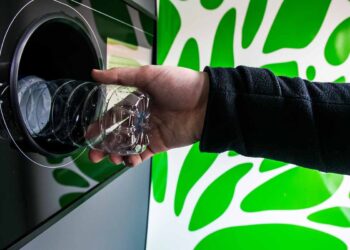
Another pair of cross-filed bills concern a deposit return system for beverage containers. SB 5502 and HB 1607 are both in their respective chamber of origin Rules Committees as of March 7 and March 9, respectively. They would set the deposit at 10 cents for containers that may include glass,plastic, or metal cans or bottles with capacities ranging from 40 milliliters to one gallon. The PRO would submit a proposed list of covered beverage containers. 

The bills would direct a PRO to set up a plan, with oversight of a 15-person advisory board. 

By the end of the second year of the program, the redemption rate must be greater than 65% aggregated for all covered beverage containers, the bills note, and by the end of year five that rises to 80%. Reuse rates should increase each year, but not by a set amount. 

MRFs would also be able to report the volume of covered beverage containers they processed and to the PRO, which would then pay the MRFs of at least 50% of the refund value on a monthly basis, in order to offset the impact to MRFs. 

Under SB 5002 and HB 1607, any retail establishments larger than 20,000 square feet must also sell bags for the bag-drop program that will be offered as part of the system and can also choose to host an express redemption site 

“While retail establishments may choose to host a redemption site, nothing in this chapter shall be interpreted to create a legal obligation on the part of a retail establishment to either accept a returned covered beverage container or allow a redemption site to be sited at a retail establishment,” the bill notes. 

SB 5175 and its companion bill HB 1789 concern the already-passed photovoltaic module stewardship and takeback program, and would push the start date back to 2028. 

The house bill was introduced Feb. 3 and is still in the House Committee on Environment and Energy. The senate bill was voted out of its chamber of origin 49-0 on March 5 and is now scheduled for a public hearing in the House Committee on Environment and Energy on March 20.

HB 1420, EPR for textiles, was introduced on Jan. 20 and referred to the House Appropriations Committee. 

HB 1497, covering organics, passed out of the House on March 7 after a vote of 57-39, and now is in the Senate Committee on Environment, Energy and Technology.

Finally, HB 1901 would set up EPR for mattresses. It was introduced Feb. 7 and referred to the House Committee on Environment and Energy on the same day.  

Tags: Container DepositsEPRLegislation & Enforcement
TweetShare
Marissa Heffernan

Marissa Heffernan

Marissa Heffernan worked at Resource Recycling from January 2022 through June 2025, first as staff reporter and then as associate editor. Marissa Heffernan started working for Resource Recycling in January 2022 after spending several years as a reporter at a daily newspaper in Southwest Washington. After developing a special focus on recycling policy, they were also the editor of the monthly newsletter Policy Now.

Related Posts

Our top stories from June 2021

Colorado advances first-in-the-nation EV battery EPR law

byStefanie Valentic
June 3, 2026

Colorado, which passed its Battery Stewardship Act in 2025, is now looking to close the gap on large-format, EV batteries.

Packaging policy is not one-size-fits-all

Packaging policy is not one-size-fits-all

byDan Felton, president and CEO, Flexible Packaging Association
June 1, 2026

Flexible Packaging Association head Dan Felton makes the case for smart policy to suit the large, diverse sector.

PureCycle maintains price expectations for its R-PP resin

EPR clarity is driving brand demand, says PureCycle CEO

byStefanie Valentic
June 1, 2026

With SB 54 registered and lawsuits already filed, PureCycle CEO Dustin Olsen says the fight over what counts as recycling...

Q1 containerboard exports drop by 19%

What SB 54 looks like from the packaging floor

byStefanie Valentic
June 1, 2026

With compliance deadlines coming on quickly, smaller companies are struggling to absorb changes and stay on the right side of...

New York bill would strengthen device repair rules

New York packaging EPR bill faces June 10 deadline

byStefanie Valentic
May 26, 2026

With the legislature set to adjourn June 10, supporters of New York's packaging EPR bill are making a final push.

WM, Circular Materials announce new Canadian facility

byStefanie Valentic
May 21, 2026

Hauler WM will open a new preconditioning recycling facility (PCF) in Edmonton in early 2027, bringing advanced optical sorting to...

Load More
Next Post

Maryland completes EPR needs assessment

More Posts

Machinex

Longview mill tragedy raises broader questions for fiber, recycling sectors

May 29, 2026
Recycling industry addresses Beyond Plastics report

Recycling industry addresses Beyond Plastics report

May 26, 2026
What a report on Starbucks cups reveals about recycling

What a report on Starbucks cups reveals about recycling

May 26, 2026
EU recyclers make case for solvent-based methods

The electronics recycling industry has a plastics problem

May 26, 2026
Illinois expands battery recycling as lithium-ion fire concerns mount

Illinois expands battery recycling as lithium-ion fire concerns mount

May 27, 2026
California extends compostable labeling law

California bills crack down on false recycling, compostable claims

May 29, 2026
Q1 containerboard exports drop by 19%

What SB 54 looks like from the packaging floor

June 1, 2026
Bottle bill backers see opportunity for action

PET collapse exposes gaps in US recycling infrastructure

May 15, 2026
New York bill would strengthen device repair rules

New York packaging EPR bill faces June 10 deadline

May 26, 2026
Emerging technology holds the key to rare earth recovery

Emerging technology holds the key to rare earth recovery

June 1, 2026
Load More

About & Publications

About Us

Staff

Archive

Magazine

Work With Us

Advertise
Jobs
Contact
Terms and Privacy

Newsletter

Get the latest recycling news and analysis delivered to your inbox every week. Stay ahead on industry trends, policy updates, and insights from programs, processors, and innovators.

Subscribe

Welcome Back!

Login to your account below

Forgotten Password?

Retrieve your password

Please enter your username or email address to reset your password.

Log In

Add New Playlist

No Result
View All Result
  • The Latest
  • Analysis
  • Recycling
  • E-Scrap
  • Plastics
  • Policy Now
  • Conferences
    • E-Scrap Conference
    • Plastics Recycling Conference
    • Resource Recycling Conference
    • Textiles Recovery Summit
  • Magazine
  • About Us
  • Advertise
  • Archive
  • Jobs
  • Staff
Subscribe
This website uses cookies. By continuing to use this website you are giving consent to cookies being used. Visit our Privacy and Cookie Policy.