





Resource Recycling
  • The Latest
  • Analysis
    • All
    • Certification Scorecard
    • Industry Announcements
    • Opinion

    Certification scorecard for the week of Feb. 9, 2026

    Meta-Corning deal signals IT hardware retirement wave

    Meta-Corning deal signals IT hardware retirement wave

    Malaysia clamps down on illegal e-waste imports amid probes

    Malaysia clamps down on illegal e-waste imports amid probes

    URT builds alliance to remake electronics plastics at scale

    ICYMI: Top 5 e-scrap stories from January 2026

    Server resale values surge in AI-driven markets

    Certification scorecard for the week of Feb. 2, 2026

    Auditors warn EU may fall short on critical metals

    Auditors warn EU may fall short on critical metals

    Industry announcements for January 2026

    Industry announcements for February 2026

    ICYMI: Top 5 recycling stories from January 2026

    Certification scorecard for week of Jan. 26, 2026

  • Conferences
  • Publications

    Other Topics

    Textiles
    Organics
    Packaging
    Glass
    Brand Owners

    Metals
    Technology
    Research
    Markets
    Grant Watch

    All Topics

Subscribe
No Result
View All Result
Resource Recycling
  • The Latest
  • Analysis
    • All
    • Certification Scorecard
    • Industry Announcements
    • Opinion

    Certification scorecard for the week of Feb. 9, 2026

    Meta-Corning deal signals IT hardware retirement wave

    Meta-Corning deal signals IT hardware retirement wave

    Malaysia clamps down on illegal e-waste imports amid probes

    Malaysia clamps down on illegal e-waste imports amid probes

    URT builds alliance to remake electronics plastics at scale

    ICYMI: Top 5 e-scrap stories from January 2026

    Server resale values surge in AI-driven markets

    Certification scorecard for the week of Feb. 2, 2026

    Auditors warn EU may fall short on critical metals

    Auditors warn EU may fall short on critical metals

    Industry announcements for January 2026

    Industry announcements for February 2026

    ICYMI: Top 5 recycling stories from January 2026

    Certification scorecard for week of Jan. 26, 2026

  • Conferences
  • Publications

    Other Topics

    Textiles
    Organics
    Packaging
    Glass
    Brand Owners

    Metals
    Technology
    Research
    Markets
    Grant Watch

    All Topics

Subscribe
No Result
View All Result
Resource Recycling
No Result
View All Result
Home Recycling

Fitting e-commerce into packaging EPR

Marissa HeffernanbyMarissa Heffernan
October 4, 2024
in Recycling
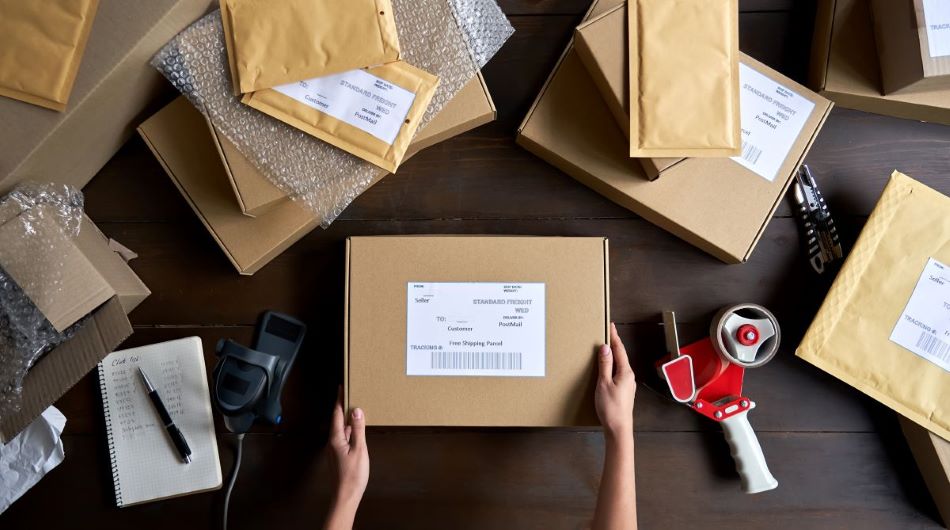
Many states have explicitly included e-commerce and remote distribution in extended producer responsibility laws, seeking to capture a significant portion of packaging material that moves in and out of states. | GroundPhoto/Shutterstock

As states work through rulemaking for packaging extended producer responsibility laws, they’re dealing with a very modern twist: how to handle e-commerce. 

California, Colorado, Minnesota and Oregon all mention how to handle online and remote distributors directly in statute, typically including that information under producer definition. Maine does not directly mention remote distribution or e-commerce in its law text.

Splitting the responsibility

Colorado, Minnesota and Oregon have similar systems to handle e-commerce, assigning responsibility for the outer shipping packaging and the inner producer packaging to different producers – unless the same company, such as Amazon, is both manufacturing the product and distributing it from a fulfillment center. 

Nicole Portley, the EPR program plan lead at Oregon’s Department of Environmental Quality, told Resource Recycling that “we have two different producer definitions in our statute, one for the inner packaging that protects and contains the product directly, and then one for the outer packaging that is used to ship the item to the consumer.” 

During a recent Product Stewardship Institute webinar, Portley gave the example of a grocery delivery platform where the customer orders groceries online from Company A. That company goes to Company B and buys all the individual products, then packages and ships them. The individual producers of the grocery items and Company B are responsible for the packaging of those individual grocery items, but Company A is responsible for the outer packaging that the groceries were shipped in.

If there are intermediaries and companies cannot track which packaging is going specifically into Oregon, Portley said they will have to estimate and prorate those fees based on national sales data. 

Wolf Kray, materials management unit leader at the Colorado Department of Public Health and Environment, said in an interview that his state takes a similar approach, and when it comes to remote distribution, the law “was very nice and clear for us.” 

“This is the one situation where there are specifically two producers,” he said, adding it’s also the “one time where both parties are subject to paying dues.” 

In California, a Department of Resources Recycling and Recovery (CalRecycle) spokesperson said via email that “e-commerce companies, considered producers by the law, must ensure all packaging on products shipped into the state comply with the new requirements under California’s plastic pollution reduction law.”

The CalRecycle spokesperson noted that “as a major part of the economy, e-commerce has a key role in reducing single-use plastics in California.” 

Small business exemptions and free rider fears

While regulating how to enforce EPR across all of the possible internet vendors seems like a daunting task, all the states have exemptions for small businesses that would come into play. 

The Oregon law exempts companies with less than $5 million in gross annual revenue or selling less than one metric ton of covered products into the state. That would more than likely exempt the majority of small online artists, such as those selling on popular e-commerce site Etsy, from being obligated producers, Portley said. 

It’s a similar situation in the other states: Colorado has the same thresholds as Oregon, while California has a threshold of $1 million, Maine has thresholds of $2 million or $5 million depending on certain factors, and Minnesota has a threshold of $2 million or one metric ton of covered products. 

The idea of e-commerce also stokes worries about free riders on the system, Portley said, along with out-of-country producers, but “that is a known area of compliance challenge.” Free riders are those who should be paying into the program, as their materials go through the recycling system, but do not, leaving the other registered producers to pick up their costs. 

“Folks should be buoyed by the fact that Amazon is one of the founding members of CAA,” she said. “They’re on board.”

In addition, many retailers who have large e-commerce sides of their business also have physical retail sales, so they will already be part of the EPR system and “I can’t imagine that they’re going to free ride for their remote distribution,” she added.  

“No EPR program has 100% compliance right off the bat,” Portley said. “I think you want the majority of your volume in the program at the start date, so something like 80% plus of the volume represented in those registered producers, and then you have to take steps to go find that 20%. When you pull them in, you’re able to charge them for the fees that they didn’t pay. There’s nothing in our statute that prohibits historic fees from being assessed by the PRO.” 

Oregon and CAA also take their respective enforcement and compliance roles seriously, Portley said. 

Colorado takes a similar approach, Kray said, noting that his agency is authorized to oversee and enforce compliance. 

“We want to take the approach that we’re working with everybody up front first, trying to get all the producers registered with CAA so they can figure out how many folks are in the system to pay into the dues,” he said. “But if we run into somebody that is a producer and that’s not registered with Circular Action Alliance or paying dues in the program, we do have the authority to pursue that enforcement action and that can include penalties if necessary.” 

The five U.S. states with packaging EPR are not operating in a silo. A variety of EPR programs have been operating in Canada – and particularly in British Columbia – for decades, as well as elsewhere around the world. Portley said when working on Oregon’s law, the Canadian system was helpful for building out the definitions of “producer” and “covered product,” “since that’s the system that our obligated producer community is familiar with.” 

“We have some elements that are more waste prevention and life cycle impact focused, and for those pieces we looked beyond North America,” she said. Portley’s team studied Austria and France for developing a waste prevention and reuse fee, Belgium for verified and responsible end markets, and the European Union for standards and methods for life cycle assessments. 

Tags: EPRLegislationPolicy Now
TweetShare
Marissa Heffernan

Marissa Heffernan

Marissa Heffernan worked at Resource Recycling from January 2022 through June 2025, first as staff reporter and then as associate editor. Marissa Heffernan started working for Resource Recycling in January 2022 after spending several years as a reporter at a daily newspaper in Southwest Washington. After developing a special focus on recycling policy, they were also the editor of the monthly newsletter Policy Now.

Related Posts

Oregon’s Recycling Modernization Act faces injunction

Court partially blocks Oregon EPR law, dismisses bulk of lawsuit

byStefanie Valentic
February 10, 2026

An Oregon federal court issued a limited injunction halting the state's EPR law for members of NAW, but rejected the...

Member states select new chair for global plastics treaty

Member states select new chair for global plastics treaty

byAntoinette Smith
February 10, 2026

During a short session, the Intergovernmental Negotiating Committee elected Chilean diplomat Julio Cordano to continue efforts toward an internationally binding...

Dual WM MRF launch strengthens Ontario recycling infrastructure

Dual WM MRF launch strengthens Ontario recycling infrastructure

byStefanie Valentic
February 9, 2026

WM has opened two new facilities in Ontario capable of processing 30% of the province's total volumes under new EPR...

REUSE Act heads to US House for consideration

byAntoinette Smith
February 9, 2026

The bill would require the US EPA to collect data on reuse and refill systems across industries including consumer packaging,...

German researchers say plastics treaty still within reach

byAntoinette Smith
February 4, 2026

In a new white paper, the group proposes three key changes to revive the treaty talks after a new chair...

States push recycling reform forward in new year

byStefanie Valentic
February 2, 2026

New Jersey just passed a bill restricting single-use plastic items, California has opened another round of public comment on SB...

Load More
Next Post

Reporting deadline for de facto EPS ban in CA nears

More Posts

Oregon’s Recycling Modernization Act faces injunction

Court partially blocks Oregon EPR law, dismisses bulk of lawsuit

February 10, 2026

Greenchip launches fund for community impact and trust

February 5, 2026
Chinese processing group details goals for US visit

AMP lays out vision of next-generation, AI-driven MRFs

July 24, 2024

REUSE Act heads to US House for consideration

February 9, 2026

Allied Industrial portfolio companies complete two early-year deals

February 5, 2026
Packaging Corp. to buy Greif containerboard segment

Export trends offset containerboard production decline

February 6, 2026

Amcor expects flat sales volumes to continue 

February 6, 2026
Agilyx leaves US chem recycling, Houston sorting center

Agilyx leaves US chem recycling, Houston sorting center

February 4, 2026
Third ExxonMobil recycling plant operational

Third ExxonMobil recycling plant operational

February 4, 2026

ecoATM recycled 7.5M phones in 2025 as payouts hit $1.5B

February 10, 2026
Load More

About & Publications

About Us

Staff

Archive

Magazine

Work With Us

Advertise
Jobs
Contact
Terms and Privacy

Newsletter

Get the latest recycling news and analysis delivered to your inbox every week. Stay ahead on industry trends, policy updates, and insights from programs, processors, and innovators.

Subscribe

Welcome Back!

Login to your account below

Forgotten Password?

Retrieve your password

Please enter your username or email address to reset your password.

Log In

Add New Playlist

No Result
View All Result
  • The Latest
  • Analysis
  • Recycling
  • E-Scrap
  • Plastics
  • Policy Now
  • Conferences
    • E-Scrap Conference
    • Plastics Recycling Conference
    • Resource Recycling Conference
    • Textiles Recovery Summit
  • Magazine
  • About Us
  • Advertise
  • Archive
  • Jobs
  • Staff
Subscribe
This website uses cookies. By continuing to use this website you are giving consent to cookies being used. Visit our Privacy and Cookie Policy.