






The number of states with e-scrap recycling programs has not changed much in the past decade, but there have been some notable updates and overhauls in recent years. Industry experts dissected those changes in a recent workshop.
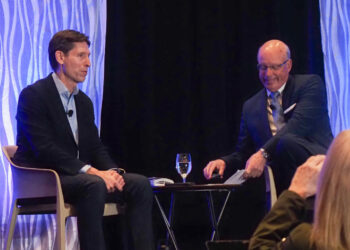
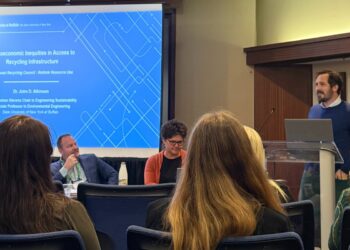
The workshop, “Key Challenges Under State Electronics Recycling Laws,” was presented by the National Center for Electronics Recycling (NCER) at the 2023 E-Scrap Conference and E-Reuse Conference, held in New Orleans Sept. 18-20.
Currently, 25 states and the District of Columbia have e-scrap laws on their books. That number has been relatively consistent since about 2014, but there have been updates and changes made in recent years.
South Carolina, Hawaii and Oregon have all made major changes to their programs, said workshop moderator Jason Linnell, who is executive director of NCER. Meanwhile, Wisconsin, Washington, D.C., and New York all made administrative and regulatory changes of late.
South Carolina switched to a clearinghouse model, also called a convenience model, which removes collection targets and instead focuses on consumer access to recycling opportunities.
A clearinghouse is “just an entity that allows the manufacturers to sort of divide up the responsibility of covering all the collection locations in the state and do that in a fair way so that everyone is paying their fair share,” Linnell explained.
Hawaii modified collection targets to be based on sales weights and also expanded the scope of covered products with targets. Oregon also expanded the scope of covered devices, ended the state contractor program in favor of a default producer responsibility organization and made changes to the convenience requirements.
In New York, recent regulations expanded outreach requirements and required recyclers to have closure plans in place. Wisconsin changed its deadlines, made more devices eligible to meet manufacturer targets and added collection, collector and recycler permitting requirements.
Finally, Washington, D.C., altered its registration deadline, required more education and outreach, and allowed both R2- and e-Stewards-certified recyclers to service the programs for manufacturers, instead of just e-Stewards.
“We’re all trying to deal with the changing mix of devices that are coming back into our programs and what is the right balance between what the manufacturers have to do, how they comply and making sure that collectors and consumers have options,” Linnell said.
Panelist Walter Alcorn, vice president of environmental affairs and industry sustainability with the Consumer Technology Association (CTA), said his organization has been very active in those state laws over the past decade.
“We’re all trying to deal with the changing mix of devices that are coming back into our programs.”
–Jason Linnel, executive director of NCER
He said linking targets recycled to the pounds of electronics sold each year is a challenge for manufacturers as the two don’t truly correlate. Three states so far have moved away from those pounds-sold targets – Minnesota, Illinois and South Carolina.
“I think what we’re seeing is that realization, and it is being incorporated into changes to these recycling laws as they come around or as various folks in the different states push changes to the laws,” he said. “That’s something that we at CTA support. We actually like targets that are rational and predictable.”
Alcorn said CTA is looking at reforms that would remove requirements that are either impossible to reach or that are so high they alter the market and drive prices.
“We do see some value in moving away from these sales-based targets and the devil is always in the details,” he said. “And that’s something that we look forward to continuing the discussions with the state stakeholders and states that still have these types of laws.”
Steve Noble, an environmental quality specialist with the Michigan Department of Environment, Great Lakes and Energy, said that targets are needed, because they create pressure for collection.
“If you go to the convenience model and there’s no targets, it’s an issue,” he said. “In Michigan, if there’s no goals, how do you get everybody to step up and do the right thing and especially service rural areas of the state?”
“We do see some value in moving away from these sales-based targets and the devil is always in the details.”
–Walter Alcorn, vice president of environmental affairs and industry sustainability with the Consumer Technology Association (CTA)
While convenience models do have requirements, Noble said he’s also seeing a lot of convenience model states allow counties to opt in or opt out.
Melanie Weitzel, senior business development and account manager for returns provider and compliance manager Reverse Logistics Group, cautioned that the South Carolina and Illinois clearing house model is still relatively new.
“I think time will tell,” she said. “We’re seeing with convenience, the amount of pounds collected drops. But you’re also seeing that there’s more availability for consumers to return and usually there’s less charging and things like that involved because it’s more fair, but I think we’re going to see how that shakes out in the next few years and how that compares to those collection targets.”
Alcorn said another challenge with many current laws is that it’s difficult for small collectors to become part of the larger programs.
“If there’s no goals, how do you get everybody to step up and do the right thing and especially service rural areas of the state?”
–Steve Noble, environmental quality specialist with the Michigan Department of Environment, Great Lakes and Energy
“There are a handful of recycling firms that can do this nationally, and they get most of the work,” he said. “It’s not a conspiracy. Every manufacturer makes their own decision who they work with. It’s just sort of the nature of the beast and it does sometimes create challenges for collectors.”
Most states do have some kind of required education and outreach as part of the program, but panelists agreed that there is room for improvement. Dave Hirschler, senior director of sustainability and legislative compliance for e-scrap recycling company ERI, said “everybody wants more education and more advertising, and it’s just a matter of deciding whether or not that should be a regulatory thing.”
Another challenge is to provide recycling opportunities to underserved communities. Hirschler noted that such service is typically more expensive, as those areas tend to be rural and transportation costs are higher.
“On our end, it’s a challenge because we want to be able to collect the most volume in the most efficient way,” he said. “And so when your target is recycling as much as possible, sometimes those areas do lose focus.”
Legislation can help correct that problem by providing incentives for certain parts of the state, which is what Minnesota, Wisconsin and Indiana do, Hirschler said. In New Jersey, the regulation requires service to a certain amount of underserved areas.
“There is a place for regulation to help make it easier for us to make that investment,” he added.
A version of this story appeared in E-Scrap News on Oct. 4.