






Resource Recycling
  • The Latest
  • Analysis
    • All
    • Certification Scorecard
    • Industry Announcements
    • Opinion
    The electronics recycling industry is undergoing a transformation from labor-intensive manual operations to highly automated, AI-driven facilities that use advanced robotics, cleaner chemistry and digital tracking systems to extract critical materials.

    The cyber-physical MRF: AI and robotics reshape e-waste recovery

    Certification scorecard for the week of Feb. 9, 2026

    Meta-Corning deal signals IT hardware retirement wave

    Meta-Corning deal signals IT hardware retirement wave

    Malaysia clamps down on illegal e-waste imports amid probes

    Malaysia clamps down on illegal e-waste imports amid probes

    URT builds alliance to remake electronics plastics at scale

    ICYMI: Top 5 e-scrap stories from January 2026

    The electronics recycling industry is undergoing a transformation from labor-intensive manual operations to highly automated, AI-driven facilities that use advanced robotics, cleaner chemistry and digital tracking systems to extract critical materials.

    Certification scorecard for the week of Feb. 2, 2026

    Auditors warn EU may fall short on critical metals

    Auditors warn EU may fall short on critical metals

    Industry announcements for January 2026

    Industry announcements for February 2026

    ICYMI: Top 5 recycling stories from January 2026

  • Conferences
  • Publications

    Other Topics

    Textiles
    Organics
    Packaging
    Glass
    Brand Owners

    Metals
    Technology
    Research
    Markets
    Grant Watch

    All Topics

Subscribe
No Result
View All Result
Resource Recycling
  • The Latest
  • Analysis
    • All
    • Certification Scorecard
    • Industry Announcements
    • Opinion
    The electronics recycling industry is undergoing a transformation from labor-intensive manual operations to highly automated, AI-driven facilities that use advanced robotics, cleaner chemistry and digital tracking systems to extract critical materials.

    The cyber-physical MRF: AI and robotics reshape e-waste recovery

    Certification scorecard for the week of Feb. 9, 2026

    Meta-Corning deal signals IT hardware retirement wave

    Meta-Corning deal signals IT hardware retirement wave

    Malaysia clamps down on illegal e-waste imports amid probes

    Malaysia clamps down on illegal e-waste imports amid probes

    URT builds alliance to remake electronics plastics at scale

    ICYMI: Top 5 e-scrap stories from January 2026

    The electronics recycling industry is undergoing a transformation from labor-intensive manual operations to highly automated, AI-driven facilities that use advanced robotics, cleaner chemistry and digital tracking systems to extract critical materials.

    Certification scorecard for the week of Feb. 2, 2026

    Auditors warn EU may fall short on critical metals

    Auditors warn EU may fall short on critical metals

    Industry announcements for January 2026

    Industry announcements for February 2026

    ICYMI: Top 5 recycling stories from January 2026

  • Conferences
  • Publications

    Other Topics

    Textiles
    Organics
    Packaging
    Glass
    Brand Owners

    Metals
    Technology
    Research
    Markets
    Grant Watch

    All Topics

Subscribe
No Result
View All Result
Resource Recycling
No Result
View All Result
Home Recycling

Paper exports stable but plastics drop dramatically

Colin StaubbyColin Staub
May 21, 2019
in Recycling

U.S. recovered plastic exports during the first quarter were down by nearly half from a year ago. Paper shipments remained stronger due to ongoing Chinese demand and growing alternative markets.

The latest trade figures, published this month by the U.S. Department of Commerce, detail where recovered paper and plastic went in March, providing a snapshot of first-quarter shipments.

Plastic exports decline

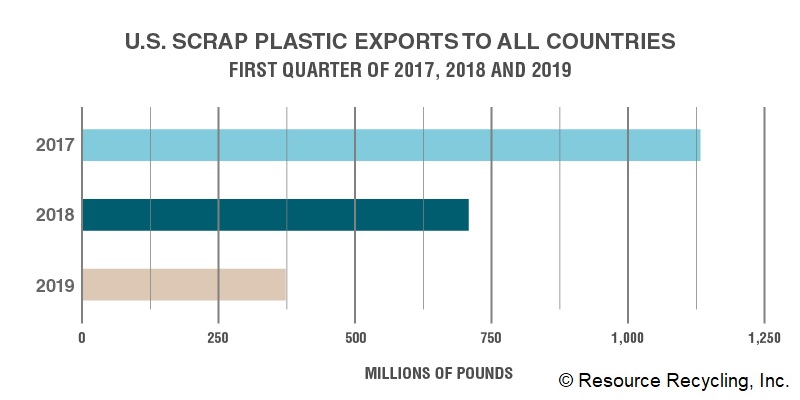
U.S. exporters shipped 374 million pounds of scrap plastic from January through March. That’s almost half the amount exported during the same period in 2018, and it’s 67% less than the first quarter of 2017.

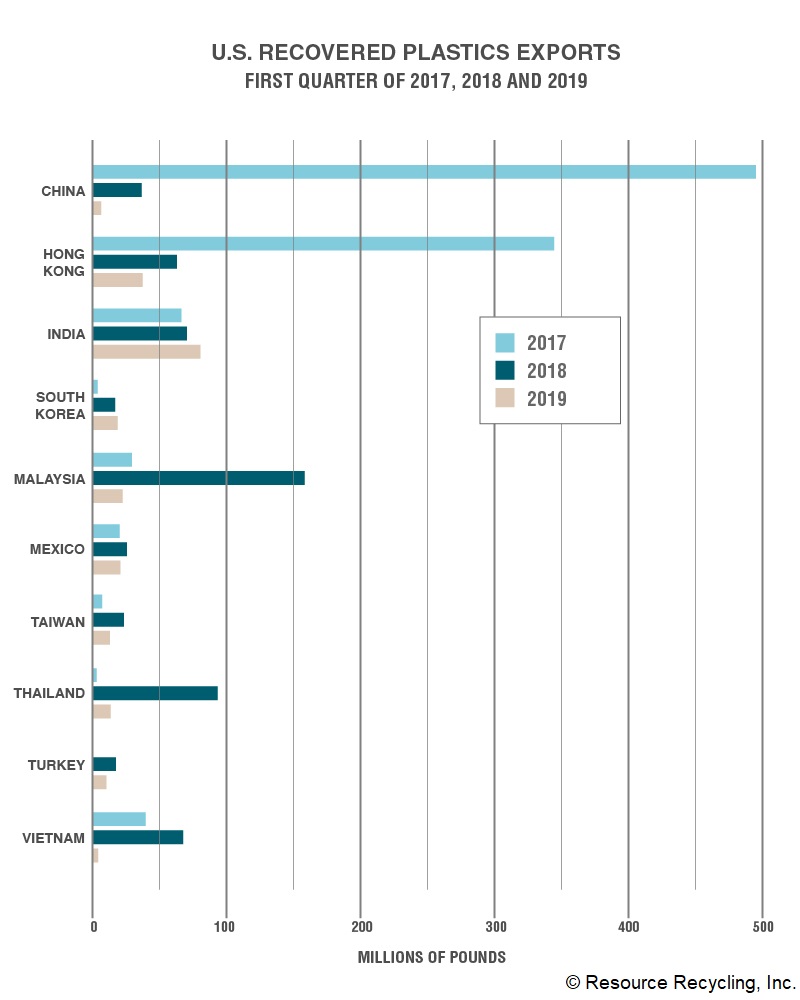
The decline was influenced largely by China, which no longer appears in the top 10 destinations of U.S. scrap plastics. Even though the country effectively banned scrap plastic from import in 2018, the small volume that entered the country still made it one of the largest importers of U.S. scrap plastic that year. But the weight has continued to drop off into 2019, and Chinese imports during the first quarter were down 98.6% from two years ago.

But the plastics decline was also driven by shifting markets beyond China. Although countries that recently increased their recovered fiber shipments have maintained those higher import volumes, many that brought in more plastic in 2018 have since enacted stringent policies reducing the imports.

After importing 30 million pounds of U.S. plastic in the first quarter of 2017, Malaysia increased its import volume to 159 million pounds during the same period in 2018. But the country’s first quarter 2019 imports are down to 23 million. That decrease corresponds with recent Malaysian government policies to restrict the trade after growing environmental concerns last year.

It was a similar story in Thailand, which went from 4 million pounds to 94 million pounds to 14 million pounds in the first quarters of 2017, 2018 and 2019, respectively. And Vietnamese imports grew from 40 million pounds in the first quarter of 2017 to 69 million pounds during that period in 2018, before plummeting to 5 million pounds this year.

(Story continues below charts.)
Alternative paper buyers partially offset China impact

Recovered fiber exports totaled 4.7 million short tons from January through March this year. That’s down from 4.9 million in the first quarter of 2018 and 5.2 million in 2017. Although it’s a decrease, recovered fiber has not faced the same drastic export drops as plastic for a few key reasons, illustrated by the trade data.

For one, China continues to bring in substantial amounts of U.S. fiber. It was, by far, the largest buyer in the first quarter, bringing in nearly 1.5 million short tons, or about 31% of all the scrap paper leaving the U.S. Still, that’s significantly down from the past couple years – the 2019 figure is down more than 2 million tons from China’s first-quarter 2017 number.

Meanwhile, countries that have ramped up U.S. fiber purchases in the wake of the Chinese import restrictions mostly maintained or grew their import volumes at the start of 2019. In the first quarter, Indonesia nearly doubled its U.S. recovered fiber imports compared with that period last year (which itself saw triple the volume Indonesia brought in during the first quarter of 2017).

Additionally, Taiwan’s first quarter U.S. paper import volume is more than triple the 2018 figure; Thailand nearly doubled its U.S. fiber imports the first quarter of this year, compared with a year earlier; and South Korea, Mexico and Vietnam also saw modest increases.

Shipments to India, however, fell by 231,000 tons in the first quarter, compared with 2018.

March export specifics

U.S. companies exported 131.9 million pounds of scrap plastic in March. The top 10 importing countries were India (28.7 million pounds), Canada (28.3 million), Hong Kong (12.7 million), Mexico (7.7 million), South Korea (7.5 million), Malaysia (7.3 million), Indonesia (6 million), Taiwan (5.3 million), Turkey (4.9 million) and Thailand (3.6 million).

On the paper side, the U.S. exported 1.62 million short tons of recovered fiber in March. The largest importing countries during the month were China (502,000 short tons), India (319,000), Mexico (144,000), Indonesia (143,000), Canada (95,000), Taiwan (90,000), South Korea (85,000), Vietnam (60,000), Thailand (47,000) and Italy (22,000).
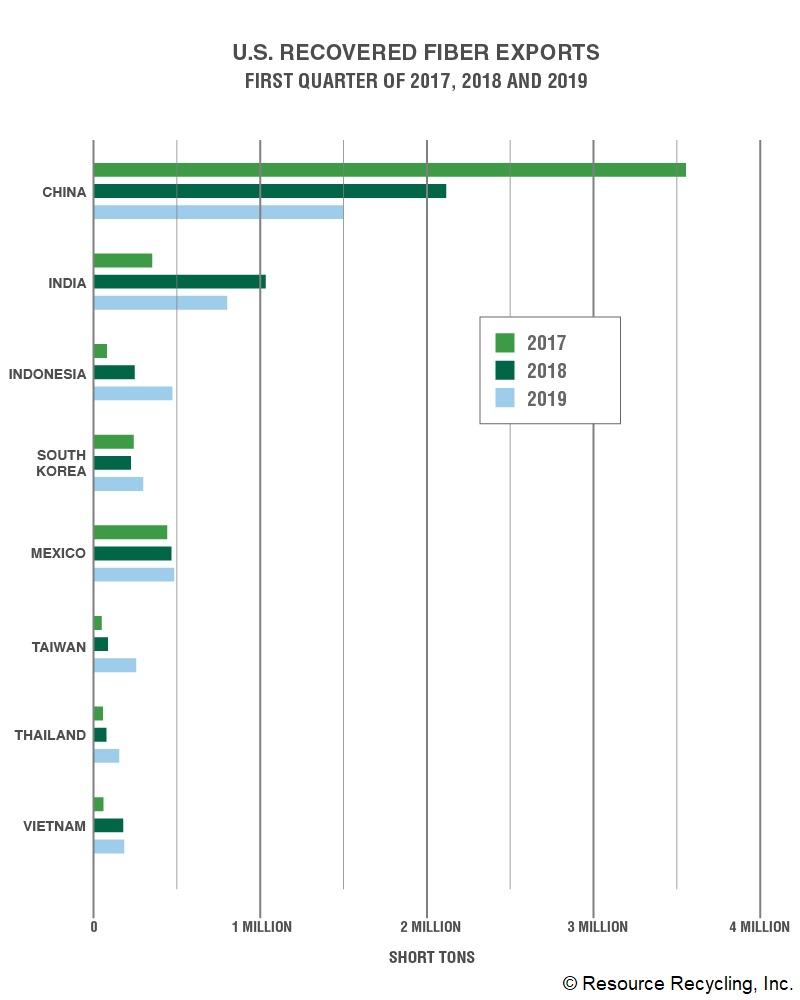
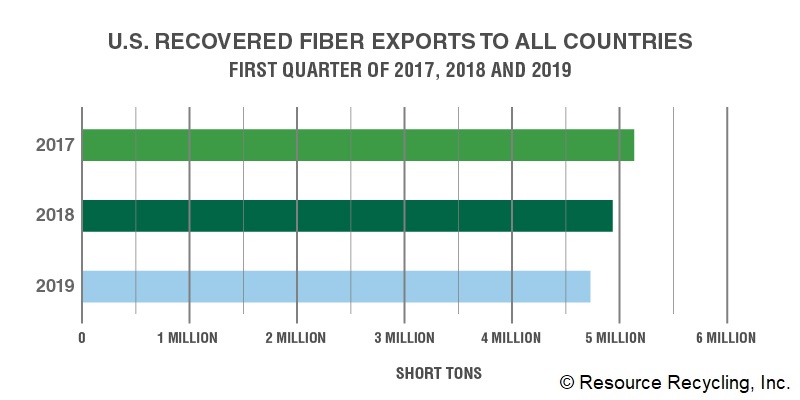
Photo credit: chenxueting/Shutterstock
 

Tags: Paper FiberPlasticsTrade & Tariffs
TweetShare
Colin Staub

Colin Staub

Colin Staub was a reporter and associate editor at Resource Recycling until August 2025.

Related Posts

NERC: Blended average prices fell 40% in third quarter

HDPE, PP bales rise as paper fiber and cans stabilize

byRecyclingMarkets.net Staff
February 12, 2026

National average prices of post-consumer material bales were flat to higher on the month.

Alpek talks PET overcapacity, soft demand

byAntoinette Smith
February 11, 2026

Executives from the Mexico-headquartered polyester giant said the Chinese government has acknowledged issues and convened PET producers, but Alpek is...

Packaging Corp. to buy Greif containerboard segment

Export trends offset containerboard production decline

byStefanie Valentic
February 6, 2026

AF&PA reported a 4% decline in containerboard production for 2025, while packaging paper shipments rose 2% in December and boxboard...

Malaysia clamps down on illegal e-waste imports amid probes

Malaysia clamps down on illegal e-waste imports amid probes

byDavid Daoud
February 6, 2026

Malaysia’s growing role as a hub for global e‑scrap is colliding with corruption probes, large container seizures and regional backlash. ...

Ace Metal and Metro Metals take the most weight in Washington

US-EU trade rift adds risk now for ITAD and e-scrap trade

byDavid Daoud
February 2, 2026

Trade tensions between the US and EU are reshaping ITAD and e-scrap markets, lifting demand for refurbished hardware while increasing...

International Paper creates two new, separate entities

byStefanie Valentic
January 29, 2026

International Paper is splitting its DS Smith and EMEA portfolio between two separate entities following multiple mill closures and strategic...

Load More
Next Post

Local leaders respond to market challenges

More Posts

Oregon’s Recycling Modernization Act faces injunction

Court partially blocks Oregon EPR law, dismisses bulk of lawsuit

February 10, 2026
Chinese processing group details goals for US visit

AMP lays out vision of next-generation, AI-driven MRFs

July 24, 2024
Malaysia clamps down on illegal e-waste imports amid probes

Malaysia clamps down on illegal e-waste imports amid probes

February 6, 2026

REUSE Act heads to US House for consideration

February 9, 2026
Meta-Corning deal signals IT hardware retirement wave

Meta-Corning deal signals IT hardware retirement wave

February 9, 2026

ecoATM recycled 7.5M phones in 2025 as payouts hit $1.5B

February 10, 2026
Texas sues over dumped wind turbine blades

Texas sues over dumped wind turbine blades

February 10, 2026

Alpek talks PET overcapacity, soft demand

February 11, 2026

APR, industry create proactive guidance for PET caps

February 12, 2026
The electronics recycling industry is undergoing a transformation from labor-intensive manual operations to highly automated, AI-driven facilities that use advanced robotics, cleaner chemistry and digital tracking systems to extract critical materials.

The cyber-physical MRF: AI and robotics reshape e-waste recovery

February 12, 2026
Load More

About & Publications

About Us

Staff

Archive

Magazine

Work With Us

Advertise
Jobs
Contact
Terms and Privacy

Newsletter

Get the latest recycling news and analysis delivered to your inbox every week. Stay ahead on industry trends, policy updates, and insights from programs, processors, and innovators.

Subscribe

Welcome Back!

Login to your account below

Forgotten Password?

Retrieve your password

Please enter your username or email address to reset your password.

Log In

Add New Playlist

No Result
View All Result
  • The Latest
  • Analysis
  • Recycling
  • E-Scrap
  • Plastics
  • Policy Now
  • Conferences
    • E-Scrap Conference
    • Plastics Recycling Conference
    • Resource Recycling Conference
    • Textiles Recovery Summit
  • Magazine
  • About Us
  • Advertise
  • Archive
  • Jobs
  • Staff
Subscribe
This website uses cookies. By continuing to use this website you are giving consent to cookies being used. Visit our Privacy and Cookie Policy.