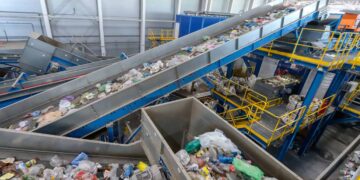







Cartons, corrugate, expanded polystyrene, film and pouches are among the materials and products California officials say could be subject to mandatory packaging management rules.
Under one system being studied by the California Department of Resources Recycling and Recovery (CalRecycle), those materials would be subject to extended producer responsibility (EPR), labeling requirements, sales bans and other policies. EPR policies require manufacturers to fund and manage the end-of-life collection and recycling of materials they produce.
The identification of priority materials, discussed during an Oct. 10 meeting, is the latest development in CalRecycle’s ongoing movement toward a mandatory system for packaging. The department views addressing packaging, which makes up a quarter of the waste stream, as a vital component of the state reaching its 75 percent diversion goal by 2020. That goal was laid out in state statute by Assembly Bill 341, passed in 2011.
California’s recycling rate has decreased markedly in the past three years and currently sits at roughly 44 percent, “which is the lowest recycling rate we’ve seen since the statute was passed,” said Karen Morrison, senior environmental scientist for CalRecycle. She added “this trend in increasing disposal is creating additional pressure and motivation” for CalRecycle to find new ways of driving up diversion.
There are other forces at work that could continue to decrease diversion, said Scott Smithline, CalRecycle’s director. That’s particularly true on the export front with China’s scrap import restrictions.
“Most of what’s collected in our recycle bins is exported … 62 percent of that goes to China,” Smithline said.
Material selection criteria
Thirteen policy tools came to the forefront at a packaging workshop in March, and since then, CalRecycle has evaluated them to determine how each would best lend itself to reducing packaging waste.
Stakeholders and the department have generally agreed a “one-size-fits-all” approach will not work for packaging due to the variety of materials covered under that umbrella. CalRecycle over the summer identified six “priority” packaging types that could be covered by the separate policies: uncoated corrugate, waxed cardboard, aseptic containers and cartons, film plastic, EPS and pouches. The list could expand in the future.
In identifying the six, CalRecycle relied on the following criteria: prevalence in the disposed waste stream, usage trends, current collection and processing infrastructure, greenhouse gas impacts of recycling and marine debris.
The proposed inclusion of marine debris contribution as a criteria drew sharp reaction from stakeholders over the summer. It was ultimately selected, Morrison said, for several reasons, including that decreasing marine debris is consistent with CalRecycle’s mission, it addresses cross-agency interests of reducing pollution, and that the material properties of marine debris relate to their long-term environmental impact.
“For those reasons, we decided to keep this criteria,” she explained.
Recyclability was notably missing from the criteria list, and Morrison explained that’s because it is difficult to measure.
Matching policies with packaging
CalRecycle developed a list of challenges associated with recycling each material. For example, film is often food-contaminated, hard to collect in curbside programs, comes in a variety of product types and can be difficult to transport economically.
To address those challenges, CalRecycle’s policy for film could include establishing stable funding sources, minimizing generation, ensuring clean streams and establishing consequences for lack of recyclability labeling.
Other specific material policy examples under consideration include:
- Aseptic containers and cartons: Deposit systems, labeling
- Expanded polystyrene: EPR, labeling, sales ban
- Pouches: Advanced recycling fees, minimum recycled content requirements, labeling requirements
- Uncoated corrugate: Source reduction, pay-as-you-throw fee and service structures, increased tipping fees, minimum content requirements
- Waxed cardboard: Mandating recyclable or compostable design, source reduction
Stakeholders respond
Representatives from manufacturers, recycling companies, industry associations, environmental advocacy groups and others spoke and submitted testimony on various aspects of the proposals.
A letter submitted on behalf of a host of manufacturers’ industry associations criticized the process and the draft criteria developed by CalRecycle, stating it would place “an undue focus on consumer products packaging, where a sustainable materials waste management strategy would be much more effective.”
The letter, signed by groups including the American Chemistry Council, American Institute for Packaging and the Environment, Foodservice Packaging Institute and Plastics Industry Association, said CalRecycle’s proposals “ignore strides in packaging technology, size and volume reduction, and distribution efficiencies, which are already contributing to a more efficient solid waste management process, as well as the state’s own data which highlights priority areas of opportunity to dramatically reduce waste to landfill, such as food waste.”
The manufacturer coalition also suggested the criteria for priority materials should consider the role packaging plays in product protection, as well as innovations in recovery technology, when determining which materials are prioritized.
Chuck White of Manatt, Phelps & Phillips, which represents a variety of players in the retail and consumer product industry, opined that CalRecycle should more clearly state the problem it is trying to solve. For example, a landfill fee on film plastics is not necessarily going to help the marine debris problem, he said, and a landfill ban could worsen it.
Howard Levenson, deputy director of CalRecycle, reiterated that CalRecycle is driven by legislation calling for the state to hit 75 percent diversion by 2020. He also responded to concerns that CalRecycle has not conducted a life-cycle analysis for all the materials it’s targeting.
“Life cycle is important, but I think that ultimately it’s paralysis if you think we’re going to have to wait for full life-cycle analyses before we can move forward on that,” he said.
Nick Lapis, director of advocacy for Californians Against Waste, said the department has a clear statutory authority to carry out the packaging work.
“As a sponsor of the bill, this is exactly the type of process we envisioned,” Lapis said. “We were hoping we’d see it earlier than 2017. The bill was passed in 2011. It’s a 2020 goal. We’re glad you’re finally getting to it.”
Several speakers pointed to packaging-handling strategies that could be added to CalRecycle’s list. Miriam Gordon from Upstream Policy brought up refillable beverage containers as a possibility for the packaging discussions, pointing to Oregon’s pilot beer refillables program.
Susan Collins, president of the Container Recycling institute, suggested CalRecycle meet some of its packaging goals by incorporating pouches and aseptic containers into the state’s existing container deposit program.
“Those items are covered in some other bottle bills in the world, the closest one being British Columbia,” Collins said.
CalRecycle is asking for further written comments by Oct. 31. Levenson said the department is also open to meeting with stakeholders individually. The department anticipates releasing its first set of draft recommendations for handling packaging early next year.