










In recent weeks, two U.S. recycling organizations have released policy positions on chemical recycling. But questions remain for the often controversial recycling methods included in the umbrella term of chemical recycling, also known as molecular or advanced recycling.
The Northeast Recycling Council, NERC, published its policy position on May 30, stating that mechanical recycling is the preferred method, “as it creates fewer environmental impacts than other currently available chemical recycling processes.” But the group said chemical recycling can be considered:
- For plastics that can’t be feasibly eliminated, replaced, redesigned or mechanically recycled.
- When there is an equal or net benefit to human health and the environment with chemical recycling compared to other waste management processes.
- If it is less environmentally harmful and less energy intensive than virgin production of plastics.
Earlier in May, the National Recycling Coalition, NRC, announced it had finalized its own policy on chemical recycling: “Thermal and chemical processes that convert plastics into petrochemical products that are fuels or used to make fuels, gases, oils, or waxes (plastics-to-oil) do not meet NRC’s definition of recycling.”
The group went on to say, “Instead, NRC supports a hierarchy of waste management preferences that prioritizes reducing the production and consumption of plastics.”
Last August, the nonprofit released a draft policy and solicited feedback from state recycling organizations and NRC members. The group’s “Definition of Recycling” policy also states that recycling is “a series of activities by which material that has reached the end of its current use is processed into material utilized in the production of new products.”
“NRC policy further excludes from its definition of recycling any materials that are reused as a fuel substitute and those used for energy production,” the group added.
In 2022, the Recycled Materials Association published its position statement for chemical recycling. The policy states that non-mechanical processes that convert end-of-life plastics into petrochemical products that are fuels or used to make fuels don’t meet ReMA’s definition of plastics recycling “and thus cannot be properly considered recycling.”
The Alberta hierarchy
The NRC approach is similar to that of the Recycling Council of Alberta in Canada, which recently reframed its R-Ladder hierarchy to reflect the nuances of its stance on waste-to-energy processes.
Although waste-to-energy consumes mixed solid waste rather than focusing on certain plastics, it can utilize similar processes as chemical recycling, including pyrolysis and gasification.
RCA’s position is that Alberta stakeholders should prioritize reduction and reuse when making policy and investment decisions.
“When all other material management strategies have been exhausted, there is a case for employing Recovery activities, including traditional waste-to-energy technologies, to complement a circular economy,” according to the policy.
“We really don’t promote recovery,” Executive Director Jennifer Koole told Plastics Recycling Update, referring to waste-to-energy processes. “It’s on our ladder, but it’s kind of at the bottom, where it’s bundled up with recycling, and it’s hard for a recycling organization to admit that recycling is not the be-all and end-all.”
Even so, RCA emphasizes that “recovery is at odds with all of the other refuse, rethink, redesign, refurbish, remanufacture, recycle” messages, Koole said. “It’s taking those materials out of a circularity stream. So it really is counterproductive to all the other activities that we want to promote and advocate for in the circular economy.”
She added, however, that waste-to-energy processes provide a way to make use of residuals when the only alternative is landfilling, and this goes toward Canada’s zero-waste goals.
“We as an organization have a luxury that we don’t have to manage the waste — we advocate and promote, and stand on our principles that waste should not exist. We need to do everything we can to move it up the R-Ladder,” Koole said.
In March, RCA launched its Explore Circularity Day, addressing the subject of whether waste-to-energy processes have a place in the circular economy. Afterward, attendees indicated that they wanted to continue the conversation.
Koole said while RCA does not want to be seen as either “promoting or not,” it does want to flag that “this is still a topic of interest to discuss.”
With RCA’s policy, “we don’t go down to the molecular level. We want the products and the materials kept in that loop as long as possible, if your principles align with those with us, then this is how we’re framing it.
In late 2024, Canada released its national standard for recycled plastics. The standards state that waste-to-energy processes are not considered to be recycling.
For plastic resin, however, the definition is more fluid, with “recycled content” referring to what is produced after the process used to prepare the feedstock for polymerization. So ethylene made from chemically recycled plastics, as well as its derivatives, would be considered to contain recycled content, but the pyrolysis oil fed into a steam cracker would not be “recycled content.”
Questions remain
Although it’s clear that some industry groups view converting scrap plastic into energy or fuel as not constituting “recycling,” that distinction can quickly become fuzzy.
In addition, such policies also often place all non-mechanical recycling methods under the umbrella of “chemical recycling” to include dissolution methods, such as that used by PureCycle, although it is not possible to use output from solvent-based methods to produce fuels.
Charles Kamenides, NRC executive director, said in an emailed statement that the organization’s new policy is meant to focus on the outcome of chemical recycling rather than the process itself.
One potential gray area is that the product from the most common chemical recycling method, pyrolysis, typically can be used both to make fuels and to make more plastics. But so far there is little clarity on how the resulting materials will be used.
In the virgin chemical industry, it is common for refiners and producers of intermediate chemicals to direct their products to applications that provide the best margins. For example, crude oil derivatives used in the extraction of paraxylene, the primary component of PET, also are used as octane boosters in gasoline. Demand for these materials rises in summer, when federal mandates require higher octane levels, and so the PET value chain must compete with high-margin gasoline production for limited amounts of the material.
Similarly, ethylene oxide, used to make another component of PET called monoethylene glycol or MEG, is also used to make surfactants for cleaning products and oilfield applications. In a quarterly investor call in October 2022, Dow CEO Jim Fitterling explicitly said the company was sending its EO toward more profitable sectors that had higher demand than for PET: “MEG is the weak spot in EO. If you look at our Industrial Solutions strategy, it is to keep investing in high-value EO applications.”
Last month Ohio-based Alterra announced that Australia’s Viva Energy had completed a trial of its pyrolysis oil at a Geelong refinery. “The trial demonstrated the technical compatibility of Alterra’s advanced recycled product with existing refining infrastructure, highlighting the transformative potential of Alterra’s technology in large-scale plastic recycling solutions across Australia,” according to a press release. Though it did not specify whether the chemically recycled material was used to make fuel or plastics, the press release said that in addition to the refinery in Victoria province, “Viva Energy operates bulk fuels, aviation, bitumen, marine, chemicals, polymers and lubricants businesses.”
Alterra did not respnd to a request for comment by press time.
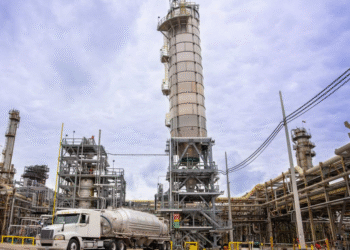
In April, Freepoint Eco-Systems announced it had delivered its first railcar of pyrolysis oil to Shell’s Norco site in Louisiana. The complex near New Orleans houses a crude oil refinery and olefins production including an ethane cracker for producing ethylene, but no polymers production. However, in May Shell announced it had signed an offtake agreement with Freepoint to supply its massive new PE facility in Monaco, Pennsylvania.
ExxonMobil, which is both a major refiner and a major polymer producer, is vague in how its own chemically recycled materials will be used. At the company’s Baytown facility in Texas, “we are already transforming millions of pounds of plastic waste into usable raw materials that can be attributed via mass balance to certified-circular plastics we sell” globally, the company told Plastics Recycling News in March.