





After months of collaboration and negotiation, stakeholders in Minnesota walked away with an extended producer responsibility bill for packaging that had elements both familiar and unique, and an overarching question: Is this the first state in a new wave of EPR or a continuation of early adopters?
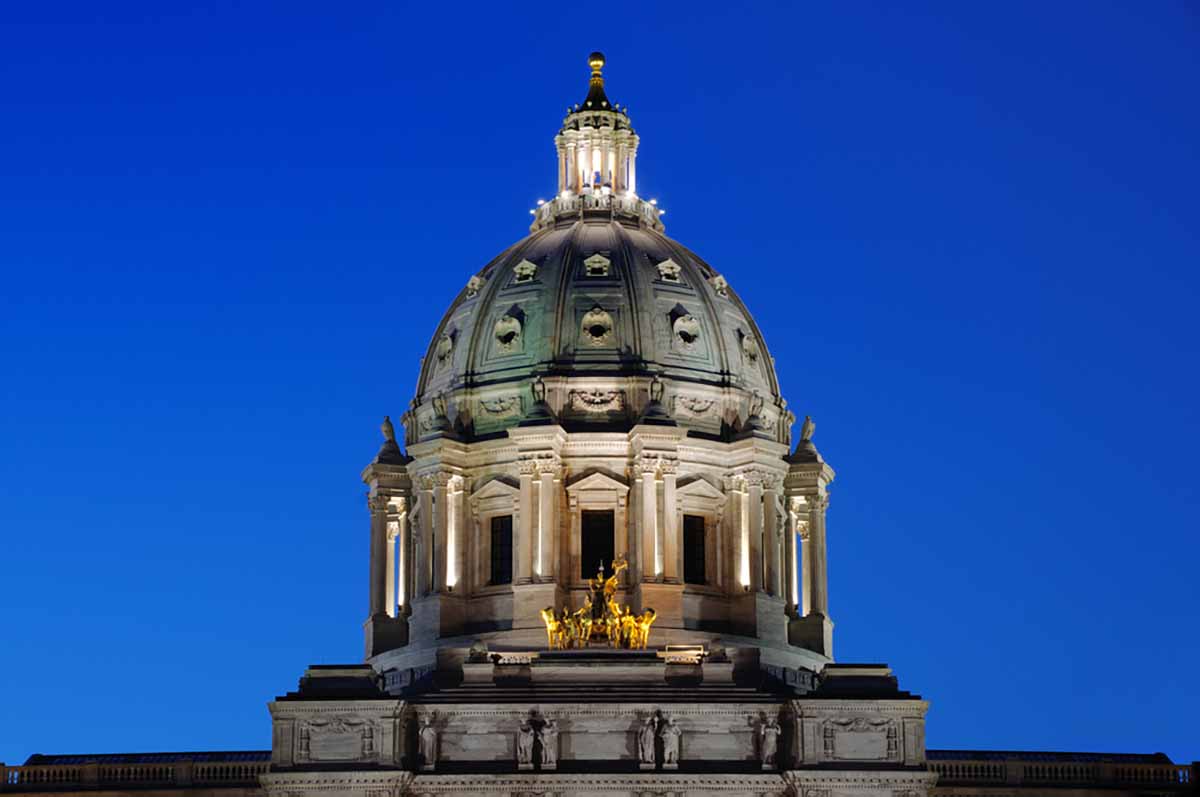
Minnesota became the fifth U.S. state to pass EPR for packaging after adding the program language into the 2024 Environment and Natural Resources Budget bill, which the governor signed on May 21. The omnibus bill also included the nation’s first EPR program for plastic boat wrap.
State Rep. Sydney Jordan, sponsor of the original Packaging Waste and Cost Reduction Act, said from the first moment she started working on an EPR bill after Maine passed its EPR law in 2021, the goal was for the bill to be “put together by Minnesotans.”
“It was important to me to make sure it was a Minnesota bill that worked for the existing government and infrastructure in Minnesota, but it is harmonized across other states and Canadian provinces,” Jordan told Resource Recycling. “We are a border state.”
Jordan, who is also vice chair of the Environment and Natural Resources Finance and Policy Committee, said it took several years of meetings and negotiations, but the end result is a bill that works for the state, which has a mature recycling system already in place and established end markets.
“Minnesota for many years was regarded by many as a state that was a leader in recycling, and I think we had really fallen,” she said. “That’s a problem for me. It’s a problem that we aren’t keeping up with effective policies, and I think passing my bill is a step forward in making us a leading state in recycling again.”
Jordan was motivated personally by the increasing amount of microplastics found in waterways and to help get a waste incinerator in her district shut down, to improve air quality and reduce the rate of asthma in the Minneapolis area, which is the highest rate in the state. Jordan has asthma herself, she said, and the county made clear that to get the incinerator shut down, “we have to have fewer things thrown out.”
As 40% of the state’s discarded materials are packaging, Jordan said EPR was a clear choice to address the issue and to gather support.
“You can’t call this ‘save the orcas’ or ‘save the sea turtles’ bill here, but that doesn’t mean that plastic isn’t a problem in Minnesota,” she said.
Industry reacts
The reception from the industry has been mixed, with some unexpected supporters.
Ameripen, an industry group representing packaging producers, announced that it supports the EPR language in the bill, the first time the organization has openly supported packaging EPR. It used to oppose the framework but in 2021 started to shift its stance.
Ameripen said Minnesota’s bill is “unprecedented in its unique framework that aligns with Minnesota’s national leadership on strong recycling and composting infrastructure.”
“Minnesota’s packaging producer responsibility legislation is a fair compromise that establishes a model of shared responsibility and is aligned with Ameripen’s key principles,” said Dan Felton, executive director. “This legislation supports a system that is reliable, efficient and effective.”
Minnesota-based nonprofit MRF operator Eureka Recycling supported the bill. Director of Policy Lucy Mullany worked closely with both state bill sponsors and the Partnership on Waste and Energy, a Minnesota joint powers authority. She said in an interview that the process had its ups and downs, but “overall, it’s a win for Minnesota.”
She lauded the inclusion of commercial packaging in the definition of packaging and of cost coverage for collection and processing of nonprofits, government entities and schools.
Mullany was also successful in getting clear criteria for potential alternative collection programs added into the bill, adding accessibility requirements and a reassessment every five years “so we can evaluate how well they’re doing.”
Finally, “Eureka really advocated for the way post-consumer recycled content is measured,” she said. “Language in there ensures that producers cannot count what they’re counting toward meeting goals in California toward reporting in Minnesota.”
“It has to be additive,” Mullany said, meaning more PCR will be used overall.
“Minnesota for many years was regarded by many as a state that was a leader in recycling, and I think we had really fallen. That’s a problem for me.” –State Rep. Sydney Jordan
The bill text notes that “producers must demonstrate that the post consumer recycled content reported to meet the performance targets is additional to amounts utilized to meet mandates in other states.”
Julie Ketchum, director of government affairs for WM and part of the local National Waste & Recycling Association chapter, said the industry did not see the draft bill language until two weeks before the session started. At that point, there were the necessary elements laid out – a PRO, an advisory group, state agency involvement, a needs assessment, a stewardship plan – but “we had to connect the dots,” she said.
“I saw it as an opportunity for us to build the EPR program” in a way that worked for haulers and the recycling industry, Ketchum said. WM is in the middle of retrofitting its Twin Cities MRF, so she was able to use that as a tangible example to explain the importance of getting a streamlined reimbursement system set up.
“That really resonated with people,” she said, adding that the final bill text calls for a collection and MRF service provider registration system that will allow them to send invoices to the PRO for reimbursement.
Another focus for the NWRA was making sure that small collectors and subscription recycling services were supported, so all current collectors could stay in business and continue to provide volume for MRFs.
The Minnesota legislation initially focused on contracts, similar to other states’ EPR legislation, she added, and the initial bill was “very urban and metro-centric,” but in some areas of the state, up to 70% of households have subscription collection, necessitating the changes.
On the other hand, the American Forest and Paper Association opposed the bill, as it has opposed EPR in other states, due to the potential for paper to subsidize the cost of recycling plastic. AF&PA members own two MRFs in Minnesota, a press release noted.
Abigail Sztein, executive director of recovered fiber at AF&PA, said in an interview that the association wanted to see an offramp option in the bill for materials achieving high recovery rates, similar to some language in California’s EPR program.
“Our industry has made early investments to improve the collection and recycling of our products, and we have the rates to prove that investment worked,” Sztein said.
AF&PA also wanted to see “some guardrails around regulation that can create both economic and system-based inefficiency,” she added.
“A competitive free market for recovered materials allows manufacturers to deliver their sustainably managed and produced products efficiently to consumers and customers without the burden of extra bureaucracy or rising costs that will dampen innovation,” Sztein said.
However, Sztein noted that there is some language in Minnesota’s bill that was positive, such as the phased cost sharing.
“That is different from other states, and that holds opportunity for making sure that the cost that our industry does bear is appropriate and not subsidizing underperforming materials or direct competitors,” she said.
Dylan de Thomas, vice president of public policy and government affairs at The Recycling Partnership, worked on the ground in Minnesota to support the bill. He told Resource Recycling earlier this month that the bill is “the fruit of many, many months of hard negotiations and work.”
“Really, it’s the fruit of many years of stakeholder efforts to be able to deliver an EPR bill that works for Minnesotans,” de Thomas said.
The Consumer Brands Association said in a statement from John Hewitt, vice president of packaging sustainability and head of state affairs, that it “supports packaging policies that protect consumer safety, improve recycling access and deliver strong environmental outcomes, which is why we commend the Minnesota legislature for passing the Packaging Waste and Cost Reduction Act.”
“The extended producer responsibility framework established in this bill, which finances recycling through shared responsibility, will strengthen Minnesota’s recycling infrastructure and increase recycling access for consumers,” Hewitt added.
A bill of compromise
The EPR program proposed in the budget has several elements now familiar in the U.S. EPR landscape: a needs assessment, a producer responsibility organization, eco-modulation and advisory boards.
However, it also differs from the other four packaging EPR bills in the U.S. in some key ways.
Notable exemptions from the covered material list include paper products used for a newspaper or magazine print publications and covered materials that a producer distributes to another producer.
Instead of bearing the full cost of the program, the PRO will partially reimburse local programs for the net costs of covered services. By Feb. 1, 2029, the PRO will have to reimburse at least 50% of the annual net costs, rising to 75% by Feb. 1, 2030, and 90% by Feb. 1, 2031.
Reimbursable costs include the cost to collect, transport and process covered material, adjusting downward for the average fair market value of the covered material in the region. Contamination management and administrative costs are also included.
“Our industry has made early investments to improve the collection and recycling of our products, and we have the rates to prove that investment worked.” –Abigail Sztein, executive director of recovered fiber at AF&PA
The original version of the Packaging Waste and Cost Reduction Act also included target rates for recycling and composting, source reduction and post consumer recycled content, but those were removed from the final bill text. Instead, the commissioner of the state Pollution Control Agency will set those targets, consulting with the PRO.
Ameripen lauded that change, stating that the PRO can “remain focused on core activities without the burdens imposed by EPR laws in other states, such as artificial timelines for arbitrary recycling targets; mandates to fund recycling for massive commercial operations that can manage their own recycling costs or landfilling; and unrelated mandates around packaging composition.”
It added that the legislation “demonstrates that each state is unique and should approach any recycling, composting and packaging policy by first considering its existing infrastructure and laws. It also reflects compromise, and a reminder that legislative debates do not produce perfect policy, but rather a reflection of what may be possible at any given moment.”
De Thomas of The Recycling Partnership noted that the targets are going to be set based on the needs assessment, “so I would see it as a necessary functional compromise.”
“It will deliver the strong environmental and economic outcomes you want to see with bills like this,” he added.
Eureka Recycling’s Mullany said the recycler “took some pretty clear stances on different pieces of the bill,” and at one point fully opposed one Senate version of the bill, but “we worked really closely with Sen. (Kelly) Morrison, who was a great leader on this.”
Some issues Eureka saw in the Senate version was that reimbursements were set to be doled out by the ton.
“Our position – the position of a number of haulers – was that reimbursing by ton does not make sense, as it costs as much to pick up a half-full cart as a full cart,” Mullany said. That language was removed from the final bill.
Mullany said she wishes that there had been specific targets included in the bill, and that it’s important “to acknowledge that we cannot recycle our way out of the plastic packaging pollution crisis.”
“At the end of the day, that fight is going to continue, and a lot is left up to what will come out of the needs assessment and how the agency will implement and interpret and what will happen in rulemaking,” she said.
She hopes that the reduction, reuse and PCR content targets that are eventually set in rulemaking “make sense and meet the urgent need.”
Under the bill, producers are directed to redesign their packaging to be recyclable by 2032, with the ability to delay that deadline until 2040. Mullany said she had hoped to shorten that extension time, but was not successful.
Ultimately, “this is a great start, but I think we’d love to see 100% coverage of cost from producers,” she added.
Jordan noted that there was a lot of national interest in this bill, but “the people who were the most helpful in figuring out solutions to problems were Minnesotan,” underscoring the importance of keeping a local focus and prioritizing local voices.
A new wave?
Looking forward, Mullany said her state represents continued momentum, and she’s waiting to see if a tipping point into a national program will ever be reached.
“We’re the first in the Midwest, and there’s often regional movement with the way markets are connected, I think that will be helpful,” she added.
“At the end of the day, that fight is going to continue, and a lot is left up to what will come out of the needs assessment and how the agency will implement and interpret and what will happen in rulemaking.” –Lucy Mullany, Eureka Recycling director of policy
WM’s Ketchum noted that some aspects of the bill “should be looked at as model legislation.”
“I think we got the best we could possibly get for our industry,” she said, especially concerning the shared responsibility system.
Sztein said it will be interesting to see if Minnesota ends up being considered an early adopter, along with Maine, California, Oregon and Colorado, or if the state represents a second wave of EPR bills that have learned and adapted from the experience of the first four states.
Jordan said as a bill author, she considers Minnesota as an early adopter, because it’s only the fifth U.S. state out of 50 – but “globally, it’s not even a third wave.”
In neighboring Ontario, for example, EPR for packaging has been on the books for over 20 years, she pointed out. Jordan does hope that her success in Minnesota galvanizes more states to take action.
“Microplastics in one part of the watershed become microplastics in another part of the watershed, so I am hopeful that more states can feel excited and energized by a Midwestern state, because I think we get slept on a lot,” she said.
A version of this story appeared in Policy Now and Resource Recycling on June 3.