





Resource Recycling
  • The Latest
  • Analysis
    • All
    • Certification Scorecard
    • Industry Announcements
    • Opinion
    Closeup of a printed circuitboard

    Can modular metals recovery challenge the smelter model?

    Intel sign outside of company building.

    What Intel’s blockbuster quarter means for ITAD

    Feds to develop repairable computer donation program

    The whitebox blind spot in PC recycling

    Analysis: circular design still elusive in laptops

    PC shipments grew in Q1, but questions remain

    The independent ITAD at a crossroads

    The independent ITAD at a crossroads

    Certification Scorecard — Week of April 20, 2026

    Apple Watch on product box.

    Wearables are coming and ITAD isn’t ready

    Certification Scorecard — Week of April 13, 2026

    EV Battery Pack - Sergii Chernov-Shutterstock

    Redwood, Rivian deal fuels US infrastructure plans

  • Conferences
  • Publications

    Other Topics

    Textiles
    Organics
    Packaging
    Glass
    Brand Owners

    Metals
    Technology
    Research
    Markets
    Grant Watch

    All Topics

Subscribe
No Result
View All Result
Resource Recycling
  • The Latest
  • Analysis
    • All
    • Certification Scorecard
    • Industry Announcements
    • Opinion
    Closeup of a printed circuitboard

    Can modular metals recovery challenge the smelter model?

    Intel sign outside of company building.

    What Intel’s blockbuster quarter means for ITAD

    Feds to develop repairable computer donation program

    The whitebox blind spot in PC recycling

    Analysis: circular design still elusive in laptops

    PC shipments grew in Q1, but questions remain

    The independent ITAD at a crossroads

    The independent ITAD at a crossroads

    Certification Scorecard — Week of April 20, 2026

    Apple Watch on product box.

    Wearables are coming and ITAD isn’t ready

    Certification Scorecard — Week of April 13, 2026

    EV Battery Pack - Sergii Chernov-Shutterstock

    Redwood, Rivian deal fuels US infrastructure plans

  • Conferences
  • Publications

    Other Topics

    Textiles
    Organics
    Packaging
    Glass
    Brand Owners

    Metals
    Technology
    Research
    Markets
    Grant Watch

    All Topics

Subscribe
No Result
View All Result
Resource Recycling
No Result
View All Result
Home Plastics

Committee explores federal role in packaging EPR

Marissa HeffernanbyMarissa Heffernan
March 13, 2024
in Plastics
The Senate Committee of Environment & Public Works held a hearing on extended producer responsibility for consumer packaging with speakers from the World Wildlife Fund, S. C. Johnson & Son and AMERIPEN. | DeawSS/Shutterstock

Industry representatives from across the plastic chain – as well as an environmental NGO – all told a federal committee that they think federal extended producer responsibility for packaging is worth considering. 

The Senate Committee of Environment & Public Works held a hearing on extended producer responsibility on March 6. The hearing, “EPR: Examining Extended Producer Responsibility Policies for Consumer Packaging,” featured Erin Simon, vice president of plastic waste and business for the World Wildlife Fund; H. Fisk Johnson, chairman and CEO of S. C. Johnson & Son; and Dan Felton, executive director of AMERIPEN. 

Sen. Tom Carper of Delaware, a Democrat and chairman of the committee, said the purpose of the hearing was to see how the federal government could support EPR for packaging efforts as more states pass such laws. 

“We’re hoping that today’s discussions sheds some light on the activity going on in our states and what the proper role of the federal government should be,” he said. 

The hearing came around the same time as a group of environmental organizations and plastics stakeholders went to Washington to lobby for a bipartisan national bottle bill.

Carper noted midway through the roughly hour-long meeting that there were many people coming in to watch, “more than I’ve seen in a long time, many of them young people,” due to the importance of and interest in recycling. 

Sen. Shelley Capito, Republican of West Virginia, said in the hearing that it’s not realistic to end all plastic production, but something does need to be done to curb pollution. She said EPR is a possible part of the solution, as is chemical recycling. 

“My primary focus in evaluating extended producer responsibility policies under consideration is making sure they are grounded in reality and consider the downstream impacts to everyday consumers,” she said.  

Capito also noted that a patchwork of EPR programs is not good for business, and “preventing this outcome … is why we need to bring these types of conversations about nationwide impacts of EPR policies.”

Johnson noted that his company has been working to increase reuse and refill options and become more sustainable, but “individual voluntary actions can only go so far.” 

“For all of our company’s work and ambition on plastic, I can’t say I can raise my hand and say I feel good about the progress we have made,” he said. “I believe the only way to have an effective program is through a government regulatory framework. We believe federal EPR is the way to go.” 

With such a framework, he said, companies can avoid over regulation and “expensive, ineffective, piecemeal approaches.” 

WWF “is not anti-plastic,” Simon said, adding the organization recognizes that “plastics are essential to modern life.” 

“They have helped us to overcome some insurmountable challenges, but the cost has been quite extreme,” she said. 

WWF believes that the current linear economy needs to transform into a circular economy, and “policies like extended producer responsibility can be part of that solution,” Simon said, “ideally established at a federal level.” 
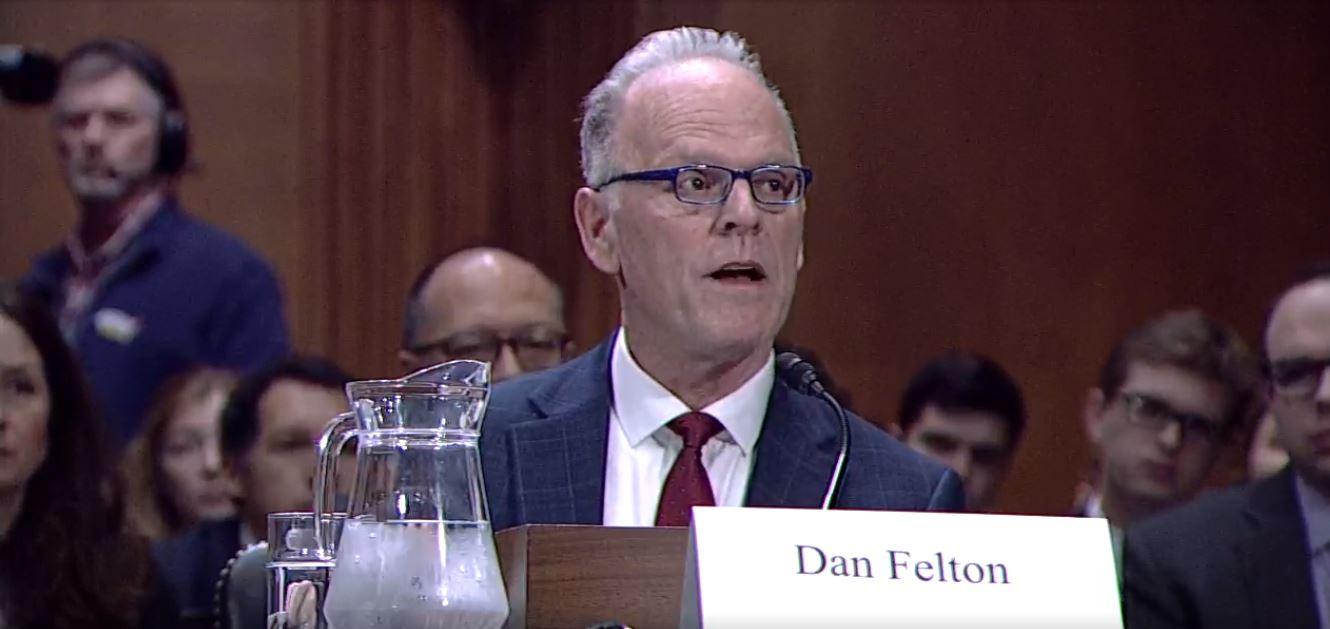
Dan Felton, executive director of AMERIPEN, speaks at the Senate Committee of Environment & Public Works hearing on extended producer responsibility.

“WWF hopes that the conversation this committee is leading today will help pave the way for Congress to develop and enact EPR legislation,” she said, and she believes that legislation can be bipartisan. 

Felton said from AMERIPEN’s perspective, “we will support thoughtful packaging EPR proposals that properly balance the needs of all stakeholders. We will not support poorly designed packaging EPR proposals that we believe are not based in reality and will not result in positive environmental change and greater packaging recovery and recycling.”

Johnson said he believes there is “urgency to get started,” but Felton noted that AMERIPEN is not convinced that federal level EPR is necessary and “is not currently suggesting that there is an immediate need for a federal framework.”

“A deeper discussion is merited on how uniformity may be achieved if packaging EPR continues to expand in the U.S., and whether something could – or should – be done at the federal level,” Felton said. “To that end, AMERIPEN would be pleased to work with federal policymakers and other stakeholders to explore the potential need and design for any federal framework or program.” 

Felton added that there is a lack of data, and the federal government could play an important role in data collection and possibly harmonization, “but states should have a lot of capability to meet their individual needs.” 

Tags: EPRIndustry GroupsLegislation & Enforcement
TweetShare
Marissa Heffernan

Marissa Heffernan

Marissa Heffernan worked at Resource Recycling from January 2022 through June 2025, first as staff reporter and then as associate editor. Marissa Heffernan started working for Resource Recycling in January 2022 after spending several years as a reporter at a daily newspaper in Southwest Washington. After developing a special focus on recycling policy, they were also the editor of the monthly newsletter Policy Now.

Related Posts

Women in Circularity: Connie Lilley

Women in Circularity: Connie Lilley

byMaryEllen Etienne
April 28, 2026

In this series, we spotlight women moving us toward a circular economy. Today, we meet Connie Lilley of We ReUse.

What is EPR and why it matters

What is EPR and why it matters

byScott Snowden
April 22, 2026

Extended producer responsibility is reshaping recycling by shifting costs to manufacturers and driving changes in product design, repairability and end-of-life...

EPR fees are a market signal. Here’s what they’re telling you.

Oregon DEQ flags 250 producers for RMA noncompliance

byStefanie Valentic
April 21, 2026

Oregon DEQ released its first quarterly producer status list under the Recycling Modernization Act on April 9, flagging 250 companies...

Recycling Partnership CEO stepping down

byStefanie Valentic
April 15, 2026

Outgoing CEO Keefe Harrison will remain until August with the organization she built from the ground up.

NERC launches hub to promote PCR demand 

byAntoinette Smith
April 15, 2026

The Northeast Recycling Council's PCR Material Demand Hub offers resources for government procurement, material- and product-specific resources, and certification and...

Reverse Logistics Network launches to support industry

byPaul Lane
April 14, 2026

The reverse logistics community has a new organization to give companies in that sector a place to connect.

Load More
Next Post
US PET bottle recovery rate increases 1.5 percentage points

Diverse coalition pushes for national deposit system

More Posts

Birch Plastics gets FDA green-light for post-industrial PP

LyondellBasell upgrade to PreZero assets on hold

April 23, 2026
The independent ITAD at a crossroads

The independent ITAD at a crossroads

April 22, 2026
EPR fees are a market signal. Here’s what they’re telling you.

Oregon DEQ flags 250 producers for RMA noncompliance

April 21, 2026

What Netflix’s ‘Plastic Detox’ gets wrong – and right

April 23, 2026

Google pilots reuse kits to extend device life

April 21, 2026
What is EPR and why it matters

What is EPR and why it matters

April 22, 2026
Earth Day

Happy Earth Day. Here’s how to celebrate

April 22, 2026
Growth challenges drive M&A for packaging

Growth challenges drive M&A for packaging

April 20, 2026
EPR fees are a market signal. Here’s what they’re telling you.

EPR fees are a market signal. Here’s what they’re telling you.

April 10, 2026
Prescription drug bottles

National Prescription Drug Take Back Day is Saturday

April 24, 2026
Load More

About & Publications

About Us

Staff

Archive

Magazine

Work With Us

Advertise
Jobs
Contact
Terms and Privacy

Newsletter

Get the latest recycling news and analysis delivered to your inbox every week. Stay ahead on industry trends, policy updates, and insights from programs, processors, and innovators.

Subscribe

Welcome Back!

Login to your account below

Forgotten Password?

Retrieve your password

Please enter your username or email address to reset your password.

Log In

Add New Playlist

No Result
View All Result
  • The Latest
  • Analysis
  • Recycling
  • E-Scrap
  • Plastics
  • Policy Now
  • Conferences
    • E-Scrap Conference
    • Plastics Recycling Conference
    • Resource Recycling Conference
    • Textiles Recovery Summit
  • Magazine
  • About Us
  • Advertise
  • Archive
  • Jobs
  • Staff
Subscribe
This website uses cookies. By continuing to use this website you are giving consent to cookies being used. Visit our Privacy and Cookie Policy.