






California’s rulemaking on the minimum post-consumer recycled content law is moving along steadily, and stakeholders are narrowing in on the things they like and dislike about the regulations.
The public comment period for California’s rulemaking on AB 793 is open through mid-March. Kate Bailey, chief policy officer with the Association of Plastic Recyclers (APR), said there are some aspects APR favors, but also a few red flags. (APR owns Resource Recycling, Inc.)
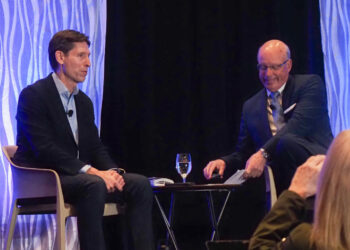
“We want the same definitions, the same reasons to get a waiver or a drop in penalties,” she told Resource Recycling. “We want to establish that this is the same thing across the country, both to make it more effective and easier for compliance.”
With several other states eyeing recycled content mandates, “we’re seeing a lot of traction on this, which is fantastic,” she added. “It is definitely needed to drive market demand and we’re really pushing for standardization.”
However, a lack of certification language and the inclusion of caps and labels in the percentage equation worries APR, Bailey said.
Mark Murray, executive director of Californians Against Waste (CAW), said the volatility of PET scrap prices over the past year “basically tells us that we’re not out of the woods and that we really need to focus on an aggressive implementation and enforcement of the recycled content standard in order to create, at minimum, stability in the marketplace for recycling PET.”
He said he would have liked to have seen adjustments to producer exemptions, but that would have had to come during the legislative process, not the rulemaking process.
“I think we’re going to support the department in terms of their interpretation of the statute,” he said.
The law as passed
AB 793 was signed in 2020, mandating a post-consumer resin (PCR) standard of 15% for plastic beverage containers subject to the California Refund Value (CRV). This standard came into effect Jan. 1, 2022, and will would increase to 25% in 2025 and 50% in 2030.
Any beverage manufacturers that fail to meet those standards will pay fines of 20 cents per pound they fall short by, starting in 2023. Those fines get deposited into the Recycling Enhancement Penalty Account, to be used to support the recycling, collection and processing of plastic beverage containers.
“We want the same definitions, the same reasons to get a waiver or a drop in penalties. We want to establish that this is the same thing across the country, both to make it more effective and easier for compliance.” -Kate Bailey, chief policy officer, the Association of Plastic Recyclers
The law also requires plastic material reclaimers to report the number of plastic containers collected and sold and that PCR manufacturers report the amount of food-grade and bottle-grade plastic material sold.
It exempts beverage manufacturers that sell or transfer 16 million or fewer plastic beverages in a year.
Murray said although it’s statutory and not part of the regulations, “I do think that we should reexamine the exemption line.”
“We totally get that it’s not hugely significant if a small mom-and-pop distributor or producer of beverages is in compliance or not in compliance – we’re really focused on the big players – but 16 million plastic beverage containers seems like a pretty high threshold,” he said.
Murray sees an opportunity to address his concern in SB 353, which was introduced this session. It would adjust how state regulators calculate the amount paid to bottle and can recycling businesses and expand the container redemption program to all 100% juice containers.
“That’s a bigger priority for us than the details of the regulation,” he said.
The rulemaking phase will define reporting entities and the goods whose production volume they are required to report, clarify the procedures and information required for beverage manufacturers to petition to reduce the PCR minimum content standard, and provide the form and manner for completing mandated reporting.
The California Department of Resources Recycling and Recovery (CalRecycle) submitted the proposed permanent regulations to the Office of Administrative Law on Jan. 24 and they were published in the California Regulatory Notice Register on Feb. 3. The public comment period started Feb. 3 and will last until the end of a rulemaking hearing on March 21.
Clarifying regulations
AB 793 allowed beverage manufacturers, through an association, to petition CalRecycle to adjust the minimum PCR standards annually beginning on Jan. 1, 2025. The proposed regulations add that the association that petitions must represent at least 35% of all registered beverage manufacturers in the state and set an annual filing deadline of Dec. 1.
The law also provides a way to reduce penalties for not meeting the PCR standards by submitting a corrective action plan to CalRecycle. The proposed regulations establish the form and manner for a beverage manufacturer to submit a request for reduction and a plan. They also cover deadlines and the criteria for granting or denying a reduction.
A policy statement noted the goal of AB 793 is “to help develop domestic markets for recycled plastic, reduce the amount of virgin plastic used and provide a closed-loop solution for plastic beverage containers.”
“Additionally, the proposed regulations will benefit the health and welfare of California residents along with the state’s environment by providing the specificity necessary to implement a minimum PCR plastic standard for plastic beverage containers, which will increase the demand for recycled plastic, reduce plastic litter, and increase the use of recycled plastic in the manufacture of plastic beverage containers thereby reducing greenhouse gas emissions,” it stated.
Bailey said APR likes the clear distinction between post-consumer and post-industrial recycled content, as the intent of the bill was to close the loop. In addition, CalRecycle is using the definition of post-consumer content from the ISO standards, which Bailey applauded.
“They’re not making up something new,” she said. “They are going with a very credible, very established definition which is something we’d like to replicate in other states.”
Two concerns for Bailey are the inclusion of the weight of the cap and label when calculating what percentage of a bottle is PCR and the lack of certification requirements for PCR.
“There is language in there that requires companies to include in the reporting the weight of the cap or lid as well as the label. APR submitted comments in 2021 opposed to this language,” Bailey said. “It is not the intent of the bill to talk about content in those materials, the intent was to talk about the content in the bottle.”
She said caps and labels were “a whole new conversation and rulemaking is not the place to introduce that.”
Murray said CAW is more focused on the “big picture of compliance and implementation and enforcement for the body of the PET containers” and he’s not as concerned about the inclusion of caps and labels.
“I don’t think any of the large beverage producers should have any difficulty complying with that 15% average,” he said, cap and label included or not.
Bailey’s second concern is the lack of language around recycled content certification. Other recently passed content mandate bills in California required recycled content to be certified by an ISO standard process, and Bailey wants to see a similar requirement in AB 793.
“This is something we’re working on in other states to make sure we know its post-consumer recycled content,” she said. “We’re not seeing clear language about the ISO certification so we’re going to look at that a little bit deeper.”
“I don’t think any of the large beverage producers should have any difficulty complying with that 15% average.” -Mark Murray, executive director, Californians Against Waste
CalRecycle estimated the cost impact of the proposed regulations were limited to the cost of reporting data, preparing and submitting corrective action plans, and submitting petitions to adjust the minimum content standard.
Approximately 695 businesses will be impacted by the proposed regulations, CalRecycle reported. Of that number, 668 are beverage manufacturers that sell beverages in plastic beverage containers and 27 are plastic material reclaimers or PCR manufacturers.
Of the beverage manufacturers, 494 are considered small businesses and of the plastic material reclaimers and manufacturers 9 are considered small businesses. Overall, 503 small businesses will be affected by the regulations, or 72%.