
Resource Recycling
  • The Latest
  • Analysis
    • All
    • Certification Scorecard
    • Industry Announcements
    • Opinion
    The electronics recycling industry is undergoing a transformation from labor-intensive manual operations to highly automated, AI-driven facilities that use advanced robotics, cleaner chemistry and digital tracking systems to extract critical materials.

    The cyber-physical MRF: AI and robotics reshape e-waste recovery

    Certification scorecard for the week of Feb. 9, 2026

    Meta-Corning deal signals IT hardware retirement wave

    Meta-Corning deal signals IT hardware retirement wave

    Malaysia clamps down on illegal e-waste imports amid probes

    Malaysia clamps down on illegal e-waste imports amid probes

    URT builds alliance to remake electronics plastics at scale

    ICYMI: Top 5 e-scrap stories from January 2026

    The electronics recycling industry is undergoing a transformation from labor-intensive manual operations to highly automated, AI-driven facilities that use advanced robotics, cleaner chemistry and digital tracking systems to extract critical materials.

    Certification scorecard for the week of Feb. 2, 2026

    Auditors warn EU may fall short on critical metals

    Auditors warn EU may fall short on critical metals

    Industry announcements for January 2026

    Industry announcements for February 2026

    ICYMI: Top 5 recycling stories from January 2026

  • Conferences
  • Publications

    Other Topics

    Textiles
    Organics
    Packaging
    Glass
    Brand Owners

    Metals
    Technology
    Research
    Markets
    Grant Watch

    All Topics

Subscribe
No Result
View All Result
Resource Recycling
  • The Latest
  • Analysis
    • All
    • Certification Scorecard
    • Industry Announcements
    • Opinion
    The electronics recycling industry is undergoing a transformation from labor-intensive manual operations to highly automated, AI-driven facilities that use advanced robotics, cleaner chemistry and digital tracking systems to extract critical materials.

    The cyber-physical MRF: AI and robotics reshape e-waste recovery

    Certification scorecard for the week of Feb. 9, 2026

    Meta-Corning deal signals IT hardware retirement wave

    Meta-Corning deal signals IT hardware retirement wave

    Malaysia clamps down on illegal e-waste imports amid probes

    Malaysia clamps down on illegal e-waste imports amid probes

    URT builds alliance to remake electronics plastics at scale

    ICYMI: Top 5 e-scrap stories from January 2026

    The electronics recycling industry is undergoing a transformation from labor-intensive manual operations to highly automated, AI-driven facilities that use advanced robotics, cleaner chemistry and digital tracking systems to extract critical materials.

    Certification scorecard for the week of Feb. 2, 2026

    Auditors warn EU may fall short on critical metals

    Auditors warn EU may fall short on critical metals

    Industry announcements for January 2026

    Industry announcements for February 2026

    ICYMI: Top 5 recycling stories from January 2026

  • Conferences
  • Publications

    Other Topics

    Textiles
    Organics
    Packaging
    Glass
    Brand Owners

    Metals
    Technology
    Research
    Markets
    Grant Watch

    All Topics

Subscribe
No Result
View All Result
Resource Recycling
No Result
View All Result
Home Plastics

PCR flows to multi-layer applications

byJared Paben
August 2, 2019
in Plastics
PCR flows to multi-layer applications
Packaging company Mondi led a project that created a pouch made of 20% post-consumer plastic. | Courtesy of Mondi.

For years, packaging producers have been marketing recyclable multi-layer flexible packages. Now, they’re finding success using recycled plastic in their products.

A number of recent developments have been announced in the multi-layer flexible space, particularly for stand-up pouches. They range from a 100% recycled-content film, produced with the use of a chemical conversion technology, to a 20% recycled-content prototype pouch, produced by extensive washing and sorting of low-grade scrap plastic.

Two-layer cheese film

Global chemical company BASF provided more details on a pilot project that used pyrolysis technology to recycle post-consumer plastic into a multi-layer film for cheese.

BASF used its ChemCycling conversion technology to break down recovered mixed plastics to produce an oil. The oil was used as feedstock to make polyamide and ethylene. Plastics producer Borealis used the ethylene to make polyethylene. Packaging company Südpack converted the plastics into a two-layer film to hold Zott Gourmet Dairy’s Zottarella mozzarella. The 100% recycled content film provides the barrier properties needed to protect the cheese.

BASF in December 2018 first announced it had made a number of products, including cheese packaging, refrigerator components and insulation panels, using the ChemCycling process.

45% recycled-content pouch

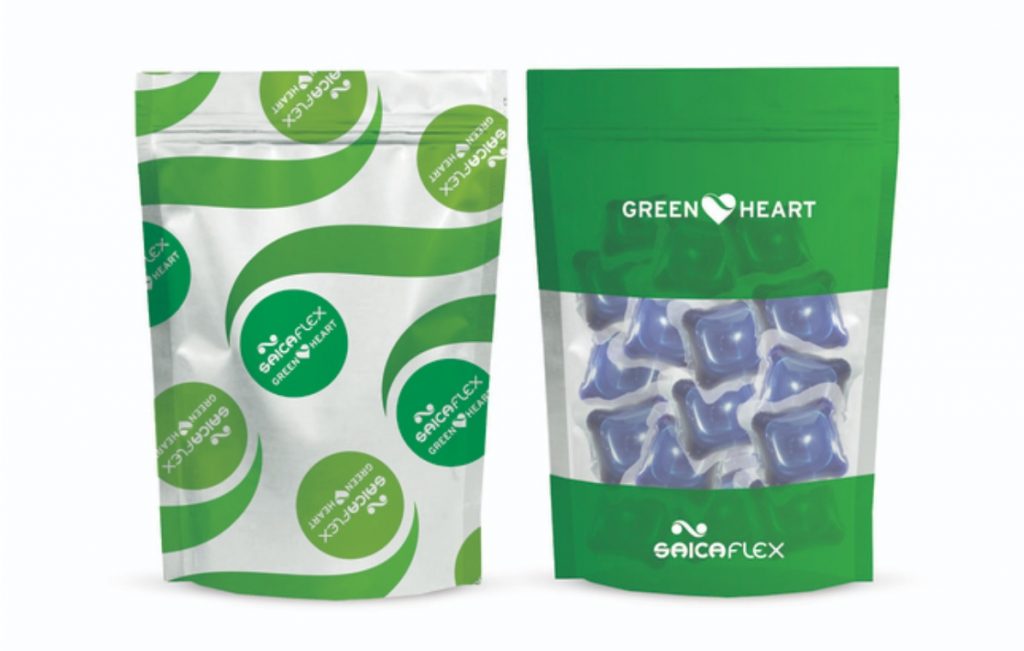
Packaging company Saica Flex has introduced a pouch for detergent tablets made with recycled LDPE. Part of the company’s new Greenheart line, the pouch is 45% recycled plastic.

The Greenheart line includes recycled plastic but is meant for non-food applications.

According to Saica Flex, the recycled plastic was provided by Saica Natur, a sister company to Saica Flex. The Natur Cycle Plus resin performs similar to virgin material in both the packaging conversion process and the form-fill-seal steps.
Overcoming recycled plastic haze

Flexible packaging producer ProAmpac has created a pouch made with 25% post-consumer plastic. It is being used to hold Justin’s brand Nut Butter Covered Nuts.

The pouch incorporates 40% recycled content in the sealant film, which comes out to 25% of the entire packaging structure, according to a press release. The pouch has the oxygen- and moisture-barrier properties needed to preserve the food.

“This flexible package is one of the first commercial pouches for food packaging to combine such a high proportion of PCR material, reducing the carbon footprint of the package without sacrificing the high-barrier snack food requirements,” Adam Grose, chief commercial officer for ProAmpac, stated in the release.

ProAmpac noted it overcame the hazy and inconsistent appearance that typically comes with using high percentages of recycled plastic by combining flexographic inks and coating technologies, as well as by optimizing the lamination processes.

From dirty scrap to pouch

Packaging company Mondi led a project that created a pouch made of 20% post-consumer plastic. Supported by the Ellen MacArthur Foundation and spearheaded by Mondi, Project Proof created a prototype pouch that can hold products such as detergent. The feedstock was considered the worst-quality material, and it required washing and sorting using a variety of technologies, according to a press release.

“We wanted to see what was possible with the worst input, and we were able to create a fully usable prototype,” Graeme Smith, Mondi Consumer Packaging’s sustainability manager, stated in the press release. “This proof-of-concept underlines the potential [of] what could be manufactured when better quality, pre-sorted materials are used as input. Better waste collection mechanisms and a focus on packaging designed for recycling will improve this process and help close the sustainability loop.”

According to Mondi, the recycled plastic results in flecks of inconsistent coloring in the pouch, which has excellent construction, seal strength and zipper integrity. The company is now developing it further so it can be rolled out as a commercially viable product for multinational brand owners.

To receive the latest news and analysis about plastics recycling technologies, sign up now for our free monthly Plastics Recycling Update: Technology Edition e-newsletter.

 

Save the Date for the 2020 Plastics Recycling Conference.

Tags: Brand OwnersEuropeMarketsResearchTechnology
TweetShare
Jared Paben

Jared Paben

Related Posts

The electronics recycling industry is undergoing a transformation from labor-intensive manual operations to highly automated, AI-driven facilities that use advanced robotics, cleaner chemistry and digital tracking systems to extract critical materials.

The cyber-physical MRF: AI and robotics reshape e-waste recovery

byDavid Daoud
February 12, 2026

The electronics recycling industry is entering a new phase of technological acceleration. Advances in artificial intelligence, robotics, advanced chemistry, and...

NERC: Blended average prices fell 40% in third quarter

HDPE, PP bales rise as paper fiber and cans stabilize

byRecyclingMarkets.net Staff
February 12, 2026

National average prices of post-consumer material bales were flat to higher on the month.

Terex beats ESG integration targets as REV group merger closes

byStefanie Valentic
February 11, 2026

Terex exceeded $25 million in ESG integration synergy targets and completed its REV Group merger, expanding its specialty equipment platform...

Member states select new chair for global plastics treaty

Member states select new chair for global plastics treaty

byAntoinette Smith
February 10, 2026

During a short session, the Intergovernmental Negotiating Committee elected Chilean diplomat Julio Cordano to continue efforts toward an internationally binding...

Packaging Corp. to buy Greif containerboard segment

Export trends offset containerboard production decline

byStefanie Valentic
February 6, 2026

AF&PA reported a 4% decline in containerboard production for 2025, while packaging paper shipments rose 2% in December and boxboard...

Royal Mint, Procurri partner for ITAD metals recovery

byScott Snowden
February 5, 2026

Reformation Metals partnered with Procurri to combine secure IT asset disposal with clean technology recycling that recovers up to 99%...

Load More
Next Post

First Person Perspective: Why we shouldn’t backpedal on carton recycling

More Posts

Oregon’s Recycling Modernization Act faces injunction

Court partially blocks Oregon EPR law, dismisses bulk of lawsuit

February 10, 2026
Chinese processing group details goals for US visit

AMP lays out vision of next-generation, AI-driven MRFs

July 24, 2024
Malaysia clamps down on illegal e-waste imports amid probes

Malaysia clamps down on illegal e-waste imports amid probes

February 6, 2026

REUSE Act heads to US House for consideration

February 9, 2026

ecoATM recycled 7.5M phones in 2025 as payouts hit $1.5B

February 10, 2026
Meta-Corning deal signals IT hardware retirement wave

Meta-Corning deal signals IT hardware retirement wave

February 9, 2026

APR, industry create proactive guidance for PET caps

February 12, 2026
Texas sues over dumped wind turbine blades

Texas sues over dumped wind turbine blades

February 10, 2026

Alpek talks PET overcapacity, soft demand

February 11, 2026
The electronics recycling industry is undergoing a transformation from labor-intensive manual operations to highly automated, AI-driven facilities that use advanced robotics, cleaner chemistry and digital tracking systems to extract critical materials.

The cyber-physical MRF: AI and robotics reshape e-waste recovery

February 12, 2026
Load More

About & Publications

About Us

Staff

Archive

Magazine

Work With Us

Advertise
Jobs
Contact
Terms and Privacy

Newsletter

Get the latest recycling news and analysis delivered to your inbox every week. Stay ahead on industry trends, policy updates, and insights from programs, processors, and innovators.

Subscribe

Welcome Back!

Login to your account below

Forgotten Password?

Retrieve your password

Please enter your username or email address to reset your password.

Log In

Add New Playlist

No Result
View All Result
  • The Latest
  • Analysis
  • Recycling
  • E-Scrap
  • Plastics
  • Policy Now
  • Conferences
    • E-Scrap Conference
    • Plastics Recycling Conference
    • Resource Recycling Conference
    • Textiles Recovery Summit
  • Magazine
  • About Us
  • Advertise
  • Archive
  • Jobs
  • Staff
Subscribe
This website uses cookies. By continuing to use this website you are giving consent to cookies being used. Visit our Privacy and Cookie Policy.