





Will molecular or chemical plastics recycling revolutionize the industry? If the billions in investments announced by brand owners and petrochemical companies over the last year are any hint, it looks like ground-breaking solutions to the plastic recycling challenge are right around the corner.
Chemical recycling, however, isn’t new, so why such enthusiasm for those solutions of late? Among the answers, context tops the list: Plastics recycling is now a public matter. Brand owners and governments alike are committed to increasing plastics recyclability as well as the percentage of recycled content in plastic packaging.
A recent report from Closed Loop Partners identified no less than 60 “transformational technologies.” Most of the clean-tech companies are at a scaling-up stage. The next one to three years will allow them to demonstrate (or not) if their process works as a pilot on an industrial scale.
With this vision, last February, Éco Entreprises Quebec (ÉEQ) and its French counterpart, Citeo, both extended producer responsibility (EPR) organizations for packaging, organized the Forum on Plastic Solutions. The event’s main purpose was to accelerate innovation in order to reach an industrial scale for 13 clean-tech companies involved in chemical recycling for PET, PE, PP, PS and even multilayer films. EPR organizations such as ÉEQ and Citeo need to play an active role to stimulate the success of plastics recycling for one main reason: They represent the brand owners who already pay for a high-performance curbside recycling program and pledge to increase the recycled content of their packaging.
Why is raising the plastics recycling rate so challenging?
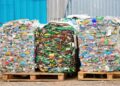
Reaching high recycling and recycled-content targets cannot be achieved through mechanical recycling methods only. Indeed, mechanical recycling presents technical and economic challenges.
Most important is the quality issue. Bale quality from MRFs notwithstanding, plastics contain additives, glues, mineral fillers and dyes that diminish the quality of recycled resin compared with virgin resin. In its 2018 End Market Demand for Recycled Plastic report, More Recycling points out that the second-most cited reason from manufacturers is “not enough post-consumer resin available that matches our specifications.”
Additionally, there is manufacturer demand for color sorting, a process that requires a significant volume but is not common in the industry. Since most plastic packaging is not color-sorted by MRFs or recyclers, the result is often a gray-greenish recycled resin, which limits the end usage to more opaque applications.
Last but not least, plastic, as a polymer, cannot be indefinitely mechanically recycled, as it loses some of its mechanical and aesthetic properties with each recycling cycle, no matter how well the process is carried out. Also, infinite closed-loop recycling is not feasible given our current recycling methods.
In the end, one question remains: How can we achieve recycled content as targeted by brand owners and some governments, the EU and Canada being in the lead? According to the latest report from Closed Loop Partners, “37 of the world’s largest consumer brands and retailers … have made public commitments to use recycled plastics in their packaging within the next 10 years … . Current projections indicate new real demand of 5 million to 7.5 million metric tons by 2030.” That will exceed current availability by 200% to 300%, according to the author.
Looking at chemical recycling
Molecular or chemical recycling can offer a complementary approach to mechanical recycling in order to bypass technical limits and help meet the future demand for recycled resin.
Molecular or chemical recycling is an umbrella term for a number of different technologies. Within the chemical recycling family, plastic-to-fuel technologies are proven ones, and also the most used worldwide. However, it’s not limited to energy production. In fact, we can identify three kinds of chemical recycling technologies.
Recycling by dissolution (or purification) involves mixing a plastic in a specific solvent that will react only with the desired type of plastic, then separating the mixture, filtering it and purifying it to obtain a pure “cleaned” plastic. There is no modification of polymers. The plastic does not lose its mechanical properties, thus resembling virgin polymers. In addition, it is possible to extract additives and dyes from the diluted polymer.
Recycling by depolymerization (or decomposition) involves breaking the bonds of the polymers to return to the monomer state. There are various methods of depolymerization to break the molecular bonds (using enzymes, methanol or glycol). Each of these methods results in different monomers that are filtered or distilled to be purified and extract dyes and additives. These monomers are then repolymerized.
Recycling by pyrolysis or gasification (or conversion) involves treating plastics by heat in the absence of oxygen to convert them into liquid and gas fuels. In this form, they are used as a source of energy or to produce intermediate compounds that can in some cases be used to manufacture new plastics.
As those transformational technologies consider the plastic molecule more than the plastic itself, they could reach beyond some of the barriers facing mechanical recycling. By removing masterbatch and dyes, we end up with a virgin-like resin in terms of quality. Moreover, as the molecular chain remains intact (dissolution) or is reassembled (depolymerization), there is no loss of mechanical or esthetical properties. Infinite closed-loop recycling could be possible.
A complementary approach to mechanical recycling
Accelerating innovations means rethinking the actual model for curbside plastics recycling, with the implementation of more vertically integrated structures, for example. During the Forum on Plastic Solutions in Paris, ÉEQ and Citeo hosted 325 attendees who are stakeholders in this new plastics recycling chain.
Based on feedback from discussions, we envision the following roles for those stakeholders:
- MRFs and mechanical recyclers. Chemical recycling should not overtake the market share for plastics that can actually be mechanically recycled. However, it should be an opportunity with low-value or hard-to-recycle plastics. Then, in a complementary approach, MRFs and mechanical recyclers could be included in the feedstock preparation process for chemical recyclers.
- Petrochemical companies. With the current low price of virgin plastic, partnerships between virgin producers, technology providers and brand owners could lower the current recycling cost structure and make recycled resin more competitive with regard to virgin resin.
- Brand owners. Their commitments to using more recycled content and buying recycled resin from virgin producers is a strong market indicator. By being part of the process, brand owners are also encouraged to review packaging design, for instance, by reducing additives that impact recyclability.
EPR organizations could be at the centre of this new economic model. For about 15 years in Canada and 30 years in Europe, brand owners have financed municipal curbside recycling programs through their EPR organizations. In Quebec, $150 million is used annually to allow recovery across 99% of the province’s territory. Within this system, materials could reach a high recovery rate. PET bottles, for example, have a recovery rate of around 75% in Quebec, compared with 29% in the U.S. The reason behind this good performance is brand owner involvement beyond their financial obligations, such as in eco-design, and now in plastics recyclability.
Plastics recycling is in the spotlight, and we all can agree that there is no one-size-fits-all solution. Chemical recycling is a promising one, but technologies that close the loop need to be tested on an industrial scale. Economics will be the leading factor in determining the success of these innovative technologies. Existing EPR models need to be redefined in order to integrate this new reality and promote vertical integration of the various actors. Whether it is through mechanical technologies, advanced mechanical technologies or chemical technologies, reaching tomorrow’s targets for plastics recycling might mean that the era of cheap plastics is over.
Pierre Benabidès is the materials and market development advisor for Eco Entreprises Quebec.
The views and opinions expressed are those of the author and do not imply endorsement by Resource Recycling, Inc. If you have a subject you wish to cover in an op-ed, please send a short proposal to news@resource-recycling.com for consideration.
To receive the latest news and analysis about plastics recycling technologies, sign up now for our free monthly Plastics Recycling Update: Technology Edition e-newsletter.