





This story originally appeared in the Summer 2020 issue of Plastics Recycling Update. Subscribe today for access to all print content.
Just as spices can complement the flavors of a dish, plastics additives can bring out the best qualities in a recycled polymer.
Experts from global additives producer Baerlocher explained how the company’s stabilizer additives help prevent visual and mechanical degradation in resins.
Ian Query, technical specialist in the Special Additives Division at Baerlocher USA, and Roberto Nunez, business head for the division, answered questions from Plastics Recycling Update about how additive innovations are helping plastic processors enhance their recycled-resin recipes.
Could you provide us an overview of your additive offerings for post-consumer plastics?
Increasing the value of recyclates and expanding the number of applications where recyclates can be used are two key goals for material recyclers. However, plastics made from recyclates need to meet converters’ important requirements. Baerlocher USA’s advanced additive packages help fulfill these requirements.

Baerlocher USA’s Baeropol resin stabilization technology (RST) is a polymer stabilizer, used as a direct or partial replacement for both acid scavengers as well as phosphite stabilizers in polymer applications. The synergy between Baeropol RST additives and phenolic antioxidants enables resin stabilization similar to standard phenol/phosphite stabilizer blends. Baeropol RST additives provide excellent melt stability in standard polyethylene and polypropylene resins during normal processing conditions. They improve color for single or multiple extrusions, and in many applications, Baeropol RST additives enhance the overall performance of the resin.
Additionally, Baerlocher USA’s Baeropol T-Blends are a product family of blended polymer stabilizers pre-formulated to provide superior stabilization for most polymer applications. They were designed as a direct drop-in for most traditional binary antioxidant blends, but with added benefits. The addition of synergistic RST allows for the complete or partial replacement of phosphites in traditional B-blends while improving overall performance.
What are some of the problems with recycled plastics that necessitate the use of stabilizers?
The instability of a plastic resin is often the root cause of many issues in recycled plastic processing and performance. When a plastic becomes unstable, it starts to react chemically with its environment (i.e. oxygen, heat, light, etc.) and changes in negative ways that are revealed as time goes on. It starts as degradation caused by heat and oxygen. Then, depending on the type of polymer, it can cause crosslinking, chain scission or other side reactions, which can alter your polymer’s rheology/melt flow, and cause the material to dehomogenize. This can result in issues like melt fracture, gels and poor dispersion, negatively affecting your products visual and mechanical properties over time. However, if a stabilizer is present, all of this can be prevented, preserving a like-prime quality. A stabilizer can also be applied to an unstable material to stop those effects from multiplying.
Often, recycled material is depleted of its initial stabilizing efficacy and needs more stabilizer to prevent further degradation. If recyclers, compounders and converters stabilize plastic regularly, the result will be a higher quality plastic with more capacity to be repeatedly recycled.
Baerlocher USA’s Baeropol RST additives will preserve the polymer’s initial structure, prevent negative chain reactions from starting, and keep the material’s average molecular weight in check. As a result, not only will the process be more stable and efficient, but the visual quality and mechanical properties of the product will be better as well. Properties such as long-term thermal stability, melt flow and color can all see improvement.

Also, typically, recyclers offering higher-quality resins use melt filtration to remove impurities. Baerlocher USA’s Baeropol technology stabilizes the polymer, enabling it to withstand the high temperatures and extrusion conditions used in the melt filtration process, preserving the polymer’s characteristics. Baeropol additives can be added before the melt filtration process quite effectively, as illustrated by our partnership with Erema.
Which polymers are they designed for?
Baerlocher USA’s line of Baeropol RST and T-Blend stabilizers have been primarily used for polyolefins like HDPE, LDPE, LLDPE and PP. Further, it has been used successfully with PS, ABS and polyamides.
When did these additives come out on the market?
Baerlocher USA’s line of Baeropol RST and T-Blend stabilizers were commercialized in 2015.
Can you describe Baerlocher’s typical Baeropol customers in the recycling business?
Baerlocher USA’s Baeropol RST and T-Blends have shown improvements in products produced using extrusion, blow molding, thermoforming, and also blown and cast film. These stabilizers can also be used in an extremely wide range of applications, including drainage pipe, wood-plastic composites, films and other durable products, and at many different stages of the plastics life cycle.
Baerlocher USA’s stabilization technology can also be successfully used in applications for prime and recycled polyolefins (HDPE, LLDPE, LDPE, PP) and styrenics. These additives are often incorporated at recycling lines when repelletizing flakes into post-consumer resin/post-industrial resin pellets. It’s important to apply stabilizers at this stage in the process, because it protects the resin during the heat and shear of recycling. Additionally, these stabilizers can be used directly at the conversion stage.
What forms do the additives take?
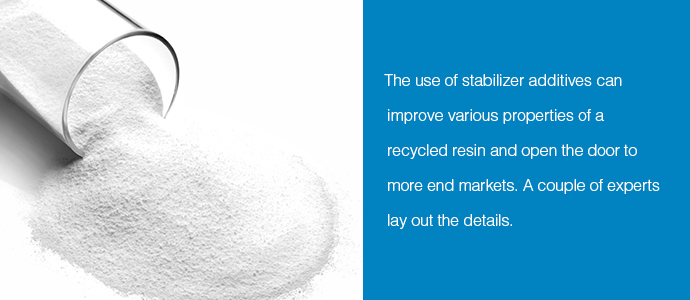
One advantage of Baeropol RST and T-Blends over traditional B-blends is the variety of product forms in which they are sold, such as pastilles, prills and rods. This diverse set of product forms allows any user to apply stabilizers regardless of their feeding capabilities.
The prilled form of the product minimizes dust exposure and housekeeping issues in the work environment. The free-flowing nature of prills avoids problems with bridging and caking and facilitates use in most bulk handling or conveying and automated weighing and metering systems.
What level of RST or T-Blends additive loading is needed to yield noticeable benefits?
Generally, to yield noticeable benefits, the loading level for traditional B-blend stabilizers would range between 0.1% and 0.3% in a given process. We typically target this range with our Baeropol T-Blends.
Are the additives consumed in the recycling process? Or are benefits from them retained in subsequent grind/melt/extrude/mold cycles?
Phenolic and phosphite stabilizers are non-regenerative; once they are used, the resin must be replenished with a new dose of a given stabilizer. This is especially important when considering how plastics should work in a circular economy. Single-use plastics made from virgin resin may be loaded with lower levels of long-term stabilizers, since their initial application doesn’t call for long-term stability. As plastic is recaptured and recycled, the levels of stabilization must be reassessed since antioxidants may have been depleted and new applications may require longer-term stability.
Do the additives have FDA approval for use in food and drink packaging?
Yes, Baerlocher USA’s line of Baeropol RST and T-Blend stabilizers meet FDA requirements under 21 CFR 178.2010 and Regulation Directive (EU) 10/2011 for additives used in plastic materials and articles intended to come into contact with foods.
Does Baerlocher make compatibilizer additives to help processors produce high-quality resin from streams with some amount of cross-polymer contamination?
Baerlocher USA does not have any compatibilizer chemistries available for this. However, Baerlocher GmbH is doing work in this area.
Are there other additives available to deal with trace physical contaminants that may affect the recycled resin quality? And, if so, how exactly do they tackle the problem?
Sometimes, blue colorants are used to offset yellowness caused by contaminant discoloration to give the appearance of a “whiter” plastic, reducing the perception of the yellow tint. The crystallization structure of PP needs attention in recycled applications. In recycled PP, you can experience haze due to contaminants that grow crystal structures at uncontrolled rates, contributing to light diffraction. Nucleators and clarifiers can be added to control the crystallization process better and reduce optical issues like haze.
Jared Paben is the associate editor of Plastics Recycling Update and can be contacted at jared@resource-recycling.com.