





Blue Whale Materials in Oklahoma has started producing its Blacksand black mass while advancing an expansion supported by a US Department of Energy grant of more than $55 million announced this month.
The company reached a pivotal milestone in August 2025 when it launched operations at its first lithium-ion battery recycling facility in Bartlesville, Oklahoma.
“We are at our inflection point for the company,” said David Fauvre, Blue Whale’s co-founder and chief strategy officer. “Our plant came online in Oklahoma in August, so we’re now processing material here in Oklahoma, and we are expanding the plant to add additional processing capacity.”
Charging up and building out
The Bartlesville site is a 50-acre campus with an initial nameplate processing capacity of about 14,000 metric tons per year. Fauvre said the early months have been about proving product quality while increasing throughput, a process he said is complicated by construction for the next phase. “We hit our spec, and now it’s just a question of ramping up throughput,” he told E-Scrap News.
The company’s focus is producing a thermally treated black mass designed for hydrometallurgical refiners that need consistent feedstocks to make battery grade materials. “What we are building at Blue Whale is really a high-quality, thermally treated black mass, which has low impurities, high cobalt, nickel and lithium content,” Fauvre said, adding that the product is “optimized for the hydrometallurgical refiners and sophisticated refiners that need a consistent high grade” material.
Blacksand is a dry mixed-metal intermediate with organics and other impurities removed and with low copper and aluminum content, characteristics the company says can help meet refiner specifications. Fauvre said the company is targeting battery materials manufacturers through refining partners, with an eye toward a closed loop in which battery makers route scrap and end-of-life batteries back into the supply chain.
“We think it really positions us well for eventually the closed loop that is going to take place,” he said.
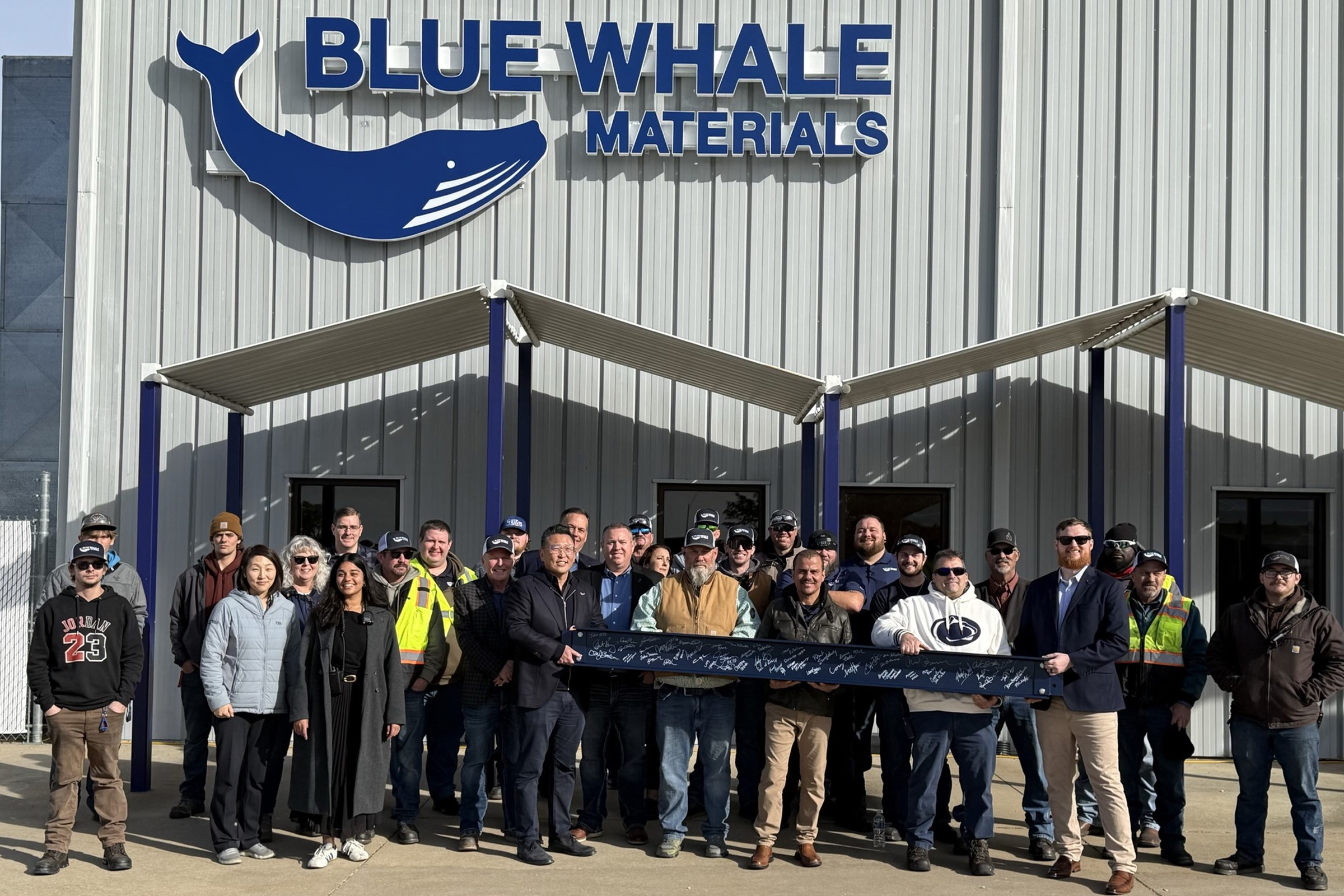
Capacity expansion is central to that strategy. Fauvre said Blue Whale is adding about 6,000 tons of annual capacity to reach 20,000 tons during the second quarter of 2026, then plans to build out to more than 50,000 tons by 2029. In a November 2025 company announcement about a beam-signing ceremony marking the start of expansion construction, Blue Whale said the grant-backed plan is designed to raise annual capacity to about 50,000 tons over four years.
Expanding processing capabilities
The company is also widening what it can accept at the front end. Fauvre said near-term upgrades include pack shredding and related capabilities to process batteries “from the cell all the way through the pack.” Blue Whale also separates copper and aluminum streams from incoming material, and it is building out testing and grading so some batteries can be routed into second-life markets rather than immediately shredded.
“They could potentially have a second use or a life continuing on as a battery, as opposed to being shredded into black mass,” he said.
Fauvre said the company has found a receptive environment in Oklahoma, where leaders have pushed for projects tied to domestic critical minerals and advanced manufacturing. “There has been no pushback,” he said, adding that Blue Whale has seen support from state and federal officials.
The plant’s central location, Fauvre said, supports inbound logistics from across the country, including both coasts and the corridor of battery manufacturing.
“We really do accept material from all over the United States,” he said. “Part of selecting Oklahoma was a decision to be able to be in a position where we could accept material from a wide part of the United States.”
Creating supply chain value
Even with demand growth, Fauvre said the most immediate challenge is execution in an industry that handles varied chemistries and formats.
“Battery recycling is a hard business, and everything that you get in is a little bit different than what you got in before,” he said. Collection remains another constraint, he added, particularly for consumer batteries sitting in people’s homes.
Looking ahead, Fauvre argued that durable progress will come from supply chains that can sustain themselves economically. “I don’t think government mandates are a solution,” he said. He pointed to the lead acid battery market as an example of a closed loop that works because participants capture value at each stage.
For lithium-ion batteries, he said, the task is building similar networks that create value for collectors, pre-processors, refiners and manufacturers, then scaling infrastructure so more critical metals are recovered and returned to manufacturing.