










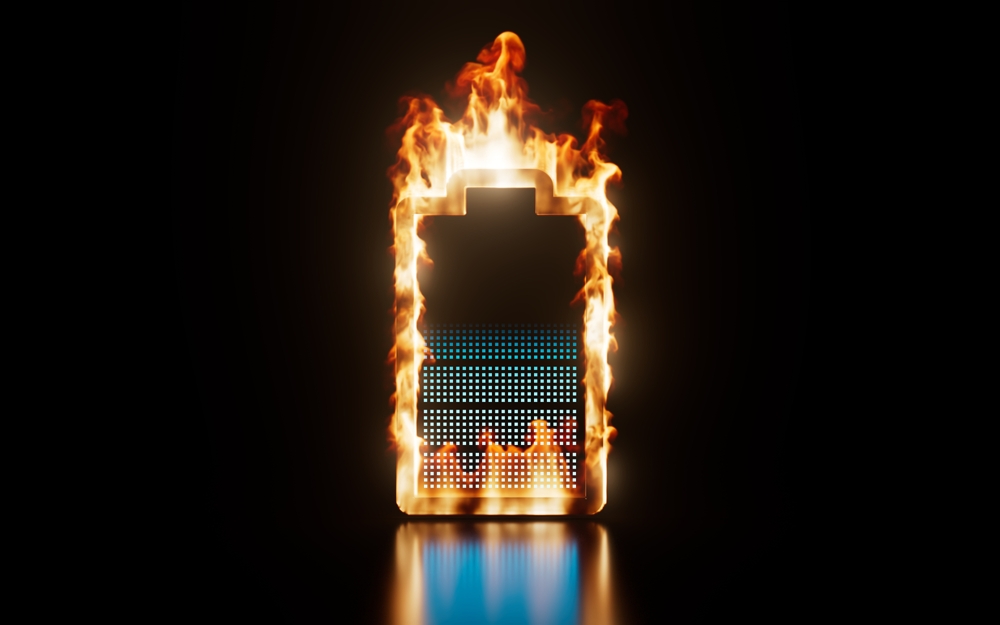
The safety threat to the waste and recycling industry continues to grow as lithium-ion battery fires rise across North America, according to a new industry guide and recently released fire incident data.
The “Guide for Developing Lithium-Ion Battery Management Practices at Materials Recovery Facilities,” jointly published by the National Waste & Recycling Association, the Recycled Materials Association and the Solid Waste Association of North America, outlines practices aimed at reducing fire risk at MRFs.
Ryan Fogelman, vice president of fire protection at Fire Rover, said the guide reflects widening agreement that battery fires are not isolated operational issues. In his January fire report, Fogelman described the problem as outpacing the sector’s ability to address it.
“The waste and recycling industry has reached a critical inflection point when it comes to lithium-ion battery fires,” Fogelman said. “For years, operators, firefighters, insurers and municipalities have grappled with a problem that continues to grow faster than our collective ability to manage it.”
Fogelman has tracked publicly reported waste and recycling facility fires in the US and Canada since 2016. He said the latest figures make 2025 the worst year on record for publicly reported incidents since he began tracking.
“If you read my reports, you already know that this year was the worst on record for publicly reported fires since I began consolidating and sharing the data in 2016,” he said. “We finished the year with 448 publicly reported waste and recycling facility fires in the US and Canada, which is more than last year’s record of 430 fire incidents and nearly 25% above the annual average of 360 fire incidents.”
Fogelman said that lithium-ion batteries, particularly those embedded in everyday consumer products, have become the leading cause of fires at waste and recycling facilities across North America. He cited devices ranging from phones and power tools to e-bikes and disposable vapes as batteries enter the waste stream in greater volume and with greater risk.
“From phones and power tools to e-bikes and disposable vapes, these batteries are entering waste and recycling streams in unprecedented volumes, often damaged, hidden and highly unstable,” he said.
The guide emphasizes risk reduction rather than elimination and calls on facilities to build multiple layers of protection. It identifies several operational priorities, including early identification and isolation practices for suspect batteries, employee training focused on recognition and response, safe storage and handling protocols, emergency response planning that accounts for lithium-ion fire behavior, and public education and customer messaging on proper disposal.
“While data alone doesn’t solve the problem, it plays a critical role in validating what operators and first responders experience on the frontlines every day,” Fogelman said, adding that the guide’s inclusion of fire incident data signals that industry groups are aligning around the idea that battery fires are a systemic risk rather than isolated facility failures.
Fogelman highlighted disposable vaping devices as a particular concern, describing what he calls the “vape effect.” He said that publicly reported fire data shows incidents increasing about 26% from 2022 to 2025 compared with the average from 2016 to 2021.
“These products combine lithium-ion batteries, thin casings and widespread improper disposal, making them uniquely dangerous once they enter processing equipment,” he said.
Fogelman argued that facilities are being asked to manage a fire risk created largely outside their control and that waste and recycling employees should not be treated as a default front-line response team unless they are fully trained and equipped.
The guide calls for collaboration, but Fogelman said that the next phase should include direct accountability and participation from battery makers, consumer electronics companies and tobacco manufacturers to help fund solutions.
“Product design changes, battery removability, takeback programs and funding for public collection infrastructure aren’t optional if we expect meaningful reductions in fire incidents,” he said.
Fogelman said Fire Rover protected more than 850 facilities by the end of 2025 and that its systems identified and responded to more than 3,500 confirmed fire or hot spot incidents during the year, helping suppress about 450 fire events.
Looking ahead, he said his annual fire report is being updated with 2025 data and analysis under the title “Fortifying the Front Lines,” while describing the new guide as a foundation rather than a finish line. “This guide is an important step toward that alignment, and one the industry has needed for a long time,” he said.