






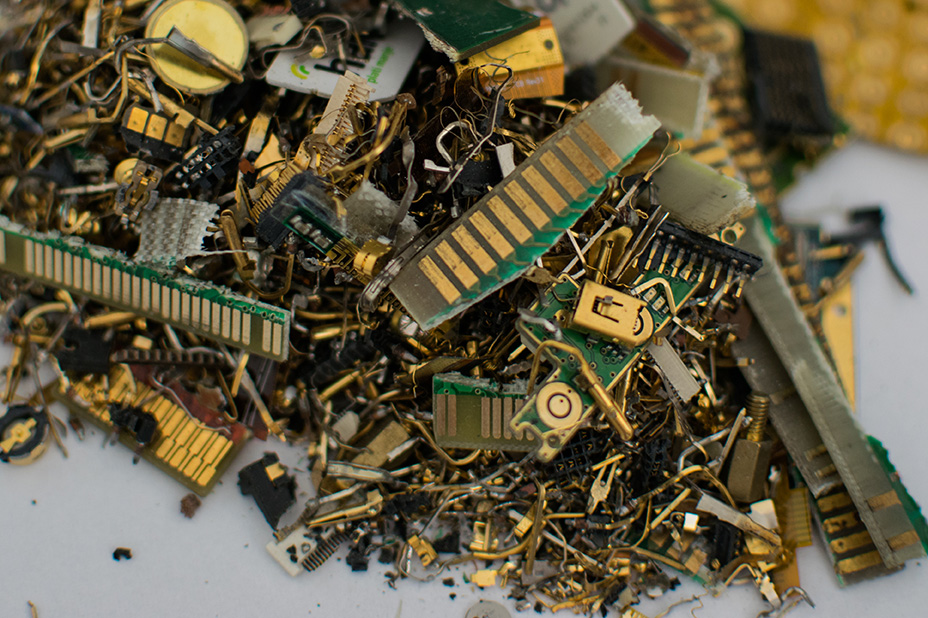
American e-scrap and ITAD operators are being pushed, incrementally and through shock events, to manage more material domestically rather than rely on long, export-dependent flows. A combination of factors is making possible the creation of an urban mining industry, an industry increasingly seen as a strategic requirement.
Five overlapping forces are driving that shift: a more active US industrial policy, tightening enforcement in key Asian destinations, conflict-related freight disruption, Europe’s scramble for critical metals and the emergence of new domestic processing capacity. Specifically:
- US policy is reframing e-scrap as a critical minerals resource, having long been considered a waste stream.
- Southeast Asian governments are closing off informal import channels and increasing the risk of export-dependent models.
- The Iran war and the resulting freight volatility are undermining long, global ITAD and e-scrap routes and compressing margins.
- Europe’s race to secure critical metals is tightening standards and raising demand for transparent, high-quality processing.
- New US investments in pre-processing and smelting are creating scalable options for keeping more material in North America.
Policy tailwinds at home
While the United States does not have a fully developed industrial policy, federal agencies are increasingly considering unused electronics in households, institutions and enterprises as part of the national critical minerals portfolio rather than as a conventional recycling stream. At the ReMADE Institute’s recent conference in Washington, federal officials and industry executives described “hibernating devices” as a domestic ore body with an estimated $67 billion in embedded value, and DOE highlighted nearly $1 billion in potential funding for mining, processing and manufacturing of critical minerals, alongside up to $134 million specifically aimed at recovering rare earths and other materials from unconventional feedstocks, including e-scrap.
That level of support is evidence of a clear policy intent to keep more of the copper, nickel, cobalt and rare earths inside US devices circulating within US supply chains. DOE’s critical minerals office is emphasizing a full value-chain approach, from collection through refining and manufacturing, instead of reinforcing a patchwork of export-reliant scrap arrangements. Federal funding and supply chain initiatives are starting to underwrite domestic processing capacity at the same time that traditional export outlets are facing greater uncertainty.
Asia is closing the back door
In parallel, the long-standing dependency on Southeast Asia as an outlet for lower-value and mixed fractions is becoming far less reliable. Malaysia’s Port Klang has seen multiple large-scale seizures of misdeclared e-waste, corruption investigations reaching senior environmental officials and political calls for tighter controls and bans on plastic and e-waste imports, all of which increase the risk and cost of relying on informal import channels. Indonesia is attempting to re-export hundreds of containers of US-origin e-waste from Batam, tying up port capacity and illustrating how disruptive it becomes when regulators stop allowing questionable loads to pass through, while Thailand is invoking Basel Convention “return to state of export” provisions at Laem Chabang and preparing to send material back that authorities say originated in the United States despite being declared as scrap from other countries.
With Thailand moving to expand its list of banned e-waste categories and align tariff codes, and Malaysia and Indonesia tightening enforcement, the region increasingly resembles the early phase of China’s National Sword, when informal import pathways for difficult streams rapidly narrowed. In this environment, exporters are more likely to retain legal and financial exposure for problematic loads, and US firms that depend on these routes have to factor in the growing probability of delays and even rejections.
War, freight shocks and stranded global ITAD
Overlay those regional developments with a militarized Gulf and the picture for export-heavy models becomes even more challenging. The US–Israel–Iran conflict has turned Dubai from a highly structured, compliance-oriented hub for global ITAD and e-scrap into a chokepoint where containers can be delayed and chain-of-custody plans quickly become unworkable. When risk escalated in and around the Strait of Hormuz, hundreds of thousands of TEUs, including mixed e-scrap and high-value ITAD loads, found themselves on the wrong side of the Gulf, and air cargo capacity for CPUs, GPUs and SSDs tightened as carriers reduced exposure.
At the same time, oil prices have moved into the low-$90-per-barrel range, pushing up diesel and fuel surcharges and forcing haulers to reprice collection and export routes within a short window. Export-oriented flows that previously worked on thin margins are far harder to justify once emergency conflict surcharges, diversions around conflict zones and longer, less predictable transit times are added, and US operators with multi-year contracts are seeing each mile driven and each container moved erode margins, which makes domestic or near-shore processing look more like a risk-management tool than a discretionary “green” choice.
Europe’s scramble and regulatory gravity
Europe’s effort to secure critical metals by 2030 is another force shortening material pathways. EU auditors have warned that diversification is lagging, new mining and refining projects will take years to mature, and recycling rates for many critical elements remain in the low single digits or effectively at zero. The bloc’s Critical Raw Materials Act sets quantitative targets for extraction, processing and recycling, but current trajectories suggest that those targets will be difficult to meet, which heightens interest in the metals embedded in existing servers, EVs and consumer devices.
That pressure is likely to translate into more material-specific rules on collection, treatment and recycled content, with closer scrutiny of where higher-risk fractions move and how much cobalt, nickel, copper, neodymium and palladium is actually recovered from them. In practice, this would mean stricter oversight of exports of rich fractions and stronger demand for transparent, high-standard processing in jurisdictions that can document environmental performance and traceability, creating an opening for US firms with robust certifications to position domestic facilities as preferred partners rather than low-cost offshore intermediaries.
From policy shock to industry build-out
Collectively, these dynamics create room to develop a more integrated domestic urban mining sector instead of a series of incremental fixes. If federal agencies continue to treat “hibernating devices” as part of the critical minerals strategy, there is scope to build out an industry framework rather than simply patching weaknesses in an export-driven model, particularly as collection, refining and manufacturing are increasingly discussed as components of a single value chain. These conditions support new investments in US-based shredding, pre-processing and metallurgical capacity and give policymakers and industry stakeholders a rationale to reconsider long-established export practices.
The Aurubis Richmond facility in Augusta, Georgia, illustrates what such a system can look like at scale. The company is investing around $800 million in a multimetal secondary smelter designed to process up to 180,000 tons per year of complex recycling materials, including printed circuit boards and copper cable, to produce approximately 70,000 tons of blister copper along with nickel, tin and precious metals. Once fully ramped, the plant is expected to create more than 240 jobs and supply strategic metals into US energy, data center, AI and defense-related manufacturing, keeping recovered value within North American supply chains instead of sending it back to Europe or Asia.
Indeed, Richmond indicates that major global metal producers see sufficient long-term feedstock, policy support and demand signals to justify greenfield secondary smelting infrastructure in the US. It also raises expectations that additional capacity could follow if supply and policy conditions remain.
The upside and the grind
The potential benefits for the industry are significant. Domestic and near-shore processing can reduce exposure to conflict-related freight disruptions and fuel price spikes that compress margins in export-heavy models, and a denser network of US pre-processors, consolidators and smelters would give ITAD firms greater bargaining power, more predictable custody chains and a more direct role in supplying critical metals for data centers, AI infrastructure and EV manufacturing. Specifically, ITAD companies could now become a critical link to a sector in need of feedstock.
However, the constraints are equally real. Building a more domestic urban mining system will require substantial additional capital beyond projects such as Aurubis Richmond, in a sector characterized by long payback periods and volatile commodity prices. Permitting new metallurgical capacity in the US tends to be protracted and contentious even for facilities that meet or exceed current environmental standards, and operators that keep more material onshore will assume a larger share of the compliance responsibility that has historically been borne by foreign downstreams, from worker protection and emissions control to data security.
Margins are also likely to remain tight even in a more localized system, as higher wages, stronger oversight and competition for feedstock from global buyers put pressure on spreads, even if freight and export risks are moderated. The key issue is less whether the system will move toward more domestic and near-shore processing, current policy, enforcement and geopolitical trends already point in that direction, and more which companies will treat this transition as a chance to invest early and help shape the emerging infrastructure, and which will wait until enforcement actions and stranded exports force a change in strategy.