
Resource Recycling
  • The Latest
  • Analysis
    • All
    • Certification Scorecard
    • Industry Announcements
    • Opinion
    NJ’s PCR delay risks making its own excuse permanently true

    NJ’s PCR delay risks making its own excuse permanently true

    E-scrap magnet recycling company scales up

    Why only some rare-earth sources are economically viable

    e-Stewards to develop an ITAD-specific standard

    Certification scorecard — week of Sept. 21

    Who should pay for lithium-ion battery fire damage?

    America’s critical-materials buildout has a feedstock problem

    Certification scorecard – week of Sept. 14

  • Conferences
    • Resource Recycling Conference
    • Plastics Recycling Conference
    • E-Scrap: The Longevity Conference
    • Textiles Recovery Summit
  • Publications
    • E-Scrap News
    • Plastics Recycling Update
    • Policy Now
    • Resource Recycling
    • Other Topics
      • All Topics
      • Brand Owners
      • Critical Minerals
      • Glass
      • Grant Watch / RFPs
      • Markets
      • Organics
      • Packaging
      • Research
      • Technology
      • Textiles
Subscribe
No Result
View All Result
Resource Recycling
  • The Latest
  • Analysis
    • All
    • Certification Scorecard
    • Industry Announcements
    • Opinion
    NJ’s PCR delay risks making its own excuse permanently true

    NJ’s PCR delay risks making its own excuse permanently true

    E-scrap magnet recycling company scales up

    Why only some rare-earth sources are economically viable

    e-Stewards to develop an ITAD-specific standard

    Certification scorecard — week of Sept. 21

    Who should pay for lithium-ion battery fire damage?

    America’s critical-materials buildout has a feedstock problem

    Certification scorecard – week of Sept. 14

  • Conferences
    • Resource Recycling Conference
    • Plastics Recycling Conference
    • E-Scrap: The Longevity Conference
    • Textiles Recovery Summit
  • Publications
    • E-Scrap News
    • Plastics Recycling Update
    • Policy Now
    • Resource Recycling
    • Other Topics
      • All Topics
      • Brand Owners
      • Critical Minerals
      • Glass
      • Grant Watch / RFPs
      • Markets
      • Organics
      • Packaging
      • Research
      • Technology
      • Textiles
Subscribe
No Result
View All Result
Resource Recycling
No Result
View All Result
Home E-Scrap

Analysis: Windows 10 sunset to drive ‘urban mining’

byDavid Daoud
October 29, 2025
in E-Scrap
Analysis: Windows 10 sunset to drive ‘urban mining’
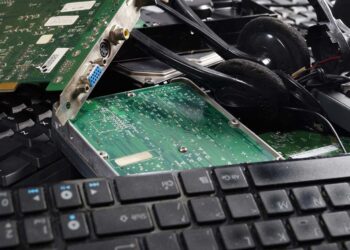
After extended service phases out in 2027-2028, retired laptops will help drive recovery of copper, aluminum and other metals. | Photo by Ivan Hafizov

These past few weekends, I found myself scrolling through Amazon’s refurbished‑laptop listings—a habit I use to gauge what’s moving through the secondary market. Page after page told the same story: hundreds of Dell Latitudes, HP EliteBooks and Lenovo ThinkPads advertised with the familiar Windows 10 Pro badge.

That sight raised a harder question: Why, in late 2025, are refurbishers still pre‑loading an operating system that has officially reached end‑of‑support and Amazon listing them despite Microsoft ending its support to that version of its operating system?

After speaking with a half dozen authorized refurbishers, I was told that the dominance of Windows 10 in refurbished channels is a matter of necessity. Most laptops entering resale today come from enterprise refresh cycles between 2019 and 2023, built around Intel’s 8th‑ to 10th‑generation processors that either lack TPM 2.0 or fail other firmware thresholds required by Windows 11. 

For refurbishers, reinstalling Windows 10 Pro remains the most seamless, compliant option. It activates instantly under Microsoft’s existing refurbishment licensing, avoids compatibility problems, and delivers a predictable customer experience.

Microsoft’s Extended Security Updates program, which allows paid patching through 2028, effectively insulates resale inventory for the next few years and keeps devices affordable for risk‑averse buyers. 

But while Windows 10 models still dominate refurbished inventory, that runway isn’t endless. As Extended Security Updates taper off between 2027 and 2028, Windows 10 devices will lose their compliance status, forcing a mass phase‑out. IDC and Gartner model roughly 500 million active business PCs worldwide, and an estimated 35-40% of them fail Windows 11 requirements. The eventual turnover could exceed 320 million units—a wave that will test both refurbishment capacity and end‑of‑life logistics. 

While metal recovery and “urban mining” firms will eventually process that hardware, the present story sits firmly in the resale economy. From now through 2026, refurbishers are effectively managing a software afterlife, extending productivity for millions of systems the OEM no longer supports.

What this means for refurbishers and ITAD providers

For ITAD and refurbishment companies, the next couple of years represent a rare moment of equilibrium: abundant supply, steady consumer interest and an operating system that still carries both trust and functionality. Firms involved in the sector should optimize imaging workflows, transparency in licensing and sustainability‑compliant remarketing to maximize value before the inevitable decline begins. And partnerships with educational distributors and circular‑procurement platforms will matter far more than downstream scrap flows.

Later on, the eventual recycling surge will carry measurable economic and environmental weight—but that stage still sits a few years downstream. Today’s refurbishers are stretching Windows 10’s lifespan with remarkable success; eventually those same devices will become tomorrow’s feedstock for recovery and reuse. 

By the late 2020s, the refurbished inventory now fueling the Windows 10 market will be entering the back end of the value chain, feeding what the UN E‑Waste Monitor expects to become an 82 million ton global e-scrap stream by 2030. 

If captured efficiently, that transition could recirculate thousands of tons of copper, aluminum, silver and gold that would otherwise disperse into mixed waste. Analysts estimate only about 35% of the world’s e‑scrap currently reaches formal recycling channels; raising that rate even modestly could unlock several billion dollars in recoverable materials while cutting associated emissions and landfill risk.

Automation, robotics and AI sorting will define that next phase. The same digital precision that now allows refurbishers to wipe drives and verify COA licenses will soon guide disassembly lines capable of extracting high‑purity metals without manual teardown. 

In that sense, the eventual “urban mining” wave will not replace the Windows 10 refurbishment economy—it will evolve directly from it. The devices keeping the refurbished market alive today are also building tomorrow’s resource pipeline, proving that reuse and recovery are not separate stories, but consecutive chapters in the same circular‑hardware narrative.

Tags: Electronics
TweetShare
David Daoud

David Daoud

David Daoud is a contributor to Resource Recycling and E-Scrap News, covering IT asset disposition, electronics recycling, and circular IT governance. He is the founder of and current Principal Analyst at Compliance Standards LLC, where he conducts independent research and advisory work on ITAD markets, sustainability and ESG compliance, data security, and lifecycle risk management. Daoud has analyzed enterprise IT trends since the late 1990s and was among the first analysts to examine ITAD as a distinct market segment during his time at IDC. He advises operators, OEMs, and investment teams on regulatory, technology, and market developments affecting the electronics lifecycle.

Related Posts

Protected: How to perform chip harvesting

Protected: How to perform chip harvesting

byDan Wang, Toyoshima Green Tech
September 28, 2026

Chip harvesting has grown from a Taiwanese factory-floor workaround into a global business, but the U.S. is barely in the...

Cutting healthcare plastics could save $18B

Report provides path to reduce medical e-scrap

byPaul Lane
September 25, 2026

The European report found that circularity in medical devices is possible through several potential initiatives.

Bin to Better gets students involved in reuse, recycling

Bin to Better gets students involved in reuse, recycling

byPaul Lane
September 24, 2026

E-scrap among three focus areas for student-run, California-based environmental advocacy group.

E-scrap magnet recycling company scales up

Why only some rare-earth sources are economically viable

byDavid Daoud
September 24, 2026

Rare-earth recycling economics depend on several factors, and there is no single price or date that makes the process pencil...

Who should pay for lithium-ion battery fire damage?

byDavid Daoud
September 21, 2026

Fires continue to be a major threat to the recycling industry, even as states explore new policy solutions.

America’s critical-materials buildout has a feedstock problem

byDavid Daoud
September 18, 2026

As the US invests in critical-minerals capacity will facilities have enough material to process?

Load More
Next Post
Top 5 stories from October 2025

Top 5 stories from October 2025

2026 Buyers’ Guide

Equipment, services and technology suppliers serving the recycling industry.

Browse the Guide

More Posts

Recyclers reeling from NJ PCR extension

Recyclers reeling from NJ PCR extension

September 23, 2026
Oregon state capitol building with state flag and blue sky.

NAW appeals Oregon EPR ruling

September 25, 2026
Bin to Better gets students involved in reuse, recycling

Bin to Better gets students involved in reuse, recycling

September 24, 2026
Analysis: Undersupply of PCR is ‘stifling’ brand goals

US lawmakers urge protection of domestic RPET

September 25, 2026
Bipartisan reps introduce bill on recycling claims

House passes bill to ease lithium-ion battery storage rules

September 24, 2026
Calif. Governor Gavin Newsom at podium.

Newsom signs battery EPR expansion, vetoes SB 54 fund bill

September 24, 2026

Who should pay for lithium-ion battery fire damage?

September 21, 2026
US packaging is evolving. The recycling system isn’t ready

US packaging is evolving. The recycling system isn’t ready

September 16, 2026
Industry announcements for January 2026

Industry announcements for September 2026

August 31, 2026
Alpek closing Pennsylvania RPET plant

Alpek seizing on war-related opportunity 

July 27, 2026
Load More

About & Publications

About Us

Staff

Archive

Magazines

Work With Us

Advertise
Jobs
Contact
Terms and Privacy

Newsletters

Get the latest recycling news and analysis delivered to your inbox every week. Stay ahead on industry trends, policy updates, and insights from programs, processors, and innovators.

Subscribe

Welcome Back!

Login to your account below

Forgotten Password?

Retrieve your password

Please enter your username or email address to reset your password.

Log In

Add New Playlist

No Result
View All Result
  • The Latest
  • Analysis
  • Recycling
  • E-Scrap
  • Plastics
  • Policy Now
  • Conferences
    • E-Scrap Conference
    • Plastics Recycling Conference
    • Resource Recycling Conference
    • Textiles Recovery Summit
  • Magazines
  • About Us
  • Advertise
  • Archive
  • Jobs
  • Staff
Subscribe
This website uses cookies. By continuing to use this website you are giving consent to cookies being used. Visit our Privacy and Cookie Policy.