





Resource Recycling
  • The Latest
  • Analysis
    • All
    • Certification Scorecard
    • Industry Announcements
    • Opinion
    Rainforest

    Inside the Circle: What the rainforest can teach us about EPR

    Closeup of a printed circuitboard

    Hardware demand puts new focus on parts harvesting

    Rare look inside the world’s largest plastics recycler

    Mass balance matters: Why different rules can lead to different outcomes 

    Certification Scorecard — Week of June 1, 2026

    IT asset disposition and electronics recycling: Now and then

    $60 billion in AI servers will create an ITAD challenge

    The independent ITAD at a crossroads

    DMD acquires ITAD firm Lifespan, outlines acquisition strategy

  • Conferences
    • Resource Recycling Conference
    • Plastics Recycling Conference
    • E-Scrap: The Longevity Conference
    • Textiles Recovery Summit
  • Publications
    • E-Scrap News
    • Plastics Recycling Update
    • Policy Now
    • Resource Recycling
    • Other Topics
      • All Topics
      • Brand Owners
      • Critical Minerals
      • Glass
      • Grant Watch / RFPs
      • Markets
      • Organics
      • Packaging
      • Research
      • Technology
      • Textiles
Subscribe
No Result
View All Result
Resource Recycling
  • The Latest
  • Analysis
    • All
    • Certification Scorecard
    • Industry Announcements
    • Opinion
    Rainforest

    Inside the Circle: What the rainforest can teach us about EPR

    Closeup of a printed circuitboard

    Hardware demand puts new focus on parts harvesting

    Rare look inside the world’s largest plastics recycler

    Mass balance matters: Why different rules can lead to different outcomes 

    Certification Scorecard — Week of June 1, 2026

    IT asset disposition and electronics recycling: Now and then

    $60 billion in AI servers will create an ITAD challenge

    The independent ITAD at a crossroads

    DMD acquires ITAD firm Lifespan, outlines acquisition strategy

  • Conferences
    • Resource Recycling Conference
    • Plastics Recycling Conference
    • E-Scrap: The Longevity Conference
    • Textiles Recovery Summit
  • Publications
    • E-Scrap News
    • Plastics Recycling Update
    • Policy Now
    • Resource Recycling
    • Other Topics
      • All Topics
      • Brand Owners
      • Critical Minerals
      • Glass
      • Grant Watch / RFPs
      • Markets
      • Organics
      • Packaging
      • Research
      • Technology
      • Textiles
Subscribe
No Result
View All Result
Resource Recycling
No Result
View All Result
Home E-Scrap

Diversion Dynamics: Vape recycling needs policy to reach full charge

Stefanie ValenticbyStefanie Valentic
October 23, 2025
in E-Scrap
Diversion Dynamics: Vape recycling needs policy to reach full charge

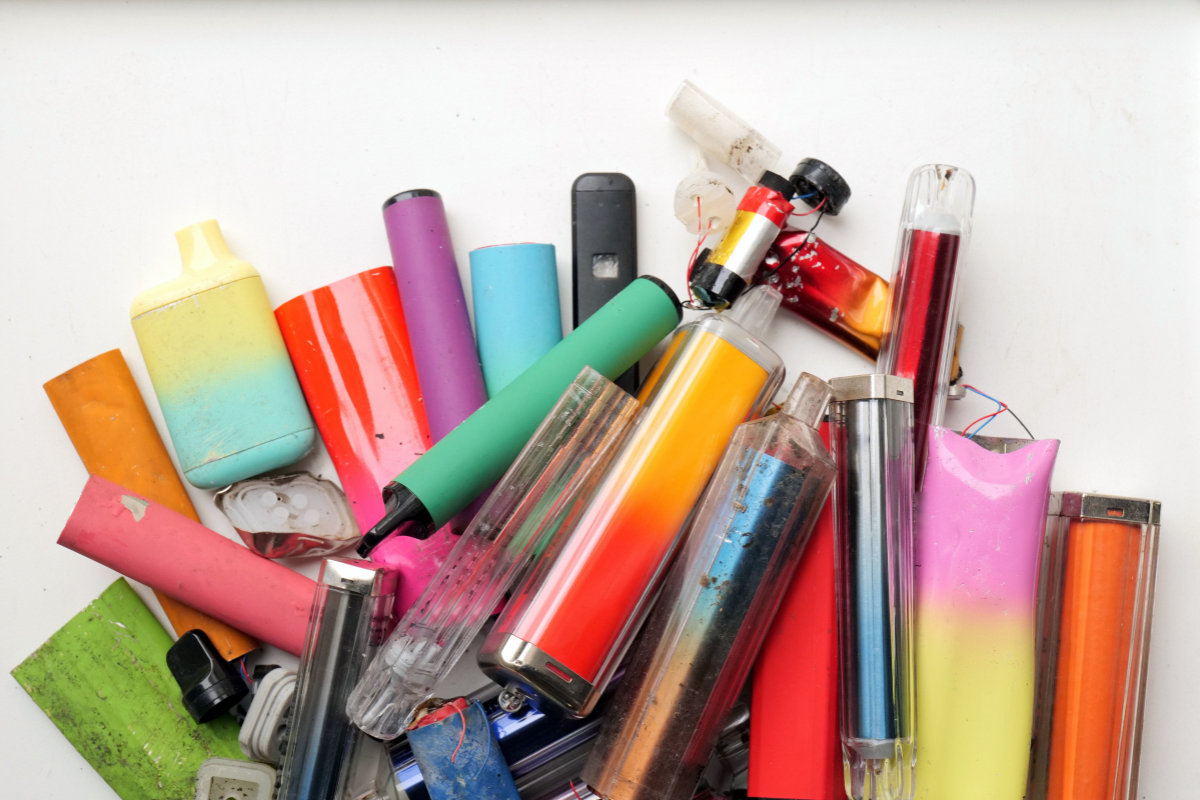
While legislators enact bans that aim to reduce vape waste, manufacturers are creating loopholes around the sale of disposable devices. | B.Robinson/Shutterstock

Editor’s Note: Diversion Dynamics is a monthly column exploring partnerships and policy that drive recycling.

I recently connected with Michael Duckworth, founder of Positive Energy Environmental Solutions, via video conference. Duckworth established the vape recycling company in 2023 after identifying a critical infrastructure gap for vape recycling in Nebraska and nationwide.

“Vapes are the worst thing that ever came to this earth and they’re here by the millions. Just in America we throw away 5.7 vapes every second, now we’re almost up to 6 vapes every second, every day of the year. 365, 24/7. That is insanity. And that’s just in the US and worldwide, we’re at 10 to 15 devices every second,” Duckworth said.

Battery-embedded vapes are classified as household hazardous waste under the federal Resource Conservation and Recovery Act. Contamination from nicotine, cannabis or other substances further complicates an already complex recycling process, compounding stringent regulatory requirements and creating barriers to both collection and processing.

We discussed how EPR policy is essential for establishing responsible collection systems for vapes embedded with lithium-ion batteries, which are predominantly incinerated. Improper disposal has contributed to a record increase in fires in curbside carts, refuse vehicles, transfer facilities, MRFs and landfills.

“We’ve got to use EPR to our advantage, so that way we can provide funding solutions for operators and for municipalities and government because it all breaks down to money, money, money,” Duckworth said. “Who’s paying for it? That’s the matter and with nicotine, specifically, there’s a lot of challenges with e-manifest reporting and regulatory hurdles that are costly and there is no solution right now.”

Duckworth referenced Nebraska’s recent passage of the state’s Safe Battery and Recycling Act, which regulates limited vapes and funds the development of a PRO as an emerging framework for addressing the escalating vape disposal crisis.

Regulatory complexities underscore why industry experts are calling for systemic policy solutions as the infrastructure to safely handle, transport and recycle vapes remains largely absent.

States target disposables

While some legislation exists regarding proper handling and disposal of vape products, categorizing them as hazardous, US state legislators are banning vapes on the basis that they are disposable and appeal to children. 

The FDA’s clamped down on e-liquid cartridges in February 2020 subsequently was the catalyst for the explosion of disposable vapes.

“Sales of disposable brands increased 196.2% by March 2023, according to the CDC Foundation. The FDA’s decision prohibited the sale of flavored pre-filled nicotine vape cartridges exemplified by popular brand JUUL, but didn’t mention disposable vapes,” stated Lucas Gutterman in a 2023 U.S. PIRG Education Fund report.

“This sin of omission created a gray market and by March sales of disposable products increased to 11.9 million units a month and have overtaken cartridges market share at 53% of vape sales,” he said.

Texas effectively banned most vapes and similar e-cigarette products beginning in September 2025 with the passage of SB 2024, 

The bill prohibits the promotion or sale of e-cigarettes or vapes that contain nicotine, THC, kratom, kava, alcohol, mushrooms or other liquid solutions. One of the most stringent measures in the US, SB 2024 targets Chinese-manufactured disposable vapes and those specifically designed to appeal to minors, with bright colors, fruity flavors and shapes like school pencils. Vapes made in the US or filled with liquids produced in the US are exempt.

“The bill bans vape pens that were manufactured in China. Unfortunately, Chinese vape pen manufacturers routinely produce products that are dangerous to human health and many times customers do not know what substances are in vape pens that were manufactured in China,” noted Senator Charles Perry in an analysis of the legislation.

Despite legislative action, product design loopholes are exposing weaknesses in how disposable vapes are defined and regulated.

Single-use ban drawbacks

Compounding the issue are disposable vapes versus those with a rechargeable battery port. Even if EPR or bans are in place, manufacturers have been adding a charging port, therefore making them rechargeable, but ultimately still single-use. Duckworth pointed to the UK, which implemented a single-use vape ban in June 2024 on products that are not rechargeable or refillable.

“Every single one of those manufacturers just came out with a device that has a USB C charging port. Now it’s not single-use. It’s still not refillable. It’s still an [all in one] AIO device, but it’s a loophole that makes it rechargeable. So, single-use vapes ban didn’t work. The problem is still there,” he said.

And where bans were enacted, the black market has prospered. A recent survey published by nicotine retailer Haypp indicated that despite the UK’s ban on single-use vapes, 63% of respondents said they were still vaping, with a quarter admitting they are buying vapes via black market transaction, largely imported from China. 

Charging forward

While bans create enforcement challenges and drive black market activity, EPR addresses the funding gap that municipalities, haulers and the industry face – who pays for the cleanup and proper disposal of vapes. And unlike bans, EPR creates financial incentives for manufacturers to design products that are easier and safer to recycle, which is crucial to bolster markets and infrastructure.

Yet even well-funded EPR programs will fail without accessible collection infrastructure, Duckworth emphasized.

“EPR doesn’t solve everybody’s problems. People think, Oh, if we have EPR and we have bans on these…Even with the producer responsibility that they have in place [in the UK], most of your retailers there, they don’t have collection systems in place because there’s no vape recyclers, there’s no services, there’s no systems, there’s no logistics management in place.”

He added, “You have to make it convenient for the consumer. If it’s not easy, they’re not going to do anything. The average person isn’t going to save their vapes and go out of their way to take it to their HHW or something along those lines. They’re just not going to.”


Tags: EPR
TweetShare
Stefanie Valentic

Stefanie Valentic

Stefanie Valentic is an award-winning journalist who has covered the waste and recycling industry for more than five years. Throughout her career, she has led editorial teams and served as a keynote speaker, moderator and panelist at numerous trade shows and conferences.

Related Posts

House resolution aims to make recyclability central to product design

NY EPR bill fails to advance after third try

byStefanie Valentic
June 8, 2026

This marks the third session in which the bill cleared the Senate only to stall in the Assembly.

Rainforest

Inside the Circle: What the rainforest can teach us about EPR

byBill Shireman
June 8, 2026

We have a lot to learn from jungles, particularly as we fight the thorny problem of plastic pollution.

CalRecycle withdraws proposed regs for SB 54

Oceana, NRDC, CAW sue CalRecycle over SB 54 regs

byStefanie Valentic
June 5, 2026

The groups allege that the new regulations have too many loopholes for packaging producers.

Rare look inside the world’s largest plastics recycler

Mass balance matters: Why different rules can lead to different outcomes 

bySarah Edwards, Eunomia
June 5, 2026

Mass balance is a critical piece of the recycling puzzle—and one that's important to get right.

Circular Materials to supply PlasCred chem recycling plant

Circular Materials to supply PlasCred chem recycling plant

byAntoinette Smith
June 4, 2026

The planned chemical recycling plant in Alberta, Canada, also has a five-year, fixed price offtake contract, ahead of reaching a...

In My Opinion: Comparing the nation’s first packaging EPR laws

What Maine’s vape EPR law means for recyclers

byStefanie Valentic
June 4, 2026

Maine is the first state to require vape manufacturers to fund end-of-life management for their products. Vape recycler Michael Duckworth...

Load More
Next Post
Analysis: copper set for new investment, recycling growth

Analysis: copper set for new investment, recycling growth

More Posts

Recycling industry addresses Beyond Plastics report

Recycling industry addresses Beyond Plastics report

May 26, 2026
Machinex

Longview mill tragedy raises broader questions for fiber, recycling sectors

May 29, 2026
Fire at an EMR recycling facility in Camden, New Jersey May 29, 2026.

EMR faces shutdown calls after numerous fires

June 2, 2026
The independent ITAD at a crossroads

DMD acquires ITAD firm Lifespan, outlines acquisition strategy

June 2, 2026
IT asset disposition and electronics recycling: Now and then

$60 billion in AI servers will create an ITAD challenge

June 3, 2026
War, not demand driving polymer pricing

War, not demand driving polymer pricing

June 2, 2026
BASF, Encina expand circular feedstock partnership

BASF, Encina expand circular feedstock partnership

June 3, 2026
Our top stories from June 2021

Colorado advances EV battery EPR law

June 3, 2026
In My Opinion: Comparing the nation’s first packaging EPR laws

What Maine’s vape EPR law means for recyclers

June 4, 2026
California extends compostable labeling law

California bills crack down on false recycling, compostable claims

May 29, 2026
Load More

About & Publications

About Us

Staff

Archive

Magazine

Work With Us

Advertise
Jobs
Contact
Terms and Privacy

Newsletter

Get the latest recycling news and analysis delivered to your inbox every week. Stay ahead on industry trends, policy updates, and insights from programs, processors, and innovators.

Subscribe

Welcome Back!

Login to your account below

Forgotten Password?

Retrieve your password

Please enter your username or email address to reset your password.

Log In

Add New Playlist

No Result
View All Result
  • The Latest
  • Analysis
  • Recycling
  • E-Scrap
  • Plastics
  • Policy Now
  • Conferences
    • E-Scrap Conference
    • Plastics Recycling Conference
    • Resource Recycling Conference
    • Textiles Recovery Summit
  • Magazine
  • About Us
  • Advertise
  • Archive
  • Jobs
  • Staff
Subscribe
This website uses cookies. By continuing to use this website you are giving consent to cookies being used. Visit our Privacy and Cookie Policy.