





Resource Recycling
  • The Latest
  • Analysis
    • All
    • Certification Scorecard
    • Industry Announcements
    • Opinion
    Closeup of a printed circuitboard

    Can modular metals recovery challenge the smelter model?

    Intel sign outside of company building.

    What Intel’s blockbuster quarter means for ITAD

    Feds to develop repairable computer donation program

    The whitebox blind spot in PC recycling

    Analysis: circular design still elusive in laptops

    PC shipments grew in Q1, but questions remain

    The independent ITAD at a crossroads

    The independent ITAD at a crossroads

    Certification Scorecard — Week of April 20, 2026

    Apple Watch on product box.

    Wearables are coming and ITAD isn’t ready

    Certification Scorecard — Week of April 13, 2026

    EV Battery Pack - Sergii Chernov-Shutterstock

    Redwood, Rivian deal fuels US infrastructure plans

  • Conferences
  • Publications

    Other Topics

    Textiles
    Organics
    Packaging
    Glass
    Brand Owners

    Metals
    Technology
    Research
    Markets
    Grant Watch

    All Topics

Subscribe
No Result
View All Result
Resource Recycling
  • The Latest
  • Analysis
    • All
    • Certification Scorecard
    • Industry Announcements
    • Opinion
    Closeup of a printed circuitboard

    Can modular metals recovery challenge the smelter model?

    Intel sign outside of company building.

    What Intel’s blockbuster quarter means for ITAD

    Feds to develop repairable computer donation program

    The whitebox blind spot in PC recycling

    Analysis: circular design still elusive in laptops

    PC shipments grew in Q1, but questions remain

    The independent ITAD at a crossroads

    The independent ITAD at a crossroads

    Certification Scorecard — Week of April 20, 2026

    Apple Watch on product box.

    Wearables are coming and ITAD isn’t ready

    Certification Scorecard — Week of April 13, 2026

    EV Battery Pack - Sergii Chernov-Shutterstock

    Redwood, Rivian deal fuels US infrastructure plans

  • Conferences
  • Publications

    Other Topics

    Textiles
    Organics
    Packaging
    Glass
    Brand Owners

    Metals
    Technology
    Research
    Markets
    Grant Watch

    All Topics

Subscribe
No Result
View All Result
Resource Recycling
No Result
View All Result
Home E-Scrap

REACT aims to transform US e-scrap recycling

byKeith Loria
September 18, 2025
in E-Scrap
REACT aims to transform US e-scrap recycling
REACT, DOE E-SCRAP finalist from Intel-E-Waste, Sunnking, Penn State and NREL, uses heat- and chemical-free separation to produce high-value e-scrap streams, piloting in 2026. | Damrong Rattanapong / Shutterstock

A project spearheaded by Intel-E-Waste is aiming to reshape US e-scrap recycling by delivering cleaner, higher-value diverse product streams and reducing dependence on overseas smelters.

REACT (Recycling E-Scrap with Adaptive Capacity Technology) is a collaboration between Intel-E-Waste, Sunnking Sustainable Solutions, Pennsylvania State University and the National Renewable Energy Laboratory (NREL). The project was a finalist in the 2025 US Department of Energy E-SCRAP Prize, which earned the State College-based operation $50,000 in funding.

Mohammad Rezaee, associate professor of energy and mineral engineering at Penn State University, said REACT is low-cost, doesn’t use heat or chemicals, and is designed to match specific feedstock characteristics, throughput and product quality requirements of electronics recycling. 

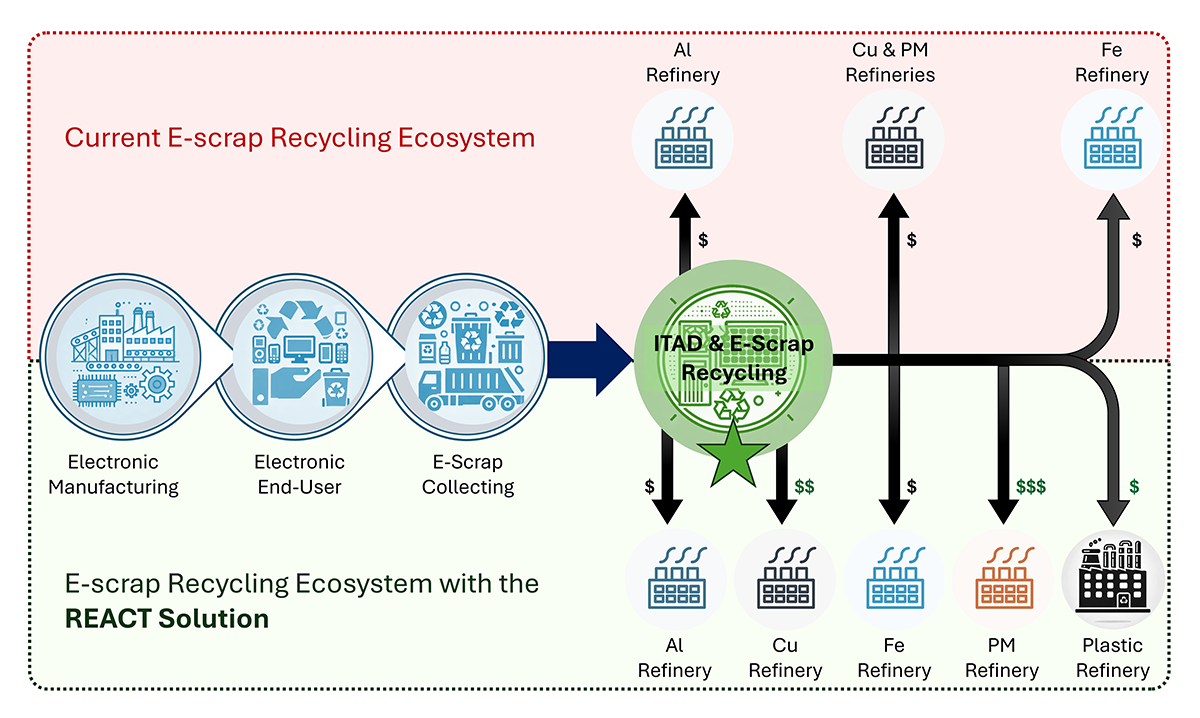
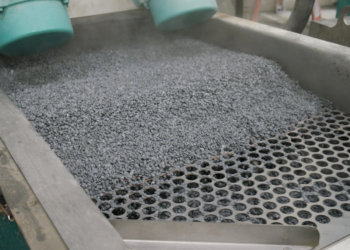
“By leveraging differences in mechanical and physical properties of materials, REACT selectively liberates and separates components into high-value product streams,” he told E-Scrap News. Unlike conventional e-scrap recycling, which primarily targets bulk ferrous and non-ferrous metals, REACT maximizes the recovery and grade of critical materials, including aluminum, copper and precious metals, while also recycling plastics, he added.

The technology also processes a wide range of particle sizes, including the often-overlooked under-10 mm precious metal–rich fraction, to help minimize material losses.

“This adaptive capacity makes REACT both a competitive and complementary solution to conventional methods,” Rezaee said. “It not only aligns with international regulations such as the Basel Convention but also diversifies and upgrades the value streams available to recyclers, strengthening revenue potential while reducing environmental impacts.”

Penn State drives the research and development of the REACT technology. Under Rezaee’s direction, the university provides expertise in mineral processing and recycling, supported by advanced laboratory and pilot facilities. 

Sunnking Sustainable Solutions has been a major asset by supplying real-world feedstock, process data, operational expertise and continuous feedback on economics and logistics, Rezaee said. 

Intel-E-Waste oversees process design, scale-up and commercialization planning. Engagement with NREL further strengthens the project by providing technoeconomic analysis and life-cycle assessment for data-driven optimization, economic viability and sustainability.

“Together, these roles bridge innovation with practical deployment, ensuring REACT is both scientifically sound and commercially viable,” Rezaee said.

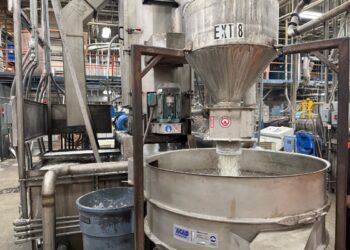
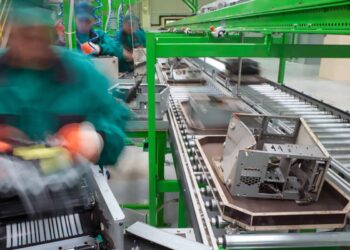
Courtesy REACT

REACT was first developed for recovering critical materials from discarded printed circuit boards and was expanded and validated for broader e-scrap in collaboration with industry partners during Phase I of the E-SCRAP Prize. 

One challenge for the project is the variability of e-scrap feedstocks, which requires consistent delivery of high recovery and grade across very different material streams. Penn State researchers are addressing this by refining adaptive process controls and validating performance with diverse feedstock provided by industry partners. 

“Another challenge lies in logistics, since collection and transport of e-scrap remain fragmented across the US, making it essential to design REACT as a modular system that can integrate directly into existing facilities with minimal disruption,” Rezaee said. “On the regulatory side, landfill policies vary widely—nearly half of US states do not regulate the landfilling of end-of-life electronics. Our goal is to make REACT cost-competitive with landfill disposal so that recyclers have a viable economic alternative.”

“We have demonstrated consistent separation of metals, plastics, glass and critical materials at high recovery and grade levels,” Rezaee said. The project partners now are preparing for prototyping and pilot-scale demonstrations with industry partners to move toward commercial deployment.

“Our immediate goal is to build and demonstrate a prototype system through integration at Sunnking Sustainable Solutions and other partner facilities,” Rezaee said. “These demonstrations will allow us to refine process efficiency, validate recovery and grade of the product streams, confirm technoeconomic and life-cycle analysis and prove cost competitiveness at pilot scale.”

Following that phase, the team would scale up REACT into a turnkey recycling line that recyclers can adopt with minimal retrofit. 

The team expects REACT to be ready for early integration by the end of 2026. In the near term, its prototypes will be demonstrated at partner facilities to validate efficiency, cost competitiveness and operational fit. 

“Because REACT is heat- and chemical-free, it is designed to slot into existing recycling facilities with minimal permitting requirements,” Rezaee said. “This accelerates the path to adoption compared to conventional technologies. With support from industry partners and the DOE E-SCRAP Prize program, our goal is to make turnkey REACT modules commercially available in the next phase of development, positioning recyclers to respond quickly to the growing volumes of e-waste.”

Tags: Processors
TweetShare
Keith Loria

Keith Loria

Related Posts

Growth challenges drive M&A for packaging

Growth challenges drive M&A for packaging

byAntoinette Smith
April 20, 2026

Vertical integration can be one option for supply security or guaranteed demand, but comes with caveats, McKinsey consultants say.

Policy update: EPR, right to repair and more

TERRA expands certified e-scrap network to Ecuador

byScott Snowden
April 1, 2026

TERRA has added Vertmonde in Quito to its certified electronics recycling network, giving the organization a first member in Ecuador...

Greenway now takes e-scrap from Midwest businesses

Greenway now takes e-scrap from Midwest businesses

byScott Snowden
March 11, 2026

Chicago-based Greenway Metal Recycling ties the move to rising volumes of retired electronics and increasing compliance demands.

What the NAND flash crunch means for remarketing, refurbishment and residual values

What the NAND flash crunch means for remarketing, refurbishment and residual values

byDavid Daoud
February 26, 2026

AI infrastructure demand is consuming the world's flash memory supply. The secondary market and ITAD industry will feel the consequences.

PET bales stacked for recycling.

Evergreen closing RPET plants in Ohio, New York

byAntoinette Smith
February 24, 2026

The Ohio-based company attributed the closure to the unexpected actions of a lender even as Evergreen was in talks with...

WM opens new $90m MRF in south Florida 

WM opens new $90m MRF in south Florida 

byAntoinette Smith
February 23, 2026

The new facility is expected to process the most volume of recyclables in the hauler's MRF network.

Load More
Next Post
E-Scrap EPR round-up part 1: Hawaii

E-Scrap EPR round-up part 1: Hawaii

More Posts

Birch Plastics gets FDA green-light for post-industrial PP

LyondellBasell upgrade to PreZero assets on hold

April 23, 2026
EPR fees are a market signal. Here’s what they’re telling you.

Oregon DEQ flags 250 producers for RMA noncompliance

April 21, 2026
The independent ITAD at a crossroads

The independent ITAD at a crossroads

April 22, 2026

What Netflix’s ‘Plastic Detox’ gets wrong – and right

April 23, 2026

Google pilots reuse kits to extend device life

April 21, 2026
What is EPR and why it matters

What is EPR and why it matters

April 22, 2026
Earth Day

Happy Earth Day. Here’s how to celebrate

April 22, 2026
Growth challenges drive M&A for packaging

Growth challenges drive M&A for packaging

April 20, 2026
EPR fees are a market signal. Here’s what they’re telling you.

EPR fees are a market signal. Here’s what they’re telling you.

April 10, 2026
Prescription drug bottles

National Prescription Drug Take Back Day is Saturday

April 24, 2026
Load More

About & Publications

About Us

Staff

Archive

Magazine

Work With Us

Advertise
Jobs
Contact
Terms and Privacy

Newsletter

Get the latest recycling news and analysis delivered to your inbox every week. Stay ahead on industry trends, policy updates, and insights from programs, processors, and innovators.

Subscribe

Welcome Back!

Login to your account below

Forgotten Password?

Retrieve your password

Please enter your username or email address to reset your password.

Log In

Add New Playlist

No Result
View All Result
  • The Latest
  • Analysis
  • Recycling
  • E-Scrap
  • Plastics
  • Policy Now
  • Conferences
    • E-Scrap Conference
    • Plastics Recycling Conference
    • Resource Recycling Conference
    • Textiles Recovery Summit
  • Magazine
  • About Us
  • Advertise
  • Archive
  • Jobs
  • Staff
Subscribe
This website uses cookies. By continuing to use this website you are giving consent to cookies being used. Visit our Privacy and Cookie Policy.