







Resource Recycling
  • The Latest
  • Analysis
    • All
    • Certification Scorecard
    • Industry Announcements
    • Opinion
    Apple Watch on product box.

    Wearables are coming and ITAD isn’t ready

    Certification Scorecard — Week of April 13, 2026

    EV Battery Pack - Sergii Chernov-Shutterstock

    Redwood, Rivian deal fuels US infrastructure plans

    Bloom ESG and e-Stewards roll out critical metals metric

    Colorado regulators suggest mid-range EPR scenario

    Why collaboration on plastic waste still matters

    Battery recycler Ascend Elements files for bankruptcy

    Battery recycler Ascend Elements files for bankruptcy

    EPR fees are a market signal. Here’s what they’re telling you.

    EPR fees are a market signal. Here’s what they’re telling you.

    Wolframite ore, the primary ore of tungsten from Altai, Russia

    Tungsten scrap export controls draw industry attention

    Certification Scorecard — Week of April 6, 2026

  • Conferences
  • Publications

    Other Topics

    Textiles
    Organics
    Packaging
    Glass
    Brand Owners

    Metals
    Technology
    Research
    Markets
    Grant Watch

    All Topics

Subscribe
No Result
View All Result
Resource Recycling
  • The Latest
  • Analysis
    • All
    • Certification Scorecard
    • Industry Announcements
    • Opinion
    Apple Watch on product box.

    Wearables are coming and ITAD isn’t ready

    Certification Scorecard — Week of April 13, 2026

    EV Battery Pack - Sergii Chernov-Shutterstock

    Redwood, Rivian deal fuels US infrastructure plans

    Bloom ESG and e-Stewards roll out critical metals metric

    Colorado regulators suggest mid-range EPR scenario

    Why collaboration on plastic waste still matters

    Battery recycler Ascend Elements files for bankruptcy

    Battery recycler Ascend Elements files for bankruptcy

    EPR fees are a market signal. Here’s what they’re telling you.

    EPR fees are a market signal. Here’s what they’re telling you.

    Wolframite ore, the primary ore of tungsten from Altai, Russia

    Tungsten scrap export controls draw industry attention

    Certification Scorecard — Week of April 6, 2026

  • Conferences
  • Publications

    Other Topics

    Textiles
    Organics
    Packaging
    Glass
    Brand Owners

    Metals
    Technology
    Research
    Markets
    Grant Watch

    All Topics

Subscribe
No Result
View All Result
Resource Recycling
No Result
View All Result
Home E-Scrap

CDC offers tips to avoid e-scrap mercury exposure

Antoinette SmithbyAntoinette Smith
January 16, 2025
in E-Scrap
CDC offers tips to avoid e-scrap mercury exposure

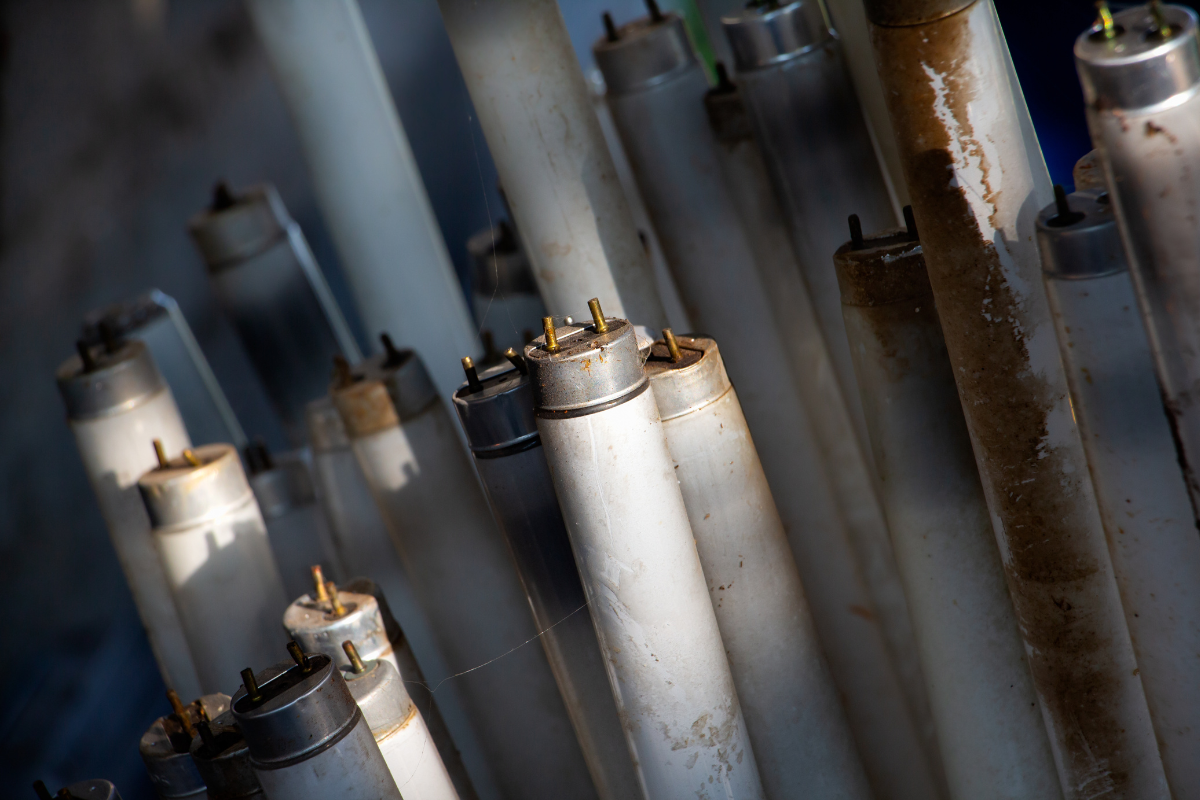
A recent report from a U.S. occupational safety unit found significant levels of mercury vapor throughout an Ohio e-scrap and lamp recycling facility, leading the team to provide recommendations for protecting worker health.

The federal Centers for Disease Control and Prevention’s National Institute for Occupational Safety and Health conducted a site visit in April 2023, after the employer expressed concerns about mercury exposure. Over two days, the CDC collected 171 air samples and tested the urine of all employees, according to the report. The facility wasn’t identified in the report.

Of the 14 urine samples, six had mercury levels above recommended exposure limits. In addition, five of six workers in lamp recycling areas had personal air exposure above the recommended levels. 

The team found that one worker with no direct involvement in lamp recycling had elevated urine mercury levels. “This finding suggests that contamination of nonproduction areas can affect nonproduction workers,” the report’s authors wrote. 

The study noted that elevated mercury levels correlated with worker tenure and primary language. The workers with elevated levels had been working there for a median length of eight months, four of them did not speak English, and five reported symptoms consistent with mercury toxicity. 

“These findings align with broader occupational health literature, which identifies language barriers and job tenure as factors influencing health and safety,” according to the study.

Mercury exposure can cause serious health issues including neurological problems and kidney damage. Symptoms include metallic or bitter taste, difficulty thinking and personality changes.  

As a result of crushing and processing lamps and other objects that may contain mercury, e-scrap workers face particular risk, the CDC said. Inhaling vapor and dust leads to rapid absorption into the bloodstream, and chronic exposure even at low levels can lead to cumulative effects. 

As a result of the study, the team provided several recommendations for mitigating mercury exposure: 

  • Installing ventilation over the conveyor in the lamp room and conducting maintenance of the facility’s heating, ventilation and air conditioning systems.
  • Implementing a workflow progressing from clean to dirty zones to prevent the spread of mercury to clean areas.
  • Providing training in workers’ preferred languages.
  • Standardizing use of recommended PPE.
  • Enforcing safety protocols.

“As the electronic waste recycling industry continues to grow, it is important for employers to evaluate mercury exposure and safeguard employees using a hierarchy of controls,” the authors wrote. “Health departments should consider monitoring occupational mercury exposure in recycling facilities, and clinicians should be aware of the potential for mercury toxicity among workers in these settings.”

Team identifies improper PPE use, language barriers

During the site visit, the CDC observed lamp room workers loading bulbs containing mercury onto a conveyor belt to be crushed. A sorting machine divided the bulbs into glass, metal and mercury dust. The facility also had a retort furnace to extract mercury from dust, but it was not in use at the time. Workers in the battery and ballast areas prepared metal and graphite electrodes to be shipped to other facilities for reuse or recycling.

The workers’ protective equipment included reusable respirators made of a flexible material with a tight seal and replaceable filter cartridges, the CDC noted. However, the investigators observed inconsistent or improper use of recommended PPE throughout the facility. For example, in the lamp room where respirators are mandatory, workers removed their respirators or wore them incorrectly, such as one employee using an N95 respirator with one of the straps cut off, “severely compromising the respirator’s seal.” 

The CDC team also observed only sporadic use of gloves and protective clothing. In follow-up interviews, some workers reported challenges with the fit and comfort of their equipment, while others cited a lack of understanding of the proper use and maintenance of equipment. 

Language barriers appeared to exacerbate these issues, as training and communication were not always provided in workers’ preferred languages, the team found. Similarly, the workers with the highest levels of mercury tended to be primarily Spanish-speaking.

Tags: Policy NowProcessors
TweetShare
Antoinette Smith

Antoinette Smith

Antoinette Smith has been at Resource Recycling Inc., since June 2024, after several years of covering commodity plastics and supply chains, with a special focus on economic impacts. She can be contacted at [email protected].

Related Posts

Oregon’s battery EPR bill officially charged for implementation

byStefanie Valentic
April 10, 2026

Oregon Governor Tina Kotek signed HB 4144 into law on April 7, setting into motion the mechanics for an extended...

AF&PA states disappointment over Oregon EPR decision

byStefanie Valentic
April 8, 2026

The American Forest & Paper Association is responding after a federal judge blocked the trade group's bid to intervene in...

MRF equipment firm Machinex wins patent fight with rival

Judge blocks four groups from joining Oregon Recycling Act injunction

byStefanie Valentic
April 7, 2026

A judge has shut the door on four industry groups seeking to join NAW's Oregon EPR injunction and clarified who's...

UBC stakeholders report on recycling progress

Trump’s Section 232 tariff overhaul provides mixed results for recycling industry

byStefanie Valentic
April 7, 2026

A sweeping overhaul of the Section 232 steel and aluminum derivatives tariff program took effect April 6, slashing duty rates...

Oregon’s Recycling Modernization Act faces injunction

Why EPR’s biggest obstacle might not be legislation

byStefanie Valentic
April 6, 2026

A miscommunication around the Oregon injunction has some of the industry operating on bad information, and it's raising bigger questions...

Minnesota State Capitol

Minnesota watches Oregon as EPR implementation advances

byStefanie Valentic
April 6, 2026

Minnesota's Packaging Waste and Cost Reduction Act passed in 2024 and is still in early implementation, making the infrastructure decisions...

Load More
Next Post

News from Republic Services, Recycle Utah and more

Leading the Charge in Safe Battery Recycling
Sponsored

Leading the Charge in Safe Battery Recycling

byThe Battery Network
April 13, 2026

We’re connecting people, brands, and communities through one nationwide network built to make battery recycling safer, simpler, and more accessible...

Read moreDetails

More Posts

EPR fees are a market signal. Here’s what they’re telling you.

EPR fees are a market signal. Here’s what they’re telling you.

April 10, 2026

Recycling Partnership CEO stepping down

April 15, 2026
Battery recycler Ascend Elements files for bankruptcy

Battery recycler Ascend Elements files for bankruptcy

April 13, 2026
Wolframite ore, the primary ore of tungsten from Altai, Russia

Tungsten scrap export controls draw industry attention

April 9, 2026

WM opens new $60m MRF in Indy

April 10, 2026
Industry group: Help us find the plastic bale volumes we need

PET bales sink further as other grades firm 

April 15, 2026

GFL acquires SECURE Waste for $6.4bn

April 13, 2026
Colorado regulators suggest mid-range EPR scenario

Why collaboration on plastic waste still matters

April 13, 2026
Solarcycle starts up Georgia recycling plant

S3399 signals a shift in how states are tackling solar panel waste

April 6, 2026

Amazon, DOE partner on critical materials recovery

April 13, 2026
Load More

About & Publications

About Us

Staff

Archive

Magazine

Work With Us

Advertise
Jobs
Contact
Terms and Privacy

Newsletter

Get the latest recycling news and analysis delivered to your inbox every week. Stay ahead on industry trends, policy updates, and insights from programs, processors, and innovators.

Subscribe

Welcome Back!

Login to your account below

Forgotten Password?

Retrieve your password

Please enter your username or email address to reset your password.

Log In

Add New Playlist

No Result
View All Result
  • The Latest
  • Analysis
  • Recycling
  • E-Scrap
  • Plastics
  • Policy Now
  • Conferences
    • E-Scrap Conference
    • Plastics Recycling Conference
    • Resource Recycling Conference
    • Textiles Recovery Summit
  • Magazine
  • About Us
  • Advertise
  • Archive
  • Jobs
  • Staff
Subscribe
This website uses cookies. By continuing to use this website you are giving consent to cookies being used. Visit our Privacy and Cookie Policy.