





Resource Recycling
  • The Latest
  • Analysis
    • All
    • Certification Scorecard
    • Industry Announcements
    • Opinion
    Unlocking the power of source reduction in US EPR

    Unlocking the power of source reduction in US EPR

    Following petition, Microsoft extends Windows 10 support

    Windows AI Recall is pushing data destruction upstream

    Certification Scorecard — Week of April 27, 2026

    Five trends shaping PCR packaging to 2031

    Intel sign on company building with blue sky and trees.

    Intel boosts margins by selling what it used to scrap

    Our top stories from April 2022

    Peters-Michaud named CEO, Houghton chair of Sage Sustainable Electronics

  • Conferences
    • Resource Recycling Conference
    • Plastics Recycling Conference
    • E-Scrap: The Longevity Conference
    • Textiles Recovery Summit
  • Publications
    • E-Scrap News
    • Plastics Recycling Update
    • Policy Now
    • Resource Recycling
    • Other Topics
      • Brand Owners
      • Critical Minerals
      • Glass
      • Grant Watch
      • Markets
      • Organics
      • Packaging
      • Research
      • Technology
      • Textiles
      • All Topics
Subscribe
No Result
View All Result
Resource Recycling
  • The Latest
  • Analysis
    • All
    • Certification Scorecard
    • Industry Announcements
    • Opinion
    Unlocking the power of source reduction in US EPR

    Unlocking the power of source reduction in US EPR

    Following petition, Microsoft extends Windows 10 support

    Windows AI Recall is pushing data destruction upstream

    Certification Scorecard — Week of April 27, 2026

    Five trends shaping PCR packaging to 2031

    Intel sign on company building with blue sky and trees.

    Intel boosts margins by selling what it used to scrap

    Our top stories from April 2022

    Peters-Michaud named CEO, Houghton chair of Sage Sustainable Electronics

  • Conferences
    • Resource Recycling Conference
    • Plastics Recycling Conference
    • E-Scrap: The Longevity Conference
    • Textiles Recovery Summit
  • Publications
    • E-Scrap News
    • Plastics Recycling Update
    • Policy Now
    • Resource Recycling
    • Other Topics
      • Brand Owners
      • Critical Minerals
      • Glass
      • Grant Watch
      • Markets
      • Organics
      • Packaging
      • Research
      • Technology
      • Textiles
      • All Topics
Subscribe
No Result
View All Result
Resource Recycling
No Result
View All Result
Home E-Scrap

Survey shows 18% drop in unused household devices

Marissa HeffernanbyMarissa Heffernan
April 28, 2022
in E-Scrap
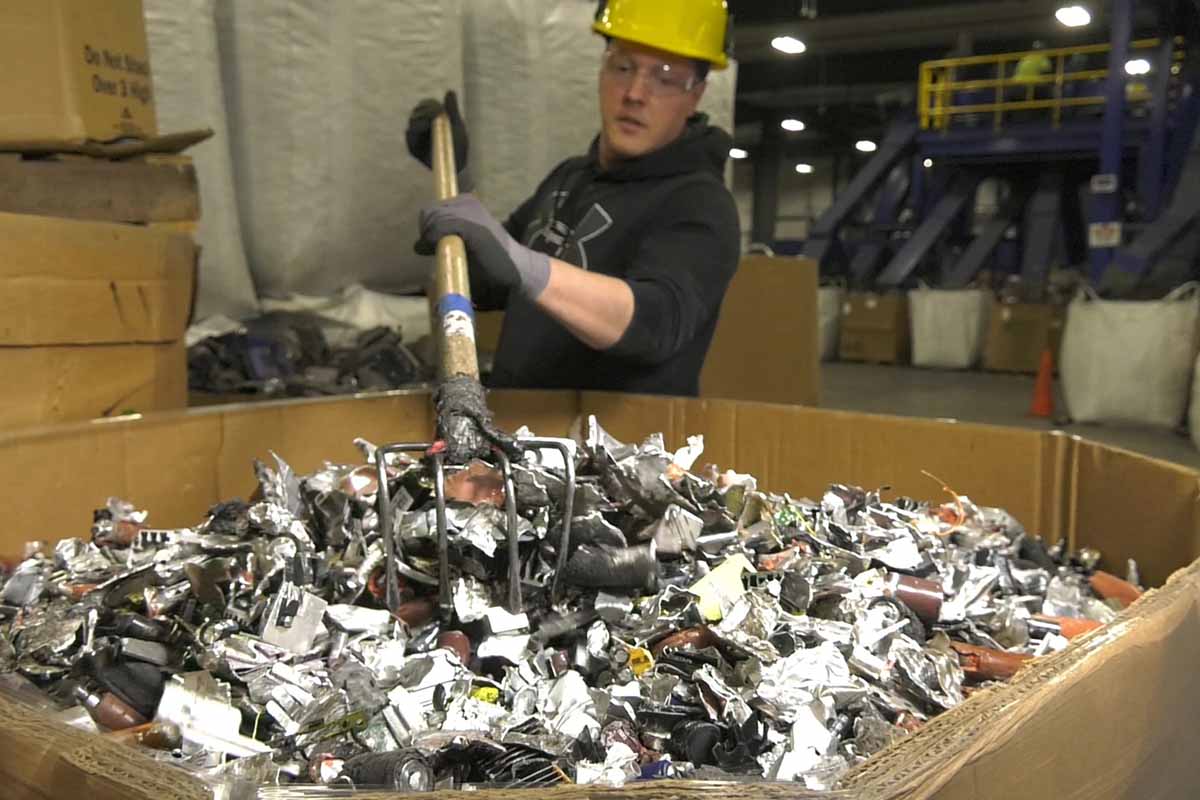
Worker at an e-scrap facility raking shredded material.

Fewer devices were sitting unused in Wisconsin homes in 2021 than three years prior, a report found.

The Wisconsin Department of Natural Resources’ (DNR) latest survey revealed the change, compared with the last survey taken in 2018, but the report said many residents still face barriers to recycling electronics.

According to a press release, of the estimated 25.2 million devices in Wisconsin households, 7.6 million devices were not in use, which was about 17% of TVs, 26% of computers and 44% of cellphones in the state. 

That number of unused devices was an 18% decrease from the estimated 9.3 million unused devices reported in 2018. 

“We were really pleased to see that fewer households were storing unwanted electronics,” Sarah Murray, DNR E-Cycle Wisconsin coordinator, said in the press release. “But a lot of us still have old cell phones, computers and TVs in drawers, closets and basements. Now is a good time to look for options, since more collection events are hosted in the spring and summer.” 

The 2021 survey was conducted from April through July and had a response rate of 48%. It was mailed to 2,000 randomly selected households. 

According to the survey, 49% of responding households said they stored unwanted cell phones, while 2% said they put them in the trash, an action against the state ban. The remaining 49% recycled or repurposed them by selling them or giving them away. 

And 56% of households also stored unwanted computers. About 1% trashed a computer, the survey said, and the remaining 42% recycled or repurposed them. 

Roughy 60% of people recycled or reused TVs, while 37% stored them and 3% trashed them.

“The 7.6 million devices sitting unused in homes reinforces the importance of helping residents find responsible reuse or recycling options,” the report said. “In total, 63% of respondents had at least one unused TV, computer or cellphone in their homes.”

Overall, about 29% of respondents said they had been unable to recycle electronics despite wanting to do so. Of that 29%, the most common reason people cited for not recycling was not knowing where or how to recycle (38%), though many also listed cost as a barrier (20%) and a lack of convenient locations (18%). Other barriers were concerns about data security (14%), not having a way to transport the item to the recycling location (4%) and other concerns (6%). 

However, the 2021 survey showed an increased awareness of Wisconsin’s electronics disposal ban and E-Cycle Wisconsin program, the report said, “perhaps due to increased outreach efforts.” 

“Receiving information about electronics recycling during the previous 12 months was the biggest factor influencing whether someone was aware of where to recycle electronics,” the report said. “The top five places respondents had heard about electronics recycling were from their communities, by word of mouth, social media, from an electronics retailer and in a news story.”

Respondents least likely to know where to recycle electronics included renters, respondents aged 18 to 49, residents of southeastern Wisconsin and women, the survey found. 

The amount of people not willing to pay anything to recycle electronics has declined over time. In 2021, 32% said they were willing to pay up to $5 per item, 21% were willing to pay $6 to $10 per item and 22% were willing to pay more than $10 per item. About 25% of people said they were not willing to pay anything to recycle. 

“This is notable because nearly all E-Cycle Wisconsin collectors charge for TVs, and many charge more than $20,” the report said. “It suggests collectors, recyclers and manufacturers may have difficulty motivating many residents to recycle TVs if fees remain high.”

In the press release, Murray noted that “responsible electronics recycling has a cost.”  

“Recyclers must properly manage the hazardous materials and lithium-ion batteries found in many electronics and protect data security,” Murray said. “Manufacturer funding covers some of that cost, but consumer fees help make up the difference as well as cover collection and transportation costs.”

Since Wisconsin’s electronics recycling law took effect in 2010, the DNR has conducted six statewide household recycling surveys. As of 2021, households and schools have recycled more than 350 million pounds of electronics through E-Cycle Wisconsin, a manufacturer-funded program administered by the DNR. 

The DNR recently launched an E-Cycle Wisconsin Electronics Collection Grant Program to provide small grants for collection sites or events in areas that lack consistent electronics recycling options. 

“The DNR will continue to look for ways to work with communities, share recycling information and support responsible recycling,” Murray said.

 

Tags: CollectionEPRResearch
TweetShare
Marissa Heffernan

Marissa Heffernan

Marissa Heffernan worked at Resource Recycling from January 2022 through June 2025, first as staff reporter and then as associate editor. Marissa Heffernan started working for Resource Recycling in January 2022 after spending several years as a reporter at a daily newspaper in Southwest Washington. After developing a special focus on recycling policy, they were also the editor of the monthly newsletter Policy Now.

Related Posts

Unlocking the power of source reduction in US EPR

Unlocking the power of source reduction in US EPR

byMichael Wassermanand1 others
May 1, 2026

EPR is evolving to include mechanisms to encourage reuse and promote design changes to enable recycling and reduce the amount...

WM: Upgrades temporarily slow tons recovered

WM Q1 volumes rise despite headwinds

byStefanie Valentic
April 30, 2026

WM posted Q1 2026 revenue of $6.23 billion and free cash flow of $920 million as recycling automation and renewable...

Prescription drug bottles

National Prescription Drug Take Back Day is Saturday

byBrian Clark Howard
April 24, 2026

The federal government is urging people to properly dispose of their unwanted medications to protect human health and the water...

Circular Services opens $61m MRF in North Texas

byStefanie Valentic
April 23, 2026

The Dallas Metroplex has a new $61 million MRF. Circular Services launched operations at the 120,000-square-foot facility this week. Construction...

What Netflix’s ‘Plastic Detox’ gets wrong – and right

byKeith Loria
April 23, 2026

Advocates are excited about the attention brought on plastics by the documentary, but scientists say more nuance is needed.

What is EPR and why it matters

What is EPR and why it matters

byScott Snowden
April 22, 2026

Extended producer responsibility is reshaping recycling by shifting costs to manufacturers and driving changes in product design, repairability and end-of-life...

Load More
Next Post
Call2Recycle one drum grouping

Service aims to reduce labor costs of scrap battery handling

More Posts

What Netflix’s ‘Plastic Detox’ gets wrong – and right

April 23, 2026
EPR fees are a market signal. Here’s what they’re telling you.

Oregon DEQ flags 250 producers for RMA noncompliance

April 21, 2026
Birch Plastics gets FDA green-light for post-industrial PP

LyondellBasell upgrade to PreZero assets on hold

April 23, 2026
Intel sign on company building with blue sky and trees.

Intel boosts margins by selling what it used to scrap

April 29, 2026

PCA keeping focus on virgin fiber products

April 27, 2026
Intel sign outside of company building.

What Intel’s blockbuster quarter means for ITAD

April 27, 2026
Float-sink technology at the Quantum Lifecycle Partners facility in Toronto, Canada enables the processing of e-plastics.

E-plastics recovery line opens in Canada

April 28, 2026
Our top stories from April 2022

Peters-Michaud named CEO, Houghton chair of Sage Sustainable Electronics

April 28, 2026
Dow touts US PE advantage amid Iran war

Dow touts US PE advantage amid Iran war

April 24, 2026
Plastic Ingenuity to use PureCycle PP for coffee lids

Plastic Ingenuity to use PureCycle PP for coffee lids

April 30, 2026
Load More

About & Publications

About Us

Staff

Archive

Magazine

Work With Us

Advertise
Jobs
Contact
Terms and Privacy

Newsletter

Get the latest recycling news and analysis delivered to your inbox every week. Stay ahead on industry trends, policy updates, and insights from programs, processors, and innovators.

Subscribe

Welcome Back!

Login to your account below

Forgotten Password?

Retrieve your password

Please enter your username or email address to reset your password.

Log In

Add New Playlist

No Result
View All Result
  • The Latest
  • Analysis
  • Recycling
  • E-Scrap
  • Plastics
  • Policy Now
  • Conferences
    • E-Scrap Conference
    • Plastics Recycling Conference
    • Resource Recycling Conference
    • Textiles Recovery Summit
  • Magazine
  • About Us
  • Advertise
  • Archive
  • Jobs
  • Staff
Subscribe
This website uses cookies. By continuing to use this website you are giving consent to cookies being used. Visit our Privacy and Cookie Policy.