




Resource Recycling
  • The Latest
  • Analysis
    • All
    • Certification Scorecard
    • Industry Announcements
    • Opinion
    Closeup of a printed circuitboard

    Can modular metals recovery challenge the smelter model?

    Intel sign outside of company building.

    What Intel’s blockbuster quarter means for ITAD

    Feds to develop repairable computer donation program

    The whitebox blind spot in PC recycling

    Analysis: circular design still elusive in laptops

    PC shipments grew in Q1, but questions remain

    The independent ITAD at a crossroads

    The independent ITAD at a crossroads

    Certification Scorecard — Week of April 20, 2026

    Apple Watch on product box.

    Wearables are coming and ITAD isn’t ready

    Certification Scorecard — Week of April 13, 2026

    EV Battery Pack - Sergii Chernov-Shutterstock

    Redwood, Rivian deal fuels US infrastructure plans

  • Conferences
  • Publications

    Other Topics

    Textiles
    Organics
    Packaging
    Glass
    Brand Owners

    Metals
    Technology
    Research
    Markets
    Grant Watch

    All Topics

Subscribe
No Result
View All Result
Resource Recycling
  • The Latest
  • Analysis
    • All
    • Certification Scorecard
    • Industry Announcements
    • Opinion
    Closeup of a printed circuitboard

    Can modular metals recovery challenge the smelter model?

    Intel sign outside of company building.

    What Intel’s blockbuster quarter means for ITAD

    Feds to develop repairable computer donation program

    The whitebox blind spot in PC recycling

    Analysis: circular design still elusive in laptops

    PC shipments grew in Q1, but questions remain

    The independent ITAD at a crossroads

    The independent ITAD at a crossroads

    Certification Scorecard — Week of April 20, 2026

    Apple Watch on product box.

    Wearables are coming and ITAD isn’t ready

    Certification Scorecard — Week of April 13, 2026

    EV Battery Pack - Sergii Chernov-Shutterstock

    Redwood, Rivian deal fuels US infrastructure plans

  • Conferences
  • Publications

    Other Topics

    Textiles
    Organics
    Packaging
    Glass
    Brand Owners

    Metals
    Technology
    Research
    Markets
    Grant Watch

    All Topics

Subscribe
No Result
View All Result
Resource Recycling
No Result
View All Result
Home E-Scrap

The factors behind one state’s collection site closures

byJared Paben
February 24, 2022
in E-Scrap
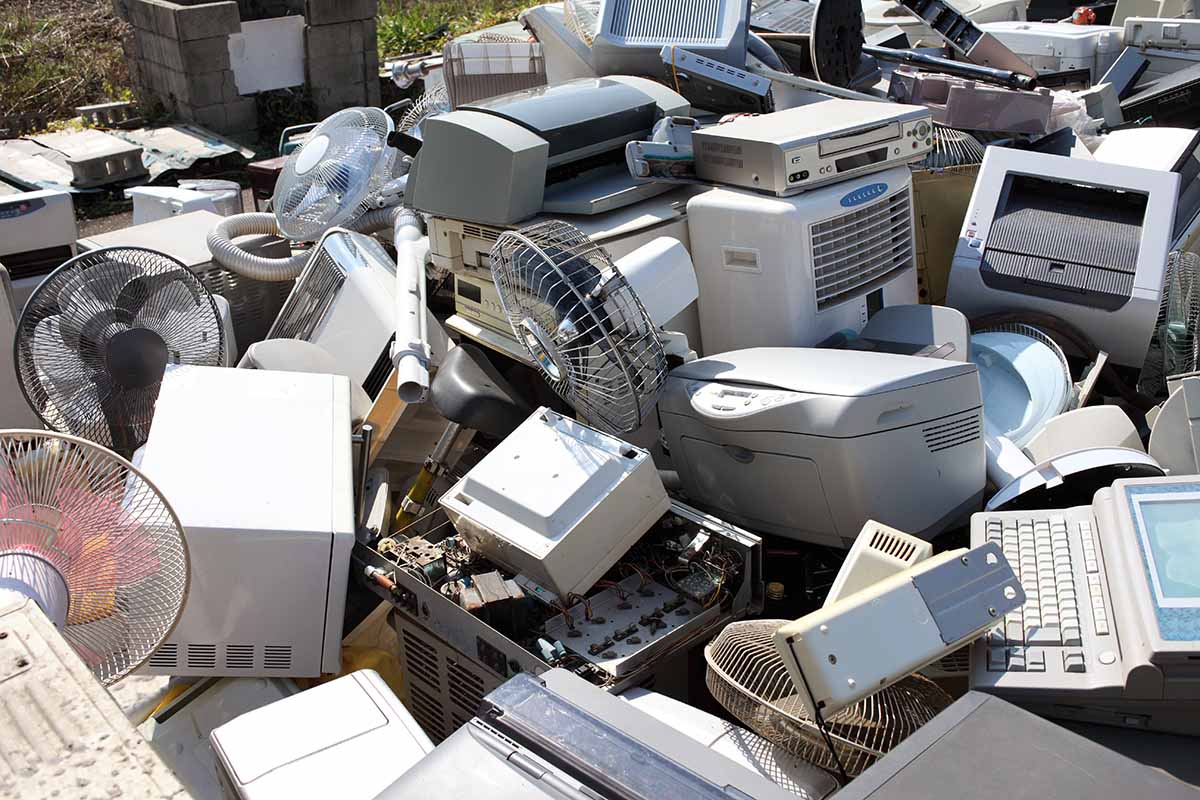
Electronics collected for recycling.
The executive director of the National Center for Electronics Recycling explains why Oregonians will lose several e-scrap collection sites. | akiyoko/Shutterstock

The loss of several e-scrap collection sites in Oregon is causing consternation in some communities, and now the legislature is mulling a bill meant to temporarily address the situation.

Oregon’s 13-year-old extended producer responsibility (EPR) law includes computers, monitors, TVs, printers and computer peripherals such as keyboards and mice. Under the law, OEMs can join either the State Contractor Program (SCP) or an industry-managed stewardship group charged with fulfilling manufacturers’ collection and recycling obligations.

Currently, the SCP is run by the National Center for Electronics Recycling (NCER), a nonprofit organization that is under contract with the state government. A second collection and recycling program is managed by Electronic Manufacturers Recycling Management Company (MRM), a stewardship group that operates in several states with EPR laws.

The SCP serves as a default group for OEMs that do not elect to join another approved group, such as MRM (Reverse Logistics Group Americas used to also run an Oregon program).

Recently, the SCP has decided to stop funding some collection sites, drawing critical local news headlines, including from News-Times on the central Oregon Coast and KOBI-TV 5 in Southern Oregon. Jason Linnell, executive director of NCER, explained to E-Scrap News the factors that went into the decision to stop paying for seven collection sites.

Targets (and budgets) fall faster than collections

The statewide collection targets that OEMs must achieve have been falling since 2015, when they hit a high of 30.5 million pounds. Last year, the target was 12.8 million pounds, and for 2022 the number fell to 11.5 million pounds, according to the Oregon Department of Environmental Quality (DEQ).

The decreases have been the product of mathematical calculations that take into consideration historical collection weights, product lightweighting, consumer purchasing and ownership behaviors, public awareness and COVID-19, according to the DEQ.

Even as the overall targets have decreased year after year, producer-funded collections have exceeded the targets, resulting in higher costs for manufacturers. In 2020, the statewide target was 13.75 million pounds, but the Oregon E-Cycles programs collected 14.33 million pounds. In 2021, the statewide target was 12.80 million pounds, but the program collected 14.07 million pounds.

Linnell explained that the over-collection was driven by the SCP, which collected 120% of its target in 2020 and 135% in 2021.

Meanwhile, the SCP’s budget is determined by multiplying the annual statewide pound target by the collective percentage of market share of OEMs represented by the SCP. That number has fallen. In 2021, the SCP was responsible for 38% of the total statewide target, or it was responsible for collecting 4.9 million pounds. This year, that dropped to 31% and about 3.5 million pounds.

The reason SCP’s collective percentage of market share dropped was because the SCP lost a couple of manufacturers in 2020 and 2021, and the biggest one had its individual market share percentage decrease, Linnell said.

As a result of the lower target – and the associated SCP budget – for 2022, the SCP needed to trim the collection network, Linnell said.

“If we didn’t make any changes to the collection network, SCP would collect well over half of the statewide target despite having less than one-third of the responsibility,” he said.

The manufacturers covered by the SCP were billed for the 3.5 million pounds last July. But they could be on the hook to pay additional sums next year if the budget is exceeded this year, Linnell said.

Going far over budget could make the SCP less appealing to some manufacturers than approved alternative programs, such as MRM’s.

Targeting sites for closure

Starting March 1, two collection sites in Southern Oregon, two in the Portland metropolitan area and three on the coast will no longer have SCP funding. The contracts were originally set to expire at the end of 2021, but SCP extended them until Feb. 28 to give MRM time to begin funding any of them, if it chooses, he said (Linnell said his understanding is MRM is looking at signing contracts to pick up a few of them).

The SCP had considered eliminating a third Southern Oregon site but reached a deal with the DEQ to keep funding it. “DEQ was able to apply funds previously paid by manufacturers into the Oregon E-Cycles program,” according to the DEQ. “This will enable the state contractor program to continue service uninterrupted in that rural community.”

The selection of the specific collection sites was chosen based partly on the need to maintain compliance with Oregon’s convenience standard, which mandates one collection site in each county and one in each city of at least 10,000 residents, he said. The SCP retains over 80 collection sites and supports over a dozen collection events across the Beaver State, Linnell said, exceeding the convenience requirements.

Regardless, state lawmakers are considering a bill, introduced by a Southern Oregon representative, that would boost the statewide collection target for this year, the YachatsNews.com reported.

The bill, House Bill 4158, increases the statewide collection target for April 1-Dec. 31, 2022 to 10.5 million pounds. The idea is that it better matches the target with how much e-scrap would likely be collected if no collection sites were jettisoned. At a hearing on Feb. 21, representatives of local governments and recycling companies weighed in in favor of the bill. A representative of the Consumer Technology Association urged lawmakers to work toward ensuring a stable collection system but argued against the approach used by HB 4158.

If the bill fails to advance during the 2022 short legislative session, DEQ officials said the situation has kickstarted conversations on how the state could update its program in the future, YachatsNews.com reported.

E-Scrap Conference and Trade Show - Sept. 19-21, New Orleans

Tags: EPR
TweetShare
Jared Paben

Jared Paben

Related Posts

What is EPR and why it matters

What is EPR and why it matters

byScott Snowden
April 22, 2026

Extended producer responsibility is reshaping recycling by shifting costs to manufacturers and driving changes in product design, repairability and end-of-life...

EPR fees are a market signal. Here’s what they’re telling you.

Oregon DEQ flags 250 producers for RMA noncompliance

byStefanie Valentic
April 21, 2026

Oregon DEQ released its first quarterly producer status list under the Recycling Modernization Act on April 9, flagging 250 companies...

Oregon’s battery EPR bill officially charged for implementation

byStefanie Valentic
April 10, 2026

Oregon Governor Tina Kotek signed HB 4144 into law on April 7, setting into motion the mechanics for an extended...

EPR fees are a market signal. Here’s what they’re telling you.

EPR fees are a market signal. Here’s what they’re telling you.

byChristine Yeager
April 10, 2026

EPR is not asking companies to be perfect, but rather to be honest about what their packaging costs the system,...

Bill to update New Jersey e-scrap program heads to governor

New Jersey recyclers talk EPR

byBrian Clark Howard
April 9, 2026

At the Association of New Jersey Recyclers’ spring meeting industry representatives discussed the state and future of the sector.

AF&PA states disappointment over Oregon EPR decision

byStefanie Valentic
April 8, 2026

The American Forest & Paper Association is responding after a federal judge blocked the trade group's bid to intervene in...

Load More
Next Post

Data Corner: A fuller picture of food loss and waste in America

More Posts

Birch Plastics gets FDA green-light for post-industrial PP

LyondellBasell upgrade to PreZero assets on hold

April 23, 2026
The independent ITAD at a crossroads

The independent ITAD at a crossroads

April 22, 2026

Google pilots reuse kits to extend device life

April 21, 2026

What Netflix’s ‘Plastic Detox’ gets wrong – and right

April 23, 2026
EPR fees are a market signal. Here’s what they’re telling you.

Oregon DEQ flags 250 producers for RMA noncompliance

April 21, 2026
What is EPR and why it matters

What is EPR and why it matters

April 22, 2026
Earth Day

Happy Earth Day. Here’s how to celebrate

April 22, 2026
Growth challenges drive M&A for packaging

Growth challenges drive M&A for packaging

April 20, 2026
Prescription drug bottles

National Prescription Drug Take Back Day is Saturday

April 24, 2026

Industrial sources drive rise in PVC recycling

April 13, 2026
Load More

About & Publications

About Us

Staff

Archive

Magazine

Work With Us

Advertise
Jobs
Contact
Terms and Privacy

Newsletter

Get the latest recycling news and analysis delivered to your inbox every week. Stay ahead on industry trends, policy updates, and insights from programs, processors, and innovators.

Subscribe

Welcome Back!

Login to your account below

Forgotten Password?

Retrieve your password

Please enter your username or email address to reset your password.

Log In

Add New Playlist

No Result
View All Result
  • The Latest
  • Analysis
  • Recycling
  • E-Scrap
  • Plastics
  • Policy Now
  • Conferences
    • E-Scrap Conference
    • Plastics Recycling Conference
    • Resource Recycling Conference
    • Textiles Recovery Summit
  • Magazine
  • About Us
  • Advertise
  • Archive
  • Jobs
  • Staff
Subscribe
This website uses cookies. By continuing to use this website you are giving consent to cookies being used. Visit our Privacy and Cookie Policy.