



Resource Recycling
  • The Latest
  • Analysis
    • All
    • Certification Scorecard
    • Industry Announcements
    • Opinion
    Closeup of a printed circuitboard

    Hardware demand puts new focus on parts harvesting

    Rare look inside the world’s largest plastics recycler

    Mass balance matters: Why different rules can lead to different outcomes 

    Certification Scorecard — Week of June 1, 2026

    IT asset disposition and electronics recycling: Now and then

    $60 billion in AI servers will create an ITAD challenge

    The independent ITAD at a crossroads

    DMD acquires ITAD firm Lifespan, outlines acquisition strategy

    Packaging policy is not one-size-fits-all

    Packaging policy is not one-size-fits-all

  • Conferences
    • Resource Recycling Conference
    • Plastics Recycling Conference
    • E-Scrap: The Longevity Conference
    • Textiles Recovery Summit
  • Publications
    • E-Scrap News
    • Plastics Recycling Update
    • Policy Now
    • Resource Recycling
    • Other Topics
      • All Topics
      • Brand Owners
      • Critical Minerals
      • Glass
      • Grant Watch / RFPs
      • Markets
      • Organics
      • Packaging
      • Research
      • Technology
      • Textiles
Subscribe
No Result
View All Result
Resource Recycling
  • The Latest
  • Analysis
    • All
    • Certification Scorecard
    • Industry Announcements
    • Opinion
    Closeup of a printed circuitboard

    Hardware demand puts new focus on parts harvesting

    Rare look inside the world’s largest plastics recycler

    Mass balance matters: Why different rules can lead to different outcomes 

    Certification Scorecard — Week of June 1, 2026

    IT asset disposition and electronics recycling: Now and then

    $60 billion in AI servers will create an ITAD challenge

    The independent ITAD at a crossroads

    DMD acquires ITAD firm Lifespan, outlines acquisition strategy

    Packaging policy is not one-size-fits-all

    Packaging policy is not one-size-fits-all

  • Conferences
    • Resource Recycling Conference
    • Plastics Recycling Conference
    • E-Scrap: The Longevity Conference
    • Textiles Recovery Summit
  • Publications
    • E-Scrap News
    • Plastics Recycling Update
    • Policy Now
    • Resource Recycling
    • Other Topics
      • All Topics
      • Brand Owners
      • Critical Minerals
      • Glass
      • Grant Watch / RFPs
      • Markets
      • Organics
      • Packaging
      • Research
      • Technology
      • Textiles
Subscribe
No Result
View All Result
Resource Recycling
No Result
View All Result
Home E-Scrap

Feds eye industry partners for e-scrap sorting tech

byJared Paben
September 16, 2021
in E-Scrap
Battery recycling equipment- Argonne National Labratory

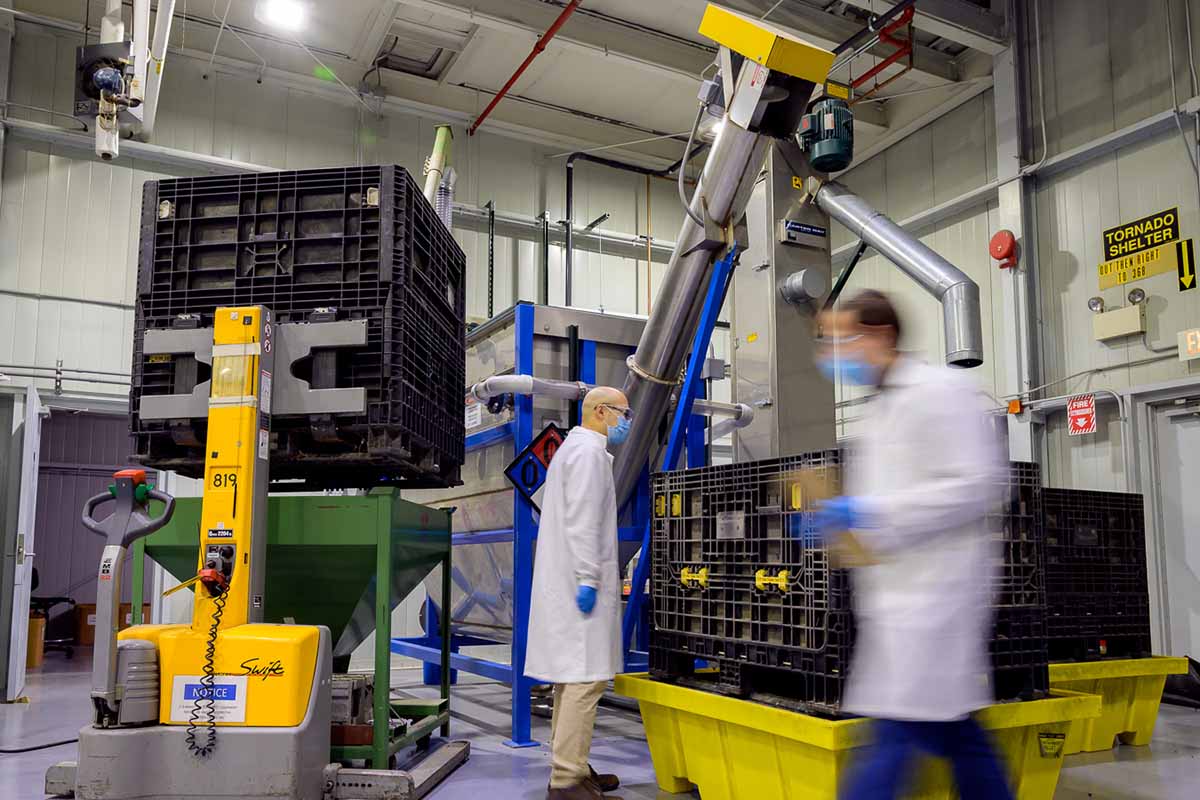
A materials separation module used for demonstrations at Argonne National Laboratory located outside of Chicago.

A materials separation module used for demonstrations at Argonne National Laboratory, located outside of Chicago. | Courtesy of Argonne National Laboratory

Scientists at a U.S. Department of Energy lab have developed unique tools that can be used to clean up shredded e-scrap, and they want to demonstrate them to e-scrap processors.

Argonne National Laboratory officials developed techniques that can be used to separate e-plastics polymers and clean up e-scrap metals streams. The wet-based separation processes allow materials to be sorted by density in float-sink tanks without using salts.

“Effectively, what we have is an opportunity where we have internal funding to demonstrate this technology for potential industry partners who are interested in licensing technology,” said Jeff Spangenberger, group leader for materials recycling at Argonne National Laboratory, which is near Chicago. “Ultimately, I’m looking for people, companies, that would like us to demonstrate our equipment to see if we can increase the value of their either waste streams or a product stream.”

In an interview with E-Scrap News, Spangenberger explained the processes were developed years ago as a way to recover materials from auto shredder residue. But the researchers also wanted to see if the separation techniques work with e-scrap and other streams.

A modified float-sink process

In a way, the technologies involve modifications to current float-sink techniques, which can be used to sort mixes of plastics, metals and other materials coming off the end of a shredding and separation line. In float-sink tanks, heavier materials sink to the bottom and lighter ones float.

A number of North American e-scrap processors and plastics reclaimers have installed float-sink systems to improve the quality of the plastics coming out of their shredders, as well as to recover metals that would otherwise be shipped out with mixed plastics. They include BoMET Polymer Solutions, eCycle Solutions, Owl Electronic Recycling, Plastic Recycling, Inc. and Universal Recycling Technologies. Many cited tighter export market specifications in their decision to invest in equipment.

Often, salts are used in the float-sink systems to increase the density of the water, which allows for separations that wouldn’t otherwise be possible in straight water. For example, ABS and HIPS, which are common e-plastics, sink alongside metals, glass and other heavier materials in unmodified water. But if enough salts are used, those styrenic polymers will float.

But using salts in those systems presents equipment corrosion concerns and wastewater treatment issues, Spangenberger noted.

Argonne National Lab scientists developed two wet-separation processes to eliminate the need for salts. One is called froth floatation, which has been used in mineral processing for years. Through that process, some materials are made to be hydrophobic and others hydrophilic. When air is introduced, the hydrophobic materials stick to the air bubbles and float to the surface, Spangenberger explained.

The other process is similar to elutriation, in which rushing air skims off lighter materials, but it uses a velocity of water to help separate materials.

Producing cleaner plastics and metals

Researchers have taken samples of shredded e-scrap through the sorting processes, which work well on low-grade scrap such as shredded printers, Spangenberger said. The techniques can be used to produce a clean fraction of styrenics (HIPS, ABS and PS) for sale, he noted. It can be used to remove metals that weren’t captured by magnets or eddy current separators and end up with the shredded plastics.

And the processes can be used to clean up metal fractions sold to smelters. For example, aggressive settings on eddy current separators can result in plastics and rubbers being ejected with nonferrous metals.

“This can help get some of the contaminants away from the metal stream so you don’t have to deal with that, and you’re not shipping all this junk,” Spangenberger noted.

Spangenberger said he wants to process samples of e-scrap from electronics recycling companies. He envisions running smaller samples to start – maybe 100 pounds – and then perhaps advancing to large-scale trials of 10,000 pounds, he said. He has funding available to perform large-scale demonstrations for two electronics recycling companies, he said.

The ultimate goal is to license the technology so it can be widely used to improve recycling, which recovers the energy that went into making the materials, he said. Interested e-scrap processors can email Spangenberger at [email protected].
 

IRT

Tags: Critical MineralsE-Plastics
TweetShare
Jared Paben

Jared Paben

Related Posts

Emerging technology holds the key to rare earth recovery

Emerging technology holds the key to rare earth recovery

byDan Wang, Toyoshima Green Tech
June 1, 2026

Toyoshima has developed a process that recovers critical materials at high purity in an efficient way.

Europe’s recyclers miss most of the critical materials

Europe’s recyclers miss most of the critical materials

byDavid Daoud
May 29, 2026

A major research project makes for sober reading for ITAD professionals.

Illinois expands battery recycling as lithium-ion fire concerns mount

Illinois expands battery recycling as lithium-ion fire concerns mount

byKeith Loria
May 27, 2026

The state is rolling out an expanded battery stewardship program, while fires continue to be a threat to recyclers nationwide.

EU recyclers make case for solvent-based methods

The electronics recycling industry has a plastics problem

byKen Thomas
May 26, 2026

Pretending otherwise is no longer a viable option, argues the president of Universal Recycling Technologies.

MP Materials breaks ground on rare earth magnet campus in North Texas

How critical mineral alliances aim to shape the future of e-scrap metals

byDavid Daoud
May 21, 2026

The Minerals Integrity & Resilience Alliance (MIRA) is part of a broader effort to strengthen transparency and resilience across critical...

Aurubis: Thefts involved scrap sample manipulation

Metals and electronics recyclers report growth

byDavid Daoud
May 20, 2026

Aurubis, Umicore and Sims show that downstream multimetal and electronics-related recovery businesses are, at least for now, operating in a...

Load More
Next Post

News from BHS-Sonthofen, Spectro Alloys and more

More Posts

Recycling industry addresses Beyond Plastics report

Recycling industry addresses Beyond Plastics report

May 26, 2026
Machinex

Longview mill tragedy raises broader questions for fiber, recycling sectors

May 29, 2026
Fire at an EMR recycling facility in Camden, New Jersey May 29, 2026.

EMR faces shutdown calls after numerous fires

June 2, 2026
The independent ITAD at a crossroads

DMD acquires ITAD firm Lifespan, outlines acquisition strategy

June 2, 2026
IT asset disposition and electronics recycling: Now and then

$60 billion in AI servers will create an ITAD challenge

June 3, 2026
War, not demand driving polymer pricing

War, not demand driving polymer pricing

June 2, 2026
Q1 containerboard exports drop by 19%

What SB 54 looks like from the packaging floor

June 1, 2026
BASF, Encina expand circular feedstock partnership

BASF, Encina expand circular feedstock partnership

June 3, 2026
California extends compostable labeling law

California bills crack down on false recycling, compostable claims

May 29, 2026
Our top stories from June 2021

Colorado advances EV battery EPR law

June 3, 2026
Load More

About & Publications

About Us

Staff

Archive

Magazine

Work With Us

Advertise
Jobs
Contact
Terms and Privacy

Newsletter

Get the latest recycling news and analysis delivered to your inbox every week. Stay ahead on industry trends, policy updates, and insights from programs, processors, and innovators.

Subscribe

Welcome Back!

Login to your account below

Forgotten Password?

Retrieve your password

Please enter your username or email address to reset your password.

Log In

Add New Playlist

No Result
View All Result
  • The Latest
  • Analysis
  • Recycling
  • E-Scrap
  • Plastics
  • Policy Now
  • Conferences
    • E-Scrap Conference
    • Plastics Recycling Conference
    • Resource Recycling Conference
    • Textiles Recovery Summit
  • Magazine
  • About Us
  • Advertise
  • Archive
  • Jobs
  • Staff
Subscribe
This website uses cookies. By continuing to use this website you are giving consent to cookies being used. Visit our Privacy and Cookie Policy.