





You’d be forgiven if you were misled by the headline of the press release announcing the most recent report from United Nations University and its partners on international e-scrap flows.
The title of the news release for the “Person in the Port Project” analysis is this: “Thousands of tonnes of e-waste is shipped illegally to Nigeria inside used vehicles.” That certainly makes it sound like there’s a major problem afoot in that corner of Africa.
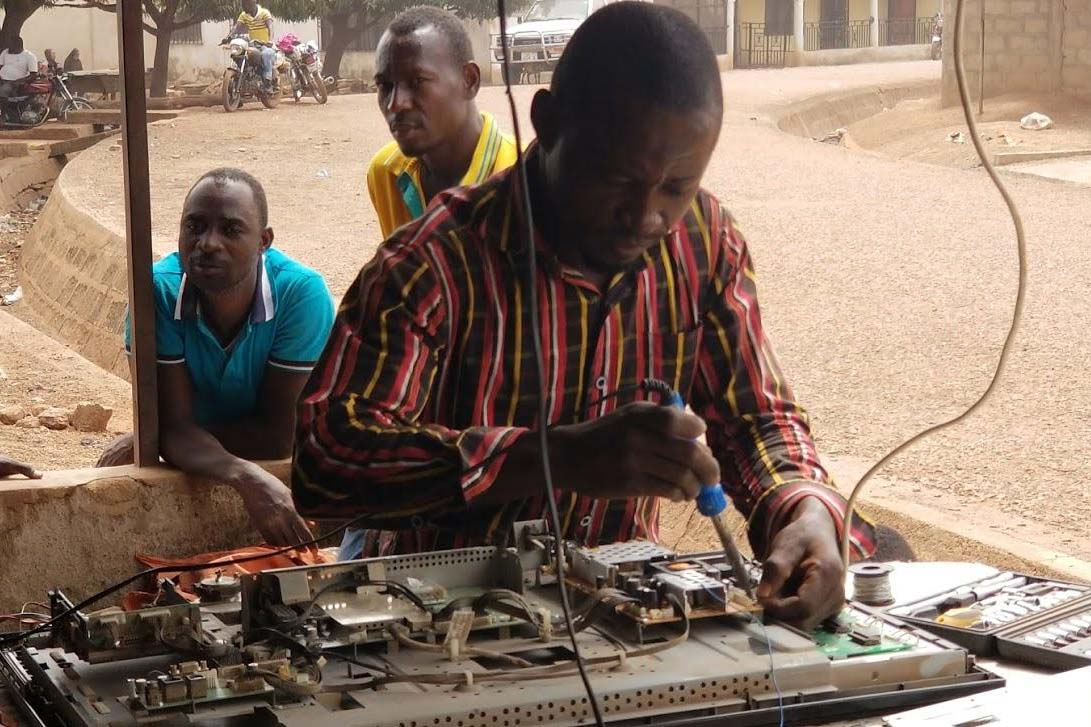
But readers who absorb the whole report will come away with a very different interpretation. The research tells us that just 25 percent of the used electronics imported into Nigeria are in need of repair and that Nigeria’s tech workers are the best on the planet at fixing them.
So what’s going on here? Why do we have a detailed report painting a picture of a market where things, in general, seem positive, and a headline that is so glaringly negative?
A better representation of realities in Africa
Let’s first focus on seven things the “Person in the Port” report gets right.
- It does the good work of explaining that material coming into Africa is controlled by Africa’s tech sector, not dumped by “sham” recyclers from the U.S. and Europe. Materials destined for export are purchased in the U.S., Europe and China by Africans, as opposed to being accepted for payment. There is no “avoided environmental cost” driver to pay for transport.
- It does not describe a single case of a container of used electronics being dumped on arrival in Africa, at scapegoat scrapyards like Agbogbloshie in Ghana.
- It adds another solid data point in the industry’s growing body of reliable statistics around the functionality of exported material. The report confirms 2011 and 2012 research by the Basel Convention Secretariat in Nigeria and Ghana that 75-80 percent of used devices shipped internationally require no repair at all.
- It points out that electronics that can’t be repaired do not represent a significant percentage of the devices at scrapyards. The reality in Africa is that most of the scrapped devices were imported decades earlier and generated by African consumers. African cities have had electricity, TV stations and other common elements of electronic infrastructure for more than 50 years.
- It underlines the fact that people repairing used electronics in Africa should not be considered “waste” or “informal” workers. Appliance repair jobs are sustainable, well-paid and well-respected in emerging markets.
- It acknowledges that African consumers prefer used solid state electronics from Europe over cheap new electronics from China.
- It demonstrates that metal recycling is alive and well in Africa and that material is not “lost” to the “circular economy.”
The report should be applauded for avoiding “poverty porn” – photos of kids posed on old TVs, for example – that marred previous efforts from United Nations University (UNU) and others to document realities of e-scrap processing and refurbishment in developing nations.
In almost every respect, this report conveys a fairer image of Africa’s tech sector.
False understanding of Basel Convention
But for all the excellent data the report provides, it also perpetuates a dangerous myth.
In the middle of the press release detailing the study is the following line: “Under the provisions of the Basel Convention, the export to and import of nonfunctional [untested electric and electronic equipment] into Nigeria are illegal.”
In reality, the Basel Convention (in Annex IX, B1110) explicitly says that used electronics exported for the purpose of repair are legal commodities, not waste. It defines as legal “[e]lectrical and electronic assemblies (including printed circuit boards, electronic components and wires) destined for direct reuse.”
It’s unfortunate that this one flaw in the report was used to impugn legal activity – and that this aspect was highlighted above all else in the press release headline.
Maybe we shouldn’t be surprised. In the “charitable industrial complex” (a phrase coined by Warren Buffett’s son, Peter), researchers and organizations need some sizzle to draw more support from funders and others. You can’t ask for money for enlightening research without a dark place in which to put it.
African members of Fair Trade Recycling have long grumbled about how pictures of kids in unsavory dumps are used to raise millions of dollars by NGOs and anti-export campaigns. But unlike UNICEF poster children, not a dime raised by the anti-export crowd goes to the pictured children or their families. The money is instead funneled to organizations based in the wealthy parts of the world.
Meanwhile, the ingenuity, social value, and wealth created by Africa’s Tech Sector are completely ignored. Africa’s geeks have, for decades, added value otherwise “lost” in repairable products. In so doing, they provided the critical mass of users without which investment in cell phone towers, internet cables, broadcast stations and more never could have been made in Africa.
Make the revision?
Africa isn’t perfect. But for too long, some recycling companies and NGOs have been reporting allegations as crimes, and offering false statistics as facts.
Robin Ingenthron
Again, this recent Nigeria report has come a long way to correct that dynamic. I just hope the groups behind it will print the real “international law” and include Annex IX, B1110, in a revised edition.
For a more nuanced and complete description of controversy in international trade, I recommend “Reassembling Rubbish“, a new book by Dr. Josh Lepawsky (MIT Press, 2018). The 28-page bibliography is all the research you need map to the truth about the secondhand market.
Top photo credit: Robin Ingenthron
Robin Ingenthron is CEO of Good Point Recycling and founder of WR3A.org (dba Fair Trade Recycling). He has a degree in international relations and was a former chief regulator at the Massachusetts Department of Environmental Protection. He can be contacted at robin@fairtraderecycling.org or through his blog.
The views and opinions expressed are those of the author and do not imply endorsement by Resource Recycling, Inc. If you have a subject you wish to cover in an op-ed, please send a short proposal to news@resource-recycling.com for consideration.