






This article originally appeared in the Summer 2020 issue of E-Scrap News. Subscribe today for access to all print content.
A well-attended town hall discussion on safety culture was among the highlights at the Canadian Association of Recycling Industries (CARI) annual convention in June 2019. Safety-related issues that attendees discussed included employee cannabis and cell phone use, the challenges of training new hires, and specific and unusual incidents that may seem impossible to anticipate.
To follow up and expand on the topics included in the town hall, CARI recently facilitated a dialogue involving CARI Chair Matt Zubick (who is also manager of Ontario-based scrap company John Zubick Ltd.) and Scott Wiggins, vice president of environmental, health and safety at the Institute of Scrap Recycling Industries.
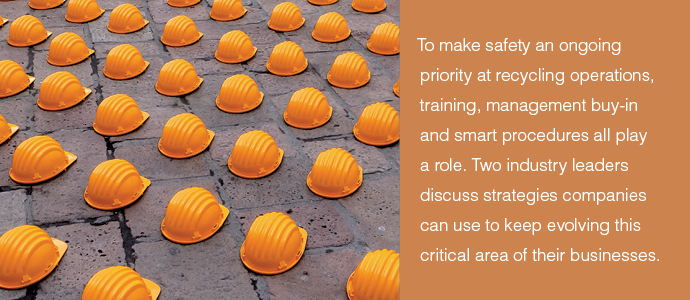
These leaders discussed the importance and fundamentals of building a safety culture within recycling companies.
CARI: What are the chief differences between simply maintaining safety and creating what we call a safety culture?
Zubick: Creating a safety culture is more about changing mindsets than about implementing policies. The trouble with our traditional view of maintaining safety is that safety is perceived as a separate external factor and is often an afterthought. When safety is not married to the natural flows of an organization, there is a risk of it being viewed as cumbersome, and a real chance of it affecting our efficiencies.
With a safety culture, we are changing the lens with which safety is being viewed. We are trying to combine safe operations with productivity in as natural a form as possible. Taking the time to find common-sense solutions that are safe and efficient makes it more likely that safe practices will be followed and helps our overall production.
Wiggins: The term “safety culture” has to do with how well an organization “lives” safety at every level. Another key difference between maintaining safety and creating a safety culture is that maintaining safety can be tied to fairly objective criteria, while a program to develop a safety culture is a continuous improvement process.
What are the key best practices to consider when creating a safety culture?
Zubick: The initiative needs to start at the top of the organization. Employees can sense when things are being implemented half-heartedly or without a sincere commitment from management. It is also very important that each situation is assessed individually to try and create a solution that fits with the natural operations of the company.
It’s important to ask your employees for ideas or solutions. To come up with common sense solutions, the employees who are performing the job should be part of the discussion. This generates better ideas and also cultivates some ownership for your employees.
Wiggins: In practice, the best indicator of where an organization stands will be its success in developing a “near-miss reporting culture.” There are several reasons for this, but the key driver is that reporting near misses is counterintuitive to an operations mindset. In other words, if near misses are being reported, it indicates that the major components for culture change – training, employee engagement, management commitment – are working.
The loading and unloading of materials in a recycling facility requires a particularly high level of attention. What are some of the ways that this part of operations can become even safer across the industry?
Zubick: A risk assessment should be the starting point because each situation is unique. Some standard precautions are that we want to control the flow of traffic, so that the risks to customers and employees are minimized. High-visibility clothing is also recommended so that employees contrast with the environment. I would highly encourage company owners to ask other people in their trade associations what works for them.
Wiggins: When loading or unloading materials, it is important that all personnel are away from the operation and at a safe distance from the truck, trailer or railcar. A safe distance will be determined by plant policy and the type of material that is being loaded or unloaded. The equipment operators, supervisors and other workers on the ground and in the area need to be made aware of these policies and held accountable.
ISRI’s mobile-equipment safety classes involve a hands-on “blind spot” drill that takes individuals who will not ever operate the equipment and puts them in the seat so that they can see what an operator sees and does not see. We then position people around the equipment in blind spot areas and have them slowly back up until they can be seen by the person in the seat. Often times while doing this drill, the person in the seat has an “ah ha” moment of realization that they were not aware of previously.
Recreational use of cannabis is now legal in Canada and in a number of U.S. states. How has this issue in particular impacted the kinds of policies and safeguards required in recycling plants?
Zubick: I have seen very diverse responses to this legislation. It comes down to ensuring that your employees are alert while performing their duties. At our company, our supervisors have been given the responsibility to question any employee who does not seem to be alert or whose actions are causing concern. It does not matter to us whether it is from drugs, alcohol, prescription medication or lack of sleep – if they are not working in a safe, competent manner, then we will be pulling them off that job.
Wiggins: Theoretically, there should be little difference between the use of alcohol and the use of recreational cannabis. There are some significant problems with cannabis. First, there is no agreed-upon laboratory limit for cannabis as there is with alcohol, such as the blood-alcohol level. Second, the residual impairment of cannabis is much longer than alcohol and much longer than the user believes it to be.
Today, virtually everyone owns a cell phone and many of us habitually check them multiple times an hour. How has this impacted safety and what kinds of policies and procedures are recommended to minimize potential problems?
Zubick: Cell phones are definitely a source of distraction in the workplace. I would think that any policy would have to be company specific.
Wiggins: Many companies have banned the use of cell phones in the facility. For those that have not, we are seeing “safe use” and “safety awareness while using a mobile device” policies.
A number of recycling businesses are finding it beneficial to offer public tours of their facilities to assist with education and community relations. What kinds of safety precautions come into play when offering such tours?
Zubick: Having tours of your yard is a fantastic way to educate the general public into who we are and what we do. For us, the tours need to be pre-arranged so that we can plan accordingly. Generally, we will have a tour route planned out so that all operating areas are aware. We will also have at least two employees so that we can bookend the group and maintain control.
Wiggins: The visitor and vendor safety policies are the first place to start, especially in terms of required personal protective equipment. Additionally, all visitors should have an orientation on what to do in an emergency. Another risk component is the span of control or the ratio of employees to visitors. The risk assessment should also include the age of visitors, industrial experience, and potential risks along the tour path. The completed risk assessment may show that the visitors need to view the operations from within a building or a vehicle, or from a certain distance that is deemed safe from harm’s way.
Certain accidents and unusual incidents are simply impossible to anticipate, but how can creating a safety culture help minimize the impact of even the most unexpected events?
Zubick: This is where it is vital to investigate near misses and deal with them appropriately. Very rarely is there an accident where there were no warning signs whatsoever. If we can eliminate the underlying causes of accidents, then we will reduce the number of accidents. The challenge is creating a culture where employees are reporting the near misses, and then following through with an investigation.
Wiggins: It is said that we are our brother’s keeper, and if that belief is held by everyone in a group or at a company, then we will tend to watch out for one another at all times. For safety culture to successfully exist in a company, it has to be believed in and transmitted from the top down and the bottom up on a constant basis. It has to be discussed at senior level manager meetings, at toolbox or tailgate meetings, in the break room, and amongst the supervision and field level management. It has to be a value of the organization, not just a priority.
As technologies, regulations, marketplaces and employment trends continue to evolve, safety must evolve as well. What are some ways to ensure that a safety culture remains fresh and current?
Zubick: That is absolutely a challenge. I know that for our organization, we will have a fresh burst of activity and then, after a period of time, we find ourselves getting comfortable. Having a vibrant health and safety committee and active conversation with other people in our association has helped me.
Wiggins: Safety culture is a continuous improvement process. In the training arena alone, there is a rapidly evolving array of excellent video presentations. While the critical safety areas don’t change much from year to year, the availability of highly engaging, video-based resources is expanding rapidly.
How can promotion of the safety cultures that we develop help with public perception of the industry as a whole?
Zubick: Even if you don’t consider the moral obligation to keep your employees safe, accidents are absolute kryptonite to productivity and public image. As an industry, we are already trying to push against negative stereotypes, and an accident only helps reinforce those negative images. Any reduction in accidents is a good thing for our whole industry.
Wiggins: By promoting a safety culture within an individual business, you will see better employee retention and happiness among the workers. By promoting a safety culture within the industry, you will see greater networking and sharing of safety ideas and values amongst the owners and leaders in the industry. We have been seeing both kinds of promotion within the ISRI membership over the past decade. It is contagious and the more we see companies step up their safety performance, the better we believe they will be perceived in the public eye.
Tony Martins is the communications coordinator for the Canadian Association of Recycling Industries. He can be contacted at tony@cari-acir.org.