
This story originally appeared in the June 2017 issue of E-Scrap News. Subscribe today for access to all print content.
Tucked amid sunburnt rolling hills in a region sacred to nearly half the world’s religious peoples lies a cave that may have been visited by Jesus 2,000 ago or, millennia earlier, by Abraham, the patriarch of Judaism, Christianity and Islam. This cave, in the Israeli-occupied West Bank territory, now bears the unmistakable char produced by the burning of scrap electronics.
Open-air burning of cables and other components of waste electrical and electronic equipment (WEEE) has occurred periodically in the area southwest of the West Bank city of Hebron for many years, spreading noxious and toxic fumes into nearby villages, farms and olive groves (both Palestinian and Israeli). Water, soil, air and the humans doing the burning are potentially harmed by this practice – all for the few shekels recovered from the resulting copper sales.
In a multi-disciplinary effort to thwart this dangerous practice, several non-governmental organizations (NGOs) from the West Bank, Israel and the U.S. have joined forces on specific projects to address the social, economic, political and educational complications that sit at the source of the problem. The electronics-burning issue transcends partisan positions, as Israelis and Palestinians breathe the same air, eat food grown in the same soil, and drink water flowing through and under the same land. The author of this article traveled to the West Bank and Israel last fall to meet stakeholders and help advance various projects that are aimed at ensuring WEEE processing poses less of a threat to local populations and the environment.
The dialogue that is underway shows how research and community connections can help heighten management of electronics and other materials, even in a corner of the world that has long been wrapped in political tension. But the West Bank experience also highlights the significant challenges that remain in setting up formal systems of handling electronic material streams.
Research and action from nonprofit groups
The Palestinian West Bank territory has been occupied by Israel since 1967, and the political and social struggles in the area have pushed environmental problems to the governmental back burner. That explains why NGOs have been crucial to moving forward conversations around WEEE.
The Green Land Society for Health (GLS) was founded in 2007 by a group of local health professionals, who aimed to improve the health status for residents of the West Bank; its scope has expanded to include environmentally caused health problems. GLS has since joined forces with the lengthily named Arab-Jewish Center for Equality, Empowerment and Cooperation – Negev Institute for Strategies of Peace and Development (AJEEC-NISPED), which is an Arab-Jewish nonprofit organization dedicated to strengthening citizen engagement through education and economic empowerment.
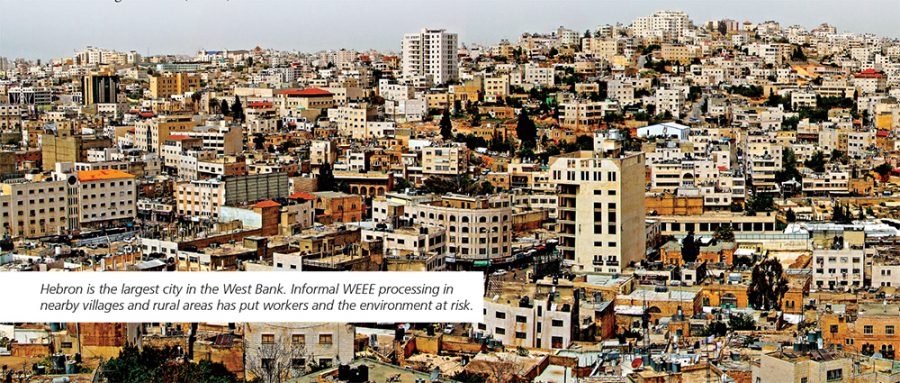
Both NGOs realized electronic waste burning was a potent cross-border issue: Much end-of-life material flows from Israel to the West Bank, where WEEE, along with many other secondhand goods, is processed in over 200 informal repair and refurbish workshops and businesses. This occurs primarily in three villages – Beit Awwa, Idhna and Deir Samit – that have a combined population of around 43,000. Cables and other unwanted components produced by these operations are burned in surrounding rural areas. Driving through these locales today, a visitor encounters the smell of burning plastics and sees school children dismantling burned material. These realities are difficult to disregard.
With help from a 2015 grant from the European Union and the Finnish Embassy in Israel, local environmental NGOs began by gathering hard data to document the scope of the crude processing problem. GLS and AJEEC-NISPED’s resulting research noted that while earlier studies had quantified the economic value and flow of motherboards in the region (Davis & Garb, Ben-Gurion University of the Negev, 2015), no study had evaluated the social aspects or health and environmental implications for the West Bank’s informal operations. The team’s January 2016 study also laid out the fact that there were no specific regulations governing the safe and responsible management of WEEE in the Palestinian territories, either at the state or local level.
A cave site near the West Bank village of Idhna is rich in religious history but now bears the marks of cable burning.
Israel has a national extended producer responsibility (EPR) law for electronics, passed in 2012, but it has proven problematic. The NGO study in 2016 found signs of a maturing WEEE recycling sector in the West Bank, but it noted the West Bank is heavily intertwined with Israel for both incoming and outgoing material flows, despite the fact that under the EPR law, only Israelis are technically allowed to work in the operations handling covered WEEE material.
According to the research, used goods flow into Beit Awwa’s repair-refurbish workshops in the village of Beit Awwa on about 62 trucks daily, each of which carries an average load of 2.5 metric tons. Around 45 percent of this material was classified as WEEE (by weight, 66 percent of the WEEE was household appliances, 31 percent was consumer electronics and 4 percent was information and communications technologies). The trucks are 98 percent from Israel, with the remaining 2 percent coming from elsewhere in the West Bank. The processing and treatment technologies in use in the area include shredding, baling and manual disassembly for metal sales (steel, aluminum and copper) as well as plastic regrind and re-melt. Most recovered materials are sold back to Israelis with the exception of some plastics flowing to factories in Hebron and some landfilling of non-recyclable plastics. Then of course there is also the open burning of cables and wires for copper recovery. This material flow is illustrated in the chart below.
The research also found nearly half the citizens in the three identified West Bank villages are involved in the electrical and electronic recovery operations. Two GLS researchers, Akram Amro and Hadeel al-Tamimi, interviewed residents and found that many had fears about the health and environmental consequences of unregulated WEEE processing, with over two-thirds agreeing that the informal practices must be stopped. In addition, three-quarters of the surveyed residents voiced support for a campaign to raise awareness of the effects of burning WEEE components.
Two subsequent 2016 studies by GLS and AJEEC-NISPED quantified the health and environmental impacts of informal electronics waste disposal practices in the three villages nearest to the burn sites. The environmental study found elevated levels of many toxic metals in both tap water and groundwater throughout the burn region. Amro and al-Tamimi’s health study found statistically significant increased incidences of cancer, respiratory ailments and miscarriages, as well as elevated blood levels of toxic metals including but not limited to aluminum, barium, cadmium, chromium, copper, gallium, iron, lead, silver and vanadium.
Both studies used control groups distant from the burn areas to differentiate findings from the villages.
A ‘gray market’ for end-of-life material
Why is this burning of cables and other components happening here? In short, the complexities of politics and economics within Israel and the West Bank have not spared end-of-life management of WEEE.
As has been observed in electronics burn sites in places such as China, Ghana and India, residents of the West Bank live at an unfortunate confluence of poverty, inadequate environmental regulations and porous borders for materials flow. In addition, as the area has a long history of informal waste processing, ignorance exists among some members of the population when it comes to health and environmental consequences of informal processing techniques.
As part of tackling this problem, the team visiting last year sought to understand the role Israel’s significant informal waste sector plays. In much of the country, residents leave unwanted goods – including all types of WEEE – outside of residences, to be collected by informal operators (often poor Palestinian citizens of Israel who can travel freely into the West Bank). “We put an old air conditioner outside our home and it was gone within a few hours,” Anat Langer-Gal of AJEEC-NISPED said. These goods then flow through informal transactions and into the West Bank. Even though it is illegal for any Israeli to contribute WEEE to the informal sector, in practice there is a robust “gray market” that cannot easily be discontinued.
Specifics of Israel’s WEEE law also contribute to the issue. The legislation requires manufacturers to only fund the recycling and treatment of 50 percent of the weight of products put on the market in any given year. This has led to inevitable cherry-picking of material by players within the formal system. High-value scrap flows through Israel-approved electronics recyclers, and the rest tends to head into the informal market, with burning at the tail end. Further, Israel’s law does not require processors to meet any international processing standards such as WEEELABEX, e-Stewards or R2.
Enforcement is an additional challenge. At a talk attended by key stakeholders given by the author and NGO representatives at Tel Aviv University, a staffer from the Israeli Ministry of Environmental Protection publicly stated the government entity does not have funds to fully hold stakeholders accountable for actions under the law. This creates a leadership void in the region that further enables informal sector activities and the resulting negative health and environmental consequences.
In response, AJEEC-NISPED and GLS have developed a number of recommendations to help stem the burning problems. These include improving health and safety for West Bank workers in existing conditions, setting up a “green police” to stop burning in the area, forming worker cooperatives or unions to leverage economies of scale and promote safer processing technologies, and addressing shortcomings in Israel’s EPR law.
Thus far, several educational initiatives have been undertaken. The author’s trip to the region in 2016, for example, was sponsored by the U.S. nonprofit group Sustainable Israeli-Palestinian Projects (SIPP). Working with the local NGOs, the author and Pete Ornstein, an environmental lawyer with SIPP, provided focused education to local populations in the West Bank on the risks of WEEE burning. We worked on the premise that the people who actually do the burning would not come to a workshop: “They are like drug dealers,” Amro of GLS told us. “They know they are doing something wrong.” But local leaders also knew that concerned citizens and officials would attend.
As part of the visit, approximately 80 officials, health workers, residents, business people and stakeholders from the international community attended an event in the village of Idhna to learn more about health and environmental risks of open burning of material. The understanding among organizers was that attendees from the three villages at the center of the issue all knew someone who knew someone who would pass the word along directly to those doing the burning.
We specifically asked the women present to teach other women that workers coming home with clothes covered in toxics-bearing soot and dirt present risks to children and other family members. We also stressed that the men share with other men along their networks about these same risks.
Further, GLS has engaged in door-to-door community outreach and educational efforts in schools focused on the risks of burning. It is also working on securing funding and designing programs to be housed at an environmental education center close to the historic cave site, which is near Idhna. This initiative will aim to influence generations of residents in environmental protection, responsible electronics recycling and their own local heritage. To move the project forward, GLS is partnering with leaders of Hiriya Waste Park’s Education Center, a world-class recycling education facility in the Ariel Sharon Park near Tel Aviv.
Finally, to move policy issues forward, AJEEC-NISPED has partnered with a group called Adam Teva V’Din, which is essentially the Israeli equivalent of the U.S.-based Environmental Defense Fund. The aim is to analyze the limitations of Israel’s EPR law and recommend changes. In a policy paper to be published later in 2017, several key recommendations are spelled out, including:
- The Israeli Ministry of Environmental Protection (MEP) should move into a leadership position with this law and offer resources to enforce the law to all stakeholders.
- International standards for WEEE treatment should be adopted, including clarifying the permitting for facilities processing e-scrap.
- Enhanced cooperation should be developed between the MEP and West Bank enforcement agencies to create a unified and coordinated policy regarding WEEE movement flowing across the border.
- The policy prohibiting non-Israelis from working in approved electronics recycling plants that manage Israeli WEEE should be withdrawn. Because Palestinians currently cannot work within the formal program, many laborers are available to take gray market material and work without health and safety regulations.
- The MEP should establish and enforce export policies to help build a WEEE processing and treatment industry that meets recognized international standards.
Used material awaits processing outside a repair shop in the village of Beit Awwa.
U.S. industry connections
SIPP continues to be involved from the U.S. in the evolving materials management situation in the West Bank and Israel, providing policy review, connecting local NGOs with air pollution researchers at the Weizmann Institute in Israel, and offering other forms of support.
SIPP is also looking at the appropriate involvement of a Colorado-based, R2-certified electronics recycler, Techno Rescue. The company is owned by Palestinian-American Nidal Allis, who has family ties in the West Bank. Business opportunities that would address some of the problems outlined above are being explored.
As of this writing, the open burning of cables and other components appears to be diminishing – but with metal prices down in the area, it is too soon to say if such dangerous practices are indeed on their way out.
Anne Peters is president at U.S.-based Gracestone, Inc., an environmentally focused consulting company, and a volunteer with group Sustainable Israeli-Palestinian Projects (SIPP). She can be contacted at annep@indra.com.