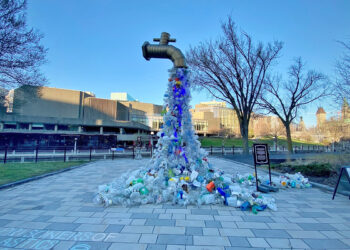










Single-use packaging is easy to spot. A short walk along a beach, anywhere in the world, will reveal the consequences of our throwaway culture as each tide brings in a fresh layer of debris, most of it single-use plastics.
In some countries, the growing pressure to do something about single-use packaging has led to restrictions on the use of certain packaging and products. Consider France, for example, which in July 2016 imposed a total ban on lightweight plastic bags, and in September 2016 became the first country in the world to ban plastic cups, plates and cutlery.
Another example can be seen in Hamburg, Germany, which in February 2016 banned coffee pods and other disposable packaging, including bottled water, beer and soda from government buildings. In the U.S., dozens of cities have banned plastic bags, starting with San Francisco in 2007. More recently, San Francisco banned polystyrene, including foam cups and food packaging, packing peanuts, and beach toys, among other things.
Push through legislation
With ban momentum mounting in the realm of single-use packaging, it makes sense that more action would take hold around reusable packaging solutions. According to a recent Ellen MacArthur Foundation report, at least 20 percent of plastic packaging could be profitably reused. Given this vast potential, it makes sense that the EU is giving consideration to reuse in its new Circular Economy Package (CEP).
In its proposal amending the Packaging and Packaging Waste Directive (PPWD), the European Parliament has called for new reuse targets (non-binding) of 5 percent (by 2025) and 10 percent (by 2030). While the European Council does not accept any reuse targets at this point, it has said that it will consider the feasibility of setting targets at a later date, and fully support the collection of data in order to better understand the current level of reusable packaging across member states. In addition, the Council has offered new legal text to encourage the increase in market share of reusable packaging by way of deposit-return schemes, targets, economic incentives and mandating a minimum percentage (by market share) of re-useable packaging sold each year.
In the context of the PPWD, packaging is defined as products used for the containment, protection, handling, delivery and presentation of goods, and this includes both raw materials and processed goods at any stage of the chain from producer to final consumer. Examples of reusable transport packaging include containers that are used multiple times, such as reusable produce crates, cases and pallets. Reusable packaging can also include consumer or sales packaging, such as beverage containers.
While there are numerous studies demonstrating the importance of packaging reuse in the retail chain, very few countries have official data on their reusable packaging and only a few EU member States voluntarily report on reuse of packaging.
Convening experts in reusable packaging
All of this spurs the question: What else can be done to promote reuse?
In an effort to engage a conversation on this topic, the Reloop Platform co-hosted the sixth European ReUse Conference in Brussels last March. The conference brought together expert speakers and participants from the refillable beverage industry, the reusable transport packaging industry, NGOs and representatives from EU institutions and member states. Besides the presentation of best practice examples, speakers at the conference discussed what was needed, politically, to further promote refillable beverage and reusable transport packaging systems in Europe.
Among the many suggestions that surfaced from the discussions were the need for clear targets for residual waste (for example, 150 kilograms of waste disposed per capita in 2025, and 130 kilograms in 2030), and the need for separate reuse quotas for sales, transport and beverage packaging. Also raised was the importance of economic incentives, such as small “eco levies” on single-use bags, coffee cups, bottles and cans or tax advantages for reusable packaging. It was widely agreed that a tax shift that decreases the costs of labor and increases the cost of pollution is a pre-condition for a circular economy.
The idea of eco-design specifications for reusable packaging, which consider things like product standardization, durability and easy reusability can also facilitate the shift to reuse.
So why has the packaging sphere been so slow to shift?
Many companies are hesitant to make the switch to reusables because of the initial higher investment. What many don’t realize, however, are that these costs are largely offset by the savings that come from eliminating the costs (purchase and disposal) associated with single-use packages. What’s more is that the greater the frequency of reuse, the greater the savings over the extended useful life of the packaging.
The economic benefits can be impressive. Consider Ghirardelli Chocolate as an example. To reduce packaging costs and cardboard waste, the company switched to reusable totes for internal distribution in 2003. Based on a five-year life of the totes, the company realized net savings of $1.9 million, and prevented 350 tons per year of soiled cardboard going to landfill, resulting in additional savings from avoided disposal costs of $2,700 per year.
Despite these benefits, the market share of reusable packaging remains small, and has even declined for some products. Refillable beverage containers, for example, are on the decline in many parts of the world, as single-use alternatives made from glass, plastic, metal, and multi-laminate materials take their place. In Western Europe alone, sales of refillable beverage containers have dropped from 63.2 billion units in 2000 to 40.2 billion units in 2015, according to a 2015 report from market analysis firm Canadean.
More recent sharp declines have been seen in some Scandinavian countries like Norway and Finland. In Finland, the green levy on non- recyclable containers was 67 euro cents per liter and recyclable containers carried a levy of 17 euro cents per litre. The numbers show how successful this combination of policies was at preserving the Finnish refillable system. In 2000, 73 percent of beer and 98 percent of soft drinks consumed in Finland were purchased in refillable containers. But on Jan. 1, 2008 the packaging tax on recyclable beverage packaging was abolished. This meant that refillable beverage containers and recyclable beverage containers were now subject to the same terms and conditions of taxation. This has had the predictable result of decimating the refillable industry in Finland. In just one year, the carbonates and water markets were fully taken over by one-way PET containers and the refillable PET bottle vanished.
Several factors can explain this decline, one of which is a shift in the retail landscape toward large retailers who refuse to sell products in reusable packaging, in an effort to reduce the labour, space and general management requirements associated with having to take them back. Another contributing factor to the decline is that refillable systems require a greater level of cost internalization by beverage producers. Whereas producers of beverages in one-way packaging generally only pay for a share of the end-of-life management costs, producers of refillable beverage containers incur the full costs of collection and refill. This un-level playing field creates an economic incentive to use one-way containers over reusable ones.
A future for reuse?
While the uptake of reusable packaging faces a number of challenges, it remains an important item on the EU policy agenda. With the release of the new CEP, it is fair to say that in Europe, at least, the days of sharing this responsibility with municipalities are over. Soon enough, producers will be responsible for 100 percent of the costs of managing their waste, and will be forced to reach higher targets. In addition to political pressure, there is considerable public pressure to move away from single-use packaging..
So maybe reuse does have a future. And, interestingly, we can look to the U.S. for one particularly promising example. In the state of Oregon, the Oregon Beverage Recycling Cooperative (OBRC) developed an innovative refillable beer bottle program in partnership with a local brewery. The pilot phase, which launched in March 2017, combines the refillable operations at Double Mountain Brewery and the collection capabilities of the OBRC’s redemption centers. Initial estimates suggest the number of bottles sold and refilled could exceed 2 million per year. ORBC’s ultimate goal is to build a dedicated refillable bottle processing facility so that it can handle a higher volume of bottles and attract more breweries to switch to refillables.
Reuse could also take another form, one where the focus is on reducing the unnecessary shipment of products from one place to another by allowing a user to refill in the home, or offering direct refilling in-store. For example, many of the products we use on a daily basis, such as household cleaning products, are currently sold in single-use bottles and consist mainly of water with only a small amount of active ingredients. California-based company Replenish provides customers with refills in 3 ounce pods that they can mix with tap water in a reusable spray bottle at home. New delivery models such as this could reduce packaging material needs by 80 to 90 percent and cut packaging costs by 25 to 50 percent.
Time to think deeper
More and more jurisdictions are considering bans on single-use packaging; the cost of raw materials continues to rise; and the high cost of transportation is making local production more attractive.
We need new, smarter materials if we’re not going to clog our oceans and overwhelm our landfills. Those that are able to think beyond the classic one-way distribution model to one that reduces energy at all stages of production and delivers the product to the consumer in the most eco-friendly way possible may indeed end up on top.
Clarissa Morawski is based in Barcelona and serves as the managing director of the Reloop Platform, which brings together industry, government, and nongovernmental organizations in Europe to form a network for advances in policy that create enabling system conditions for circularity across the European economy. She is also principal of Canada-based CM Consulting Inc.