




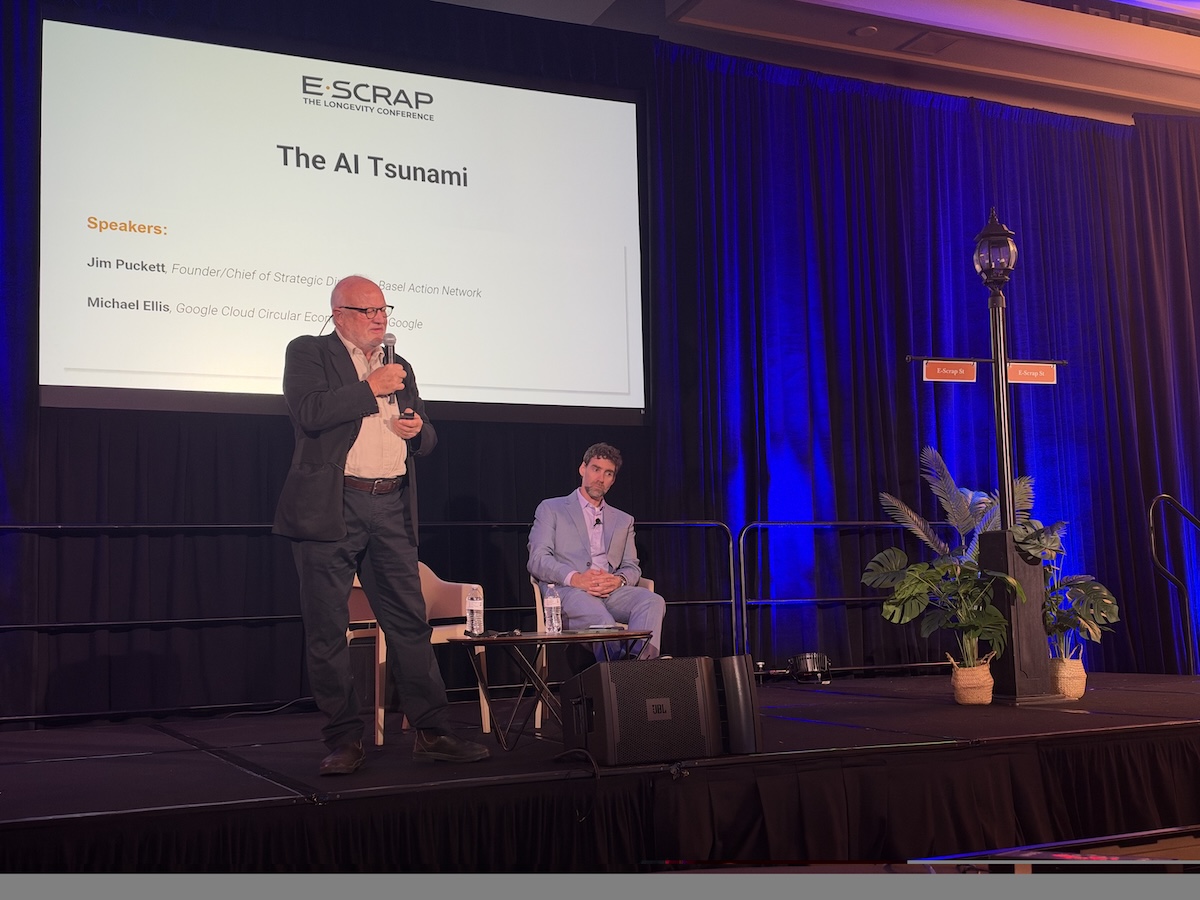
As the world prepares for what an environmental advocacy group calls an AI tsunami, at least one global tech giant says it’s taking steps to mitigate the impact of a pending surge in out-of-use hardware.
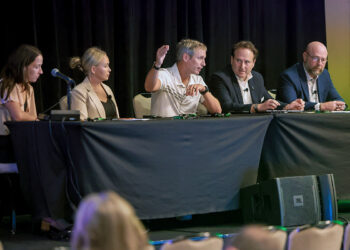
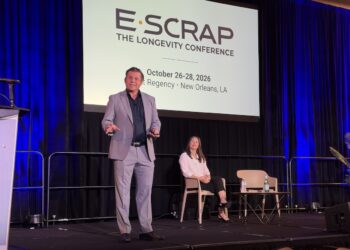
Jim Puckett, founder of the Basel Action Network, discussed his white paper on the AI waste wave during this week’s E-Scrap Conference in New Orleans. Speaking with him was Michael Ellis, circular economy lead for Google Cloud, one of a handful of hyperscalers Puckett cited as the main drivers of the wave.
Puckett’s research — which evolved from an intended single paper into a four-part report due to the volume of material involved — looked at the extent of current and future e-scrap volumes amid the surge in data center construction, which Puckett said wasn’t accounted for when previous e-scrap reports such as the UN’s Global e-Waste Monitor were released. Increased demand has resulted in the hyperscaling of AI hardware — companies hit a ceiling on chip speed, Puckett said, requiring horizontal scaling from the likes of Google, Amazon and Meta to meet productivity demands.
Previous AI-related e-scrap estimates were low, Puckett said, because they generally only account for servers. He said servers account for 13% of all data center equipment by mass. Proper counts should include cooling, networking, battery and power equipment that AI data centers also require. Adequate estimates should also account for what Puckett called “AI contagion,” waste resulting from the forced obsolescence of equipment used outside of data centers.
So, as more AI infrastructure hits the market ($7 trillion worth in the next five years, by Puckett’s estimate), those same products will hit obsolescence in the same general timeframe. The result: millions of hard drives, chips, cords and other devices with no place to go. Puckett estimates a global e-scrap total of 91 million to 95 million metric tons in 2030 and 196 million to 211 million metric tons by 2050
“Tech companies will hyperscale AI infrastructure, but will they also hyperscale proper waste downstream management and design for longevity and reuse?” Puckett said.
The answer, according to Ellis, is yes. Although he couldn’t commit to certain calls for transparency from Puckett pertaining to where some scrap will end up, Ellis said Google’s data center buildout — the company updated its 2026 capital expenditure guidance over the summer to $195 billion-$205 billion — incorporates recycling, reuse and other measures to mitigate the impact end-of-life equipment will have.
“At the data center level, we have all of that within our control,” said Ellis, who said Google uses several recycling companies to work with its facilities around the world. “The last thing we want is for any of our stuff to end up in the landfill or in one of those places overseas it shouldn’t be.”
Other hyperscalers are building equally aggressively; Meta spent $34.9 billion on capital expenditures in the third quarter of this year alone, with a full-year guidance of $135 billion-$145 billion, while Amazon is expected to spend $389 billion. While the US lacks some of the infrastructure to process large volumes of e-scrap, Ellis said companies like these are “committed to trying to build that out.”
On Google’s end, the company reuses and remarkets its hard drives, Ellis said. It and other hyperscalers are also part of the Open Compute Project, an industry collaboration working to enable open hardware designs for data centers and related projects. Additionally, Ellis said Google is working to obtain UL Zero Waste to Landfill certification.
“Zero waste to landfill is the floor, and we need to make sure we are properly managing these materials,” Ellis said. “We work with a lot of minerals that have the capacity to be recycled. Hyperscalers are building the infrastructure to recycle.”
Puckett said some zero-landfill commitments fall flat, as sending used electronics overseas technically meets that pledge despite it not solving the problem. So the transparency he wants from hyperscalers is key, he said, for companies to prove they’re acting responsibly as e-scrap continues to accumulate.
Ellis said Google will do its best to ensure proper disposal.
“We are committed to making sure we see the best outcome for these materials, making sure we can trace these materials and report on their longevity,” he said. “We commit to try and ensure these materials get in the right streams and we recover as much as possible.”
Parts two through four of Puckett’s report will focus, respectively, on how much e-scrap can be saved by circular strategies, the qualitative nature of the waste, and potential solutions. The problem won’t be as easy to solve as encouraging reuse, Puckett said, due to complications such as data security, hardware not meant to be disassembled and loss of device value.
Collaboration between hyperscalers and players across the industry is essential as the problem grows, Puckett said: “What can we all do together? This is a very unique waste stream.”