





Resource Recycling
  • The Latest
  • Analysis
    • All
    • Certification Scorecard
    • Industry Announcements
    • Opinion
    ESG

    Foreign equity is moving into North America’s e-scrap origination

    From claims to custody: PCR procurement grows up

    Certification Scorecard — Week of August 17, 2026

    Sorted: Country roads, take my recycling

    State program revamp proposal advances in Oregon

    Oregon EPR ruling looms: what legal experts think

    Triple-digit revenue gains propel ABTC’s expansion

    LFP batteries gain acceptance. Can they be recycled?

    May pricing bullish for most bales

    August pricing bearish for plastic bales

  • Conferences
    • Resource Recycling Conference
    • Plastics Recycling Conference
    • E-Scrap: The Longevity Conference
    • Textiles Recovery Summit
  • Publications
    • E-Scrap News
    • Plastics Recycling Update
    • Policy Now
    • Resource Recycling
    • Other Topics
      • All Topics
      • Brand Owners
      • Critical Minerals
      • Glass
      • Grant Watch / RFPs
      • Markets
      • Organics
      • Packaging
      • Research
      • Technology
      • Textiles
Subscribe
No Result
View All Result
Resource Recycling
  • The Latest
  • Analysis
    • All
    • Certification Scorecard
    • Industry Announcements
    • Opinion
    ESG

    Foreign equity is moving into North America’s e-scrap origination

    From claims to custody: PCR procurement grows up

    Certification Scorecard — Week of August 17, 2026

    Sorted: Country roads, take my recycling

    State program revamp proposal advances in Oregon

    Oregon EPR ruling looms: what legal experts think

    Triple-digit revenue gains propel ABTC’s expansion

    LFP batteries gain acceptance. Can they be recycled?

    May pricing bullish for most bales

    August pricing bearish for plastic bales

  • Conferences
    • Resource Recycling Conference
    • Plastics Recycling Conference
    • E-Scrap: The Longevity Conference
    • Textiles Recovery Summit
  • Publications
    • E-Scrap News
    • Plastics Recycling Update
    • Policy Now
    • Resource Recycling
    • Other Topics
      • All Topics
      • Brand Owners
      • Critical Minerals
      • Glass
      • Grant Watch / RFPs
      • Markets
      • Organics
      • Packaging
      • Research
      • Technology
      • Textiles
Subscribe
No Result
View All Result
Resource Recycling
No Result
View All Result
Home Recycling

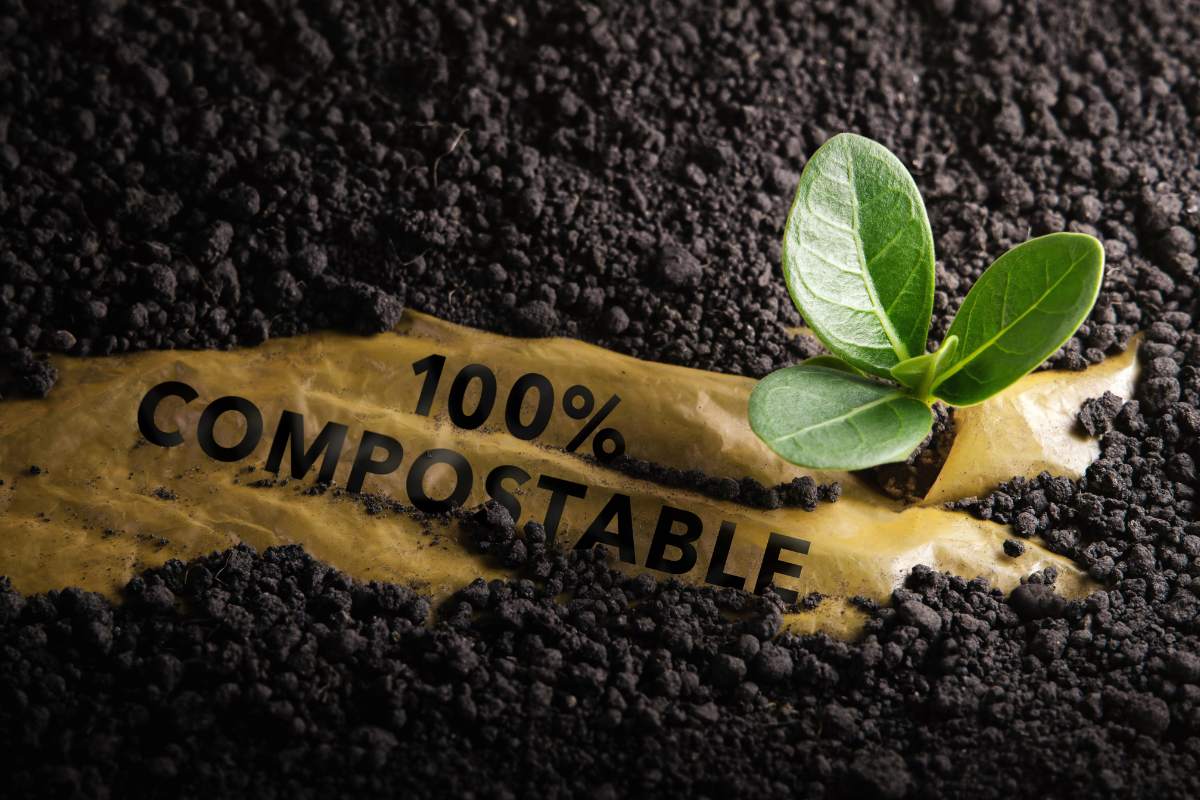
Report finds path forward for compostable packaging

byKeith Loria
April 28, 2026
in Plastics, Recycling
California extends compostable labeling law

Black Salmon / Shutterstock

A new report by Closed Loop Partners’ Composting Consortium, which examined five years of research, field testing and cross-industry collaboration, revealed best practices for compostable packaging recovery and composting infrastructure in the US.

Caroline Barry, senior program manager at Closed Loop Partners, said the Composting Consortium’s work, led by Closed Loop Partners’ Center for the Circular Economy, uncovered critical insights into how compostable materials perform outside of controlled environments.

“The Composting Consortium unearthed numerous insights on compostable packaging disintegration––many of which were brought to light during our field tests,” she said. “What surprised us most was not that certified compostable packaging could successfully disintegrate in real-world composting systems, but how clearly the data showed that disintegration performance is closely tied to operating conditions.”

In what was the largest singular field test of certified, food-contact compostable packaging in North America, compostable plastics averaged 98% disintegration by surface area, while compostable fiber averaged 83%, with both exceeding industry thresholds.

“One finding that challenged common assumptions was the performance of compostable plastics,” Barry said. “In many parts of the industry, there has been a persistent concern that compostable packaging—particularly compostable plastics—do not break down quickly enough for facilities with shorter processing timelines. Our field data helped challenge that assumption.”

She noted that by approximately 47 days into the composting process, compostable plastics had already reached 98% disintegration on average, while compostable fiber reached roughly 78%.

“That midpoint result is important because it speaks directly to the operational concerns of compost manufacturers managing for throughput, efficiency and product quality,” Barry said.

The research also highlighted widely held beliefs about fiber-based materials.

“The study also surfaced a more nuanced point about compostable fiber packaging,” she said. “Fiber is often viewed as the more benign material in composting systems, yet our data showed that compostable plastics, on average, disintegrated more consistently across the composting technologies and operating environments we studied.”

While the findings do not suggest one material is universally better than another, the report does highlight the importance of process conditions.

“That does not suggest compostable plastics are inherently superior,” she said. “Rather, it points to a more important operational reality that certain compostable fiber formats may require stronger process conditions including sufficient agitation, turning and consistent moisture to break down effectively in compost piles.”

Beyond material performance, contamination remains a major operational challenge for composters.

“On average, composters in our study spent 21% of operating costs on contamination removal, and conventional plastics accounted for 85% of the contamination they received by volume,” Barry said.

That reality, she explained, shifts the conversation away from consumer behavior alone and toward system-level solutions.

“There are certainly upstream steps that matter—clearer differentiation between compostable and non-compostable packaging, better alignment across accepted-material lists and stronger coordination across brands, municipalities, haulers and processors,” she said. “But if the question is what is most realistic in the near term, targeted investment is one of the most immediate levers available.”

The Consortium has already taken steps in that direction through its national Composting Consortium Grant Program.

“We supported eight municipal and composter-led projects designed to expand access, strengthen infrastructure and improve regional recovery capacity,” Barry said.

Despite progress, achieving a standardized national system remains a work in progress.

“The US has made meaningful progress over the last five years, but there is still a lot of work needed to achieve a truly standardized national system for compostable packaging acceptance,” she said, pointing out that composting in the US is still highly localized, with acceptance decisions influenced by facility conditions, policy and infrastructure.

“Acceptance decisions are shaped by facility configuration, permitting conditions, end-market requirements, contamination tolerance, collection system design and local policy,” Barry said. “Acknowledging the landscape of the US composting system, the goal should not be a one-size-fits-all national mandate. What matters more is building greater consistency where it counts.”

For brands investing in compostable packaging today, the biggest opportunity Closed Loop Partners sees is to approach it not simply as a packaging material decision, but as part of a broader organics recovery strategy.

“Collaboration will be critical to moving the needle,” Barry said. “The more brands can engage early and directly with the broader recovery ecosystem, the more progress can be made.”

Ultimately, the Consortium’s work underscores a central lesson that compostable packaging can only succeed when the systems around it are designed to support it.
Tags: OrganicsPaper Fiber
TweetShare
Keith Loria

Keith Loria

Related Posts

Google explores how to capture 4.5 billion tons of plastic

Bale pricing diverges for August

byRecyclingMarkets.net Staff
August 18, 2026

Pricing for post-consumer plastics dropped while paper fiber prices rose and UBCs remained steady.

A Republic Services truck picks up a recycling cart in Fort Collins, Colorado.

Fort Collins, CO builds a roadmap to zero waste

byKeith Loria
August 6, 2026

The midsize city has big ambitions on waste reduction and is working with partners to advance its goals.

Tiger Group offers OCC pulp mill equipment sale

Tiger Group offers OCC pulp mill equipment sale

byTiger Group
July 1, 2026

Sale by Tiger and partner Can-Am Machinery features pulping, drying, baling and other assets from a fiber-processing and pulp-production plant...

Smurfit Westrock climate goals evolving post-merger 

Smurfit Westrock climate goals evolving post-merger 

byAntoinette Smith
June 26, 2026

In its first integrated sustainability report, Smurfit Westrock announced new targets but continues to iron out other key details.

Compliance push drives new Republic organics facility

byStefanie Valentic
June 18, 2026

Republic Services started construction on a 140-acre organics facility in San Bernardino designed to expand Southern California's composting capacity under...

Group updates on UBC-sorting robot’s success

Plastic bale pricing falls while paper, UBCs firm

byRecyclingMarkets.net Staff
June 15, 2026

PET bales remained steady at low levels, while HDPE and PP grades fell; paper and aluminum cans saw pricing gains.

Load More
Next Post
Float-sink technology at the Quantum Lifecycle Partners facility in Toronto, Canada enables the processing of e-plastics.

E-plastics recovery line opens in Canada

2026 Buyers’ Guide

Equipment, services and technology suppliers serving the recycling industry.

Browse the Guide

More Posts

The Maine state capitol in Augusta.

Circular Action Alliance won’t bid on Maine’s PRO contract

August 19, 2026
The Maine state capitol building.

No bidders respond to Maine’s EPR RFP

August 20, 2026
Alpek closing Pennsylvania RPET plant

Alpek seizing on war-related opportunity 

July 27, 2026
Company debuts battery-containing device shredder

New battery shredding system debuts stateside

August 20, 2026
ESG

Foreign equity is moving into North America’s e-scrap origination

August 19, 2026
State program revamp proposal advances in Oregon

Oregon EPR ruling looms: what legal experts think

August 17, 2026
PureCycle sees easing headwinds to R-PP adoption

PureCycle says H2 outlook already playing out 

August 13, 2026
Google explores how to capture 4.5 billion tons of plastic

Bale pricing diverges for August

August 18, 2026
Lawsuits hover days after SB 54 approval

NAW-backed coalition seeks SB 54 injunction

August 21, 2026
Triple-digit revenue gains propel ABTC’s expansion

LFP batteries gain acceptance. Can they be recycled?

August 17, 2026
Load More

About & Publications

About Us

Staff

Archive

Magazine

Work With Us

Advertise
Jobs
Contact
Terms and Privacy

Newsletter

Get the latest recycling news and analysis delivered to your inbox every week. Stay ahead on industry trends, policy updates, and insights from programs, processors, and innovators.

Subscribe

Welcome Back!

Login to your account below

Forgotten Password?

Retrieve your password

Please enter your username or email address to reset your password.

Log In

Add New Playlist

No Result
View All Result
  • The Latest
  • Analysis
  • Recycling
  • E-Scrap
  • Plastics
  • Policy Now
  • Conferences
    • E-Scrap Conference
    • Plastics Recycling Conference
    • Resource Recycling Conference
    • Textiles Recovery Summit
  • Magazine
  • About Us
  • Advertise
  • Archive
  • Jobs
  • Staff
Subscribe
This website uses cookies. By continuing to use this website you are giving consent to cookies being used. Visit our Privacy and Cookie Policy.