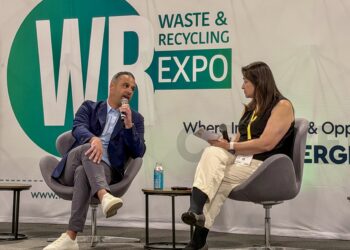







Panelists from environmental non-governmental organizations (NGOs) and the plastics recycling industry sought to find common ground during the Plastics Recycling Conference in San Diego on Feb. 24.
The ultimate goal, they agreed, is to reduce the plastic pollution crisis gripping the world.
“No one wants to see plastic on the beach, or in the park, and telling that story will help people have continued interest in our recycling system,” said Anja Brandon, director of plastics policy for the Ocean Conservancy NGO.
Emily Tipaldo, session moderator and program manager at the Association of Plastic Recyclers (APR), stressed that plastics recyclers right now are “up against a lot,” with a flood of low-cost virgin resins in the market and expanding capacity of fossil fuel-based plastics production globally.
Lindsey Jurca, a senior campaigner for Greenpeace, acknowledged the challenges, saying “we need recycled plastics to be cheaper.” She said subsidies to petroleum companies need to be reduced to “balance out” the playing field.
The plastics recycling industry would benefit from some policy interventions, agreed Scott Trenor, APR technical director. Examples include post-consumer recycled (PCR) content mandates for a number of products, “not just for packaging but across durable goods,” he said. “Let’s look at pipes and storage containers; we could really use a nudge to grow those markets.”
“We should not be putting virgin plastic in our trash bags when we have end markets that are collapsing,” said Brandon.
APR owns Resource Recycling, Inc., organizer of the conference and publisher of Plastics Recycling Update.
Voluntary targets?
The panelists discussed the value of voluntary targets by brands for recycled content. “Voluntary agreements have an important role to play,” said Arturo Rojas, a senior specialist with the UK-based NGO WRAP (Waste and Resources Action Programme), which works to drive circularity in plastic packaging. Voluntary targets can help companies test new technologies and prove them out, he said.
Trenor cautioned that companies can too often fall short on voluntary commitments, leaving recyclers who have built up their infrastructure hanging out to dry.
Brandon pointed to a study at the University of California, Santa Barbara that found that the most effective way to reduce plastic pollution would be to enact a 40% minimum PCR content standard in products, which would lead to a 51% decrease in globally mismanaged plastic. That beat plastic bans and virgin production caps in the study. “That really blew my mind as someone who has been working in this space for a long time,” Brandon said.
Seeking solutions
A global plastics treaty, including a cap on production, would help increase recycling rates, said Jurca of Greenpeace, which recently put out a report critical of plastics recycling.
But Brandon said plastics recycling “is not an either-or question”: “We can’t do it without recycling. This is going to take a suite of solutions, and we need every tool.” She pointed to reuse and reducing virgin plastic production as other tools in the box.
Trenor agreed that recycling “isn’t the only solution.”
Jurca said more scientific research is needed to ensure that recycled plastics are safe for use in food-contact packaging and consumer products, given concerns over endocrine disruption and other possible harms.
But Trenor said that science “is not where it needs to be.” In an email after the panel, Trenor added, “There are procedures and processes that FDA, Health Canada, EFSA and other regulatory bodies have to help ensure safe use of recycled plastics in food packaging. While sometimes recycled materials that shouldn’t be used in food applications are misused, that’s due to producers, not necessarily the recycler. This is where traceability and PCR certification can play an important role.”
Trenor said via email that studies on the health effects of plastics and their components have shown correlations with potential impacts but not causation. “This is partially due to the newness of this work as well as the difficulty in performing health studies.”
Jurca added via email that during the panel she “agreed that rigorous research into the health implications of plastics is important, particularly given the material’s ubiquity and the growing number of studies linking plastic-associated chemicals to endocrine disruption and other health concerns. At the same time, I emphasized that as the science continues to evolve, we already have sufficient evidence to justify the application of precautionary principles.”
Brandon added that there are easy, effective solutions to plastic pollution available now, such as adding a filter to a washing machine to catch microplastics shedding off synthetic clothing.
“There is technology we can start doing today while we work on more long-term solutions,” she said.