






Forget peering into crystal balls or reading tea leaves. Maybe we should consult the recyclables price chart.
Some individuals with decades of recycling market experience have been telling me that recyclables prices offer clues about the trajectory of the economy. And the clues aren’t just coming from Dr. Copper, the metal that’s long been an indicator of economic health.
Recovered commodities are used in construction products (polyethylene in piping), to make other goods (PET plastic in carpet) or to package products (cardboard boxes in new boxes). And copper, which is recovered from electronics, is used in a huge variety of products, making it a good indicator of demand across sectors.
All of the above commodities are products that generally get used more when times are good.
“If prices for those go down, it certainly implies some negative things for the economy,” said Chaz Miller, who conducts recycling markets analyses following a career in the U.S. EPA and multiple waste and recycling industry groups.
Recyclables may be trying to tell us something
First, let’s look more at recent pricing activity. In short, it has been a roller coaster with drops that push your stomach up into your throat.
Copper, nicknamed “Dr. Copper” because it’s used in so many different products that its price is indicative of the entire economy, needs its own doctor after its pricing health declined this summer. In early June, the metal was trading on the London Metal Exchange for about $4.40 per pound, and late last week it was hovering around $3.50 (which is actually better than the $3.30 a pound it hit at the end of September).
And the trend isn’t just limited to one non-ferrous metal.
A year ago, in September 2021, a bale of recovered cardboard boxes cost about $171 per ton. The national average price per ton slowly slipped over the following months, but, as of July 2022, it was still hovering around $130 per ton. Then it fell off a cliff, dropping to $114 in August, $78 in September, and $40 this month, according to RecyclingMarkets.net
Robert Boulanger, owner of RecyclingMarkets.net and a longtime observer of pricing trends around North America, told me the last time he saw a decline that steep was in the lead-up to the 2008-09 recession.
He recently gave me some numbers to illustrate: In September and October 2008, a ton of old corrugated containers was trading for $110 and $103, respectively. Then, in November 2008, when world leaders were in the throes of attempting to stave off a banking and housing market crisis that would eventually drag us into recession, the price nose-dived to $23 per ton. And that’s where it stayed for quite some time. Boulanger noted that it took over a year for the scrap corrugated box price to climb back to anything approaching that September 2008 level.
If consumers are anxious about their financial futures, they’ll slow down their discretionary spending, which means stores won’t sell as much, which means they expect that in coming months they’ll need fewer boxes, which means box makers won’t need as much recovered fiber feedstock in the near term, which means less demand for bales, which puts downward pressure on prices.
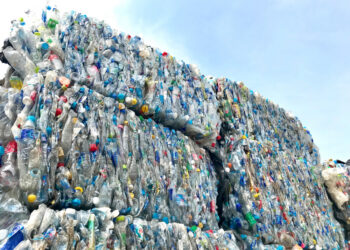
Recovered color high-density polyethylene (HDPE) and PET also serve as examples of how material pricing connects with wider economic trends. For readers unfamiliar with curbside plastics, an orange Tide detergent bottle is a classic example of color HDPE, and clear water and soda bottles are primary examples of residential PET.
Advanced Drainage Systems (ADS), a huge manufacturer of pipes, septic systems and other construction-type products, eats up a decent portion of all color HDPE bales generated by curbside recycling programs in the U.S.
A year ago, color HDPE was 58 cents per pound. The price then slid to about 29 cents in June. Since then – yep, you guessed it – it crashed down to today’s 6.41 cents. Boulanger said a similar thing happened at the start of the Great Recession: Color HDPE was 35 cents in October 2008, only to collapse to less than 7 cents the following month.
Meanwhile, PET is used to make carpet, fiber for clothes, strapping, and food and drink packaging. Recently, carpet stewardship group Carpet America Recovery Effort (CARE) noted that carpet sales in California had decreased, which is one of the reasons it’s asking consumers to pay dramatically higher fees starting in 2023 to cover carpet collection and recycling. If fewer homes are built because mortgage rates are rising or people are worried about their future income, then less new carpet is purchased, and carpet manufacturers such as Mohawk that use a lot of RPET in carpet face fiber consume fewer bales.
In fact, Mohawk touched on some of those dynamics in its earnings release in late July, noting that “as residential carpet volumes declined due to softening markets and inventory reductions, we are aligning capacity with demand.” The company noted that in the second quarter, major retailers all dramatically cut orders for carpet products “to reduce inventory as their sales forecasts weakened.”
As recently as May, RecyclingMarkets.net pegged recovered PET bales at nearly 40 cents per pound. The price is now 8.5 cents. In October 2008, PET bales sold for 17 cents per pound. The following month, they fell to 4 cents, and it took nearly a year and a half for the price to recover.
Why nothing – including the argument above – is as simple as it seems
Alright, everything I’ve said above comes with some important caveats.
First, Miller, who produces in-depth market reports for the Northeast Recycling Council (NERC), pointed out that recovered commodity pricing is affected by a number of factors. For example, PET values are altered by seasonal markets, with demand being high leading into the hot summer months, when we’re out and about and buying bottled water and soda.
Markets for old corrugated boxes and mixed paper are in a similar boat. Traditionally, demand for fiber wanes in November and December, because box makers have already purchased their feedstock and have cranked out the boxes needed for the holiday shopping season.
Still, Miller has some concerns. Purchasing agents are making orders based on projected demand for their products a month or two in advance, he noted. “If they’re retreating from the market, that’s their way of saying they’re not going to sell as much.”
Joe Pickard is the chief economist for the Institute of Scrap Recycling Industries (ISRI), and he recently presented during an ISRI press briefing. I asked Pickard what recycled material prices mean for our economic near-future. That was right after he got done running down a major list of macro economic indicators, including logistics costs, interest rates, currency valuations, geopolitical uncertainty and a lot more.
He acknowledged that many reporters look at copper as an economic indicator, but he also said the relationship only goes so far. “I think there’s probably a little too much attention focused on the volatility in commodity prices, especially these days, as an indicator of a recession,” he said.
And he generally doesn’t put too much stock in looking at one particular commodity as an indicator of a looming recession.
He then pointed out that we’re living in some wacky economic times (my words, not his) coming out of COVID. Unemployment is low, and the labor market is continuing to add jobs. At the same time, as was underscored by the $18 sandwich (with tip) I recently bought for lunch, inflation is hot.
“There are some real bright spots within the economy, and I think the volatility that we’re seeing in some of the prices these days has more to do with global economic jitters, in addition to rising interest rates,” Pickard noted.
Of course, there are indicators we’re already in a recession. Feds with calculators estimated that the U.S. economy shrank during the first and second quarters, which aligns with a long-held informal definition of a recession as two straight quarters of declining economic activity, according to an AP News explainer from two weeks ago.
If that’s the case, the mystical recyclables price may not be indicating we’re headed for recession as much as it’s warning that we’re destined for tougher times than we’re now experiencing.
Jared Paben is the associate editor of Resource Recycling and can be contacted at jared@resource-recycling.com.
A version of this story appeared in Resource Recycling on October 3.