



Resource Recycling
  • The Latest
  • Analysis
    • All
    • Certification Scorecard
    • Industry Announcements
    • Opinion
    Groups identify recovered plastics users in the Northeast

    Bale pricing for recycled plastics diverges

    Why global ITAD is stranded in the Gulf

    Why global ITAD is stranded in the Gulf

    Certification scorecard for the week of March 9, 2026

    Diversion Dynamics: Secondhand exports slow down fast fashion

    Certification scorecard for the week of March 2, 2026

    Industry announcements for January 2026

    Industry Announcements for March 2026

    HP receives ocean plastics certification

    HP Inc. earnings point to memory inflation challenge

    Certification scorecard for the week of Feb. 23, 2026

    Umicore highlights strength in recycling, catalysis

  • Conferences
  • Publications

    Other Topics

    Textiles
    Organics
    Packaging
    Glass
    Brand Owners

    Metals
    Technology
    Research
    Markets
    Grant Watch

    All Topics

Subscribe
No Result
View All Result
Resource Recycling
  • The Latest
  • Analysis
    • All
    • Certification Scorecard
    • Industry Announcements
    • Opinion
    Groups identify recovered plastics users in the Northeast

    Bale pricing for recycled plastics diverges

    Why global ITAD is stranded in the Gulf

    Why global ITAD is stranded in the Gulf

    Certification scorecard for the week of March 9, 2026

    Diversion Dynamics: Secondhand exports slow down fast fashion

    Certification scorecard for the week of March 2, 2026

    Industry announcements for January 2026

    Industry Announcements for March 2026

    HP receives ocean plastics certification

    HP Inc. earnings point to memory inflation challenge

    Certification scorecard for the week of Feb. 23, 2026

    Umicore highlights strength in recycling, catalysis

  • Conferences
  • Publications

    Other Topics

    Textiles
    Organics
    Packaging
    Glass
    Brand Owners

    Metals
    Technology
    Research
    Markets
    Grant Watch

    All Topics

Subscribe
No Result
View All Result
Resource Recycling
No Result
View All Result
Home E-Scrap

State looks to reduce e-scrap program revenues

byJared Paben
June 13, 2019
in E-Scrap
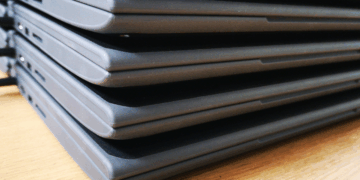
Laptops displayed at an electronics store.

California regulators plan to lower the fees consumers pay to fund electronics recycling. The issue? The state is accumulating too much money.

The California Department of Resources Recycling and Recovery (CalRecycle), which oversees the oldest state e-scrap recycling program in the country, is proposing to lower the fees consumers pay when they buy new electronics.

The move is in response to e-scrap processors handling significantly lower weights of regulated material in recent years. As a result, CalRecycle is paying processors less money out of the state fund, and the fund balance keeps growing.

The fees vary depending on the size of the screen. They are currently $5 for each device with a screen less than 15 inches (anything 4 inches and less is exempt), $6 for 15- to 34-inch screens and $7 for 35-plus-inch screens. At the CalRecycle monthly public meeting scheduled for June 18, the agency will consider reducing the charges to $4, $5 and $6.

Under the state program, fees are paid on purchases of new CRTs TVs and monitors (not a reality in today’s marketplace), LCD TVs and monitors, laptops and tablets with LCD screens, plasma TVs, and portable DVD players with LCD screens.

The state collects the money and uses it to pay companies that collect and recycle covered devices. CalRecycle currently provides collection and recycling payments of 49 cents per pound for CRTs and 60 cents per pound for non-CRT covered devices. It paid them a combined $53.5 million during the 2017-18 fiscal year.

All told, from Jan. 1, 2005, when the program began, through the end of 2018, the state has paid e-scrap processors about $1 billion to recycle over 2.3 billion pounds.

Dropping weights

California’s program has seen lower collection and recycling weights since 2012, but the decreases have accelerated over the past few years, in particular. Last year, CalRecycle received payment claims for just over 100 million pounds of e-scrap, down 21% from 2017, which was down 17% from 2016, which was down 13% from 2015.

“In recent years, the amount of recovered and recycled CRT devices has continued to decline significantly due to legacy stockpile depletion, at the same time as the amount of non-CRT devices increases,” CalRecycle staff wrote in a memo.

The end-of-life stream has been shifting in California for years, as the CRT wave has broken and receded. In 2013, non-CRT devices made up over 2% by weight for the first time. Fast forward to 2017, when they made up 14% by weight. Last year, non-CRT devices made up about 20% of the stream.

The shifts prompted CalRecycle to create a non-CRT payment rate last year. Previously, the agency paid processors the same rate for all covered device types.

Because CalRecycle is paying processors less out of the fund, the balance has grown. CalRecycle expects to end the 2018-19 fiscal year with a fund balance of $113.5 million, up from $110.9 million the year before.

If approved, the lower fees would go into effect starting Jan. 1, 2020, midway through the 2019-20 fiscal year, which starts July 2019 and runs through June 2020. If CalRecycle kept the current fees, it would collect about $86.5 million during the 2019-20 fiscal year. If it reduces each fee by $1, it would expect to bring in $80.9 million.

In memos, CalRecycle staff say the reduced fees will bring the fund reserve down over the next few fiscal years while still providing enough money to run the program and respond to unexpected expenses.

Photo credit: woff/Shutterstock

 

Tags: CaliforniaEPR
TweetShare
Jared Paben

Jared Paben

Related Posts

Minnesota EPR program advances in budget bill

AF&PA seeks injunction on Oregon EPR, defends paper recycling

byStefanie Valentic
March 17, 2026

AF&PA has filed for a temporary injunction on Oregon's Recycling Modernization Act, arguing the EPR law threatens an already high-performing...

Oregon state capitol building with state flag and blue sky.

Oregon opens comment on updated REM plan

byStefanie Valentic
March 16, 2026

The revised responsible end market plan from Circular Action Alliance aims to accelerate EPR implementation with a nationally scalable end-market...

Trade flow shifts, volatility require varied responses

Trade flow shifts, volatility require varied responses

byAntoinette Smith
March 9, 2026

Both long- and short-term solutions including policy, localization can help support the industry, panelists said during the 2026 Plastics Recycling...

EPR rules take shape in Oregon, as first test

Oregon passes battery EPR Law, banning lithium-ion disposal

byStefanie Valentic
March 6, 2026

A 20–8 Senate vote sends Oregon's HB 4144 to the governor, mandating that battery producers fund and operate collection infrastructure...

Common goal of responsible end markets: transparency 

Common goal of responsible end markets: transparency 

byAntoinette Smith
March 5, 2026

Panelists from state government, Circular Action Alliance and a reclaimer explored the particulars of REMs at the 2026 Plastics Recycling...

Emerging US EPR programs spark harmonization talks

Washington designates CAA to lead EPR implementation

byStefanie Valentic
March 4, 2026

The state is the sixth to name Circular Action Alliance as the producer responsibility organization for its packaging EPR law.

Load More
Next Post
Ingram Micro building exterior.

Partnership model helps firm expand ITAD globally

More Posts

Chinese processing group details goals for US visit

AMP lays out vision of next-generation, AI-driven MRFs

July 24, 2024
ERI sues Revivn alleging raid on staff and trade secrets

ERI sues Revivn alleging raid on staff and trade secrets

March 10, 2026
War-driven fuel costs compound recycling woes

War-driven fuel costs compound recycling woes

March 16, 2026
E-scrap export pause urged to keep rare earth scrap in US

E-scrap export pause urged to keep rare earth scrap in US

March 11, 2026
How rising fuel and memory prices are impacting ITAD’s margins

How rising fuel and memory prices are impacting ITAD’s margins

March 10, 2026

AI servers reshape ITAD sector, recyclers brace for new wave

March 9, 2026
Groups identify recovered plastics users in the Northeast

Bale pricing for recycled plastics diverges

March 17, 2026
Landfill

Oregon DEQ issues $3.1 million fine to Republic Services subsidiary

March 12, 2026
Ex-Glencore chief starts Valor to refine critical metals

Ex-Glencore chief starts Valor to refine critical metals

September 18, 2025
Greenway now takes e-scrap from Midwest businesses

Greenway now takes e-scrap from Midwest businesses

March 11, 2026
Load More

About & Publications

About Us

Staff

Archive

Magazine

Work With Us

Advertise
Jobs
Contact
Terms and Privacy

Newsletter

Get the latest recycling news and analysis delivered to your inbox every week. Stay ahead on industry trends, policy updates, and insights from programs, processors, and innovators.

Subscribe

Welcome Back!

Login to your account below

Forgotten Password?

Retrieve your password

Please enter your username or email address to reset your password.

Log In

Add New Playlist

No Result
View All Result
  • The Latest
  • Analysis
  • Recycling
  • E-Scrap
  • Plastics
  • Policy Now
  • Conferences
    • E-Scrap Conference
    • Plastics Recycling Conference
    • Resource Recycling Conference
    • Textiles Recovery Summit
  • Magazine
  • About Us
  • Advertise
  • Archive
  • Jobs
  • Staff
Subscribe
This website uses cookies. By continuing to use this website you are giving consent to cookies being used. Visit our Privacy and Cookie Policy.