





This article originally appeared in the Fall 2018 issue of E-Scrap News. Subscribe today for access to all print content.
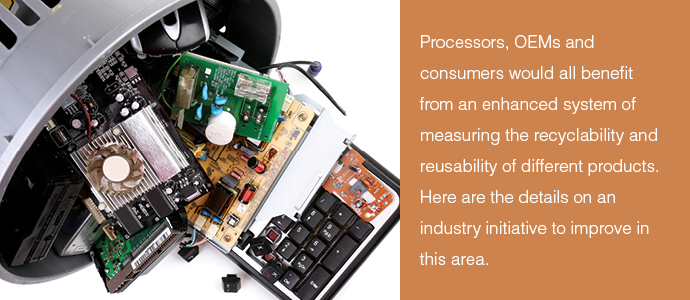
To what degree is a given electronic product recyclable or reusable?
That question is growing in importance as the electronics industry encounters more legislative requirements and customer demands. To meet expectations, product designers and developers need a reliable and credible means of assessing and reporting the value their devices carry in the end-of-life stream.
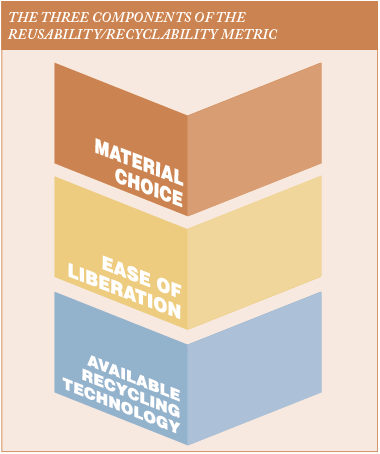
To help, electronics stakeholder group iNEMI is working to develop a metric that takes into account material choices, ease of separating components and materials, and the availability of regional recovery technologies and services.
The ultimate goal is to give manufacturers, recyclers, regulators and consumers a clear scoresheet that articulates how products stack up on reuse and recycling. And the effort is taking pains to make sure the system is based on the realities of materials processing today.
Metrics are relevant for whole value chain
The International Electronics Manufacturing Initiative (iNEMI) is an industry-led consortium of electronics manufacturers, suppliers, industry associations, government agencies, research institutes and universities. One of iNEMI’s primary initiatives is an elecronics manufacturing roadmap that defines the needs of the electronics industry and identifies critical voids in the technology infrastructure. The consortium then establishes implementation projects to eliminate those gaps.
 These projects address some of the chief technological barriers and opportunities facing the industry, including those in the environmental realm (see sidebar on page 60 for more on the sustainability component of the roadmap.)
When it comes to end-of-life concerns for electronics, two iNEMI initiatives address key leverage points for achieving a circular economy. This article on reuse and recycling metrics is the first in a two-part series. The second iNEMI end-of-life initiative, focused on optimizing recovery values, will be detailed in the next edition of E-Scrap News. Both projects relate to the performance of products at the end of their “first” life and seek to incorporate all major options created by the reuse, refurbishing and recycling industries.
It’s worth starting the discussion by asking a fundamental question: What good is it to measure the reusability/recyclability of a product?
For one thing, there is some wisdom to the old saw that you can’t manage what you don’t measure. Surely, you can do a lot of things without measuring anything, but if you want to maximize or optimize something, measurements of the potential and performance are essential.
But, more concretely, a metric system for product reusability and recyclability has actionable value for different stakeholder groups, including the following:
Brand owners, designers and developers. In the event that a brand owner has an internal requirement that their products be recyclable, the company needs a system to demonstrate that they meet that objective. And if its product designers and developers use a metric that is generally recognized, the results will be more reliable and credible than if they use an ad hoc system. Moreover, product recyclability requirements frequently come to brand owners from regulators and/or customers (federal and state laws increasingly require manufacturers to report on their products’ recyclability). A common metric system is essential to credibly meet such mandates.
Reuse organizations, refurbishers, remanufacturers and recyclers. For organizations that manage end-of-life products, information about a product’s recyclability can help them quickly select the best processing methods when material loads arrive on their docks. Has a product been designed for easy manual disassembly? Or does its design only allow for removal of a battery before shredding? If a metric system for individual products is readily available, it could aid reuse and recycling organizations in maximizing efficiency and value recovery. Additionally, if a system is designed to specifically call these factors out, manufacturers may be encouraged to design their products for more optimal processing.
Customers. Institutional customers, and even some individual consumers, are thinking more and more about the end of a product’s life when they make purchases. A reliable metrics tool could allow customers to reduce some downstream costs while also bringing them the satisfaction of knowing they made an environmentally responsible decision. In addition, public procurement departments often have requirements for product recyclability. A recognized metric system for recyclability makes it possible for procurement officials to have confidence that the claims from manufacturers in fact meet their procurement specifications.
Three areas of measurement
It’s important to clarify that iNEMI’s project is by no means the first to try to develop a measure of product recoverability. However, the project team has evaluated several such measures and, in general, found them lacking. Most notably, previous metric attempts often failed to fully incorporate practicalities of the “real world” of recovery or they did not include a full reuse component.
The iNEMI system looks to move the industry needle on these issues, and it does so by focusing on three metric areas. Two measurements look at “potential” end-of-life performance: material content and ease of resource recovery. The third determines “real-world” performance by assessing the regional availability of recovery technologies and services.
When it comes to scoring a product’s reuse or recycling value in the area of material content, various factors come into play. These include quantity of materials used, origin of materials, environmental impacts of the extraction and transformation of materials, reparability and durability of the product, and recyclability, reusability and recovery of the product. The relevance of these aspects was studied and published by BIO Intelligence Service for a 2013 report commissioned by the EU’s European Commission.
The iNEMI team drew on the following material efficiency criteria identified in the BIO Intelligence report to help shape the material content subsection for the recycling and reuse metric:
- Quantity of material used in product life cycle, including:
Critical raw materials (CRM)
Material input per service (MIPS) – this describes the amount of resources needed to make a product perform a given function. - Environmental impact of product materials over the life cycle, including:
Abiotic depletion potential
Recyclability benefit ratio - Recoverability of material/product, including:
Recoverability benefit ratio - Origin of materials, including:
Recycled content
Reused components
Raw materials with sustainable origin - Reusability of components and products, including:
Reusability benefit ratio
- Reparability and durability of components and products, including:
Lifetime and warranty
After material content, the next factor iNEMI considers in its metric is how easy or difficult it is to separate or remove different factions of the product.
Most previous attempts to develop metrics for recyclability, such as the IEC Technical Report 62635, neglect the ease and effectiveness of separating components and materials. The IEC report assumes when a material is present, its recoverability can be estimated with a generic percentage. However, in the real world, where time is money, how the material is joined with other components can strongly affect the ability to create a marketable resource. This shortcoming of past metrics is understandable because the separation factor can be the most difficult factor to measure objectively.
However, academics and consultants have offered strategies that point the way forward in this realm.
The iNEMI metric system first calls on the product designer to be explicit about the resource recovery goal for their product and the method that they intend to use to achieve that goal. The key question is how deeply the designer intends that the product be disassembled – either manually or mechanically – for the purpose of separating components and materials. The metric provides three choices: 1) removal of hazards (a battery, for example) only, then shredding; 2) liberation of a few key components or materials, then shredding; or 3) the liberation of a majority of components and materials into pure streams.
 Because shredding produces lower grade, and thus less valuable, materials, the iNEMI metric awards more points for liberation of components into pure streams.
Then the metric measures the time and force needed to achieve the disassembly intent through assessment of joint types, number of joints, tools required, and position and accessibility of the targets for liberation. Ease and rapidity of disassembly are also rewarded.
The final factor is worker safety, which measures the presence of potential hazards, the presence of shielding, and the likelihood of possible exposure of the worker.
Taking regional realities into account
The third consideration in the metric – availability of recovery technologies – makes sure that the resource liberation claims made in the second component are realistic. If a product is designed for a method of processing that cannot be performed in the region into which it will be sold, the metric will not allow the brand owner to claim credit for that capability in that region.
The iNEMI team has developed a concept dubbed AR*T to answer the question of whether a device can in fact be reused or recycled where it ends up after use. The asterisk after the “R” is there to denote the fact that when it comes to “recovery,” a variety of possibilities exist, including recycling, reuse, remanufacturing and refurbishment. In determining whether a product has value at end-of-life we must know whether it is applicable to any of those “R” avenues in the specific area of the world where the product resides.
Answering this is of course not always easy, with no two countries recovering e-scrap in the exact same manner or with the same results. So how does a manufacturer know if a product can be recycled in different regional markets? Put another way, where does the manufacturer need to assure additional recovery capabilities in order to claim recyclability?
To try to begin to frame this discussion, the iNEMI metric system uses three factors to rank a country or region’s materials recovery capacity:
- Regulatory and infrastructure capability.
- Economic development and investment potential.
- Electronics recycling rate.
The output is a ranking score by country. For global calculations of a product’s recoverability, this can be aggregated using the percentage of sales targeted for each country.
The point is that major electronics manufacturers are under pressure to lower the real-world cost of recovery and the environmental damage that could be caused by their products at end-of-life. In pursuit of this goal the brand owner needs to consider – as part of their design decisions – the recovery technologies that are in fact available in the markets to which they sell.
Step one for the brand owner is to define the product’s target market. Then the second step is to define the product’s form, fit and function. They can thus balance their costs, including waste handling, with the price the market is willing to pay for the product. In the European Union, it is structured in law (WEEE) that producers pay a fee based on the volume of their products in the end-of-life stream and the cost-sharing of the recovery process.
Other regions have similar requirements, but in some locations the customer must pay to have material handled properly. It is the entire community that suffers if e-scrap is dumped or mishandled, and an understanding of the actual availability of recovery in their markets is vital for a brand owner to achieve their product responsibilities.
Development of regional recovery capabilities will be essential for many parts of the planet. The stakeholders involved with iNEMI are dedicated to worldwide recovery of resources from their products, and they are realistic about the financial and time investments that will be required.
This metric system is an important tool to highlight these issues and contribute to mapping a global strategy.
Tied together in a master scoresheet
The final step is to pull the three measurement areas together into a straightforward product metric, and iNEMI is developing a master scoresheet that will do just that. All of the factors discussed above are assessed by the product designer using a standard, simple scoring system.
Each factor will receive a score (either -1, 0 or +1) for each of the criteria provided in the metric. These individual factor scores will then be accumulated into a full product score, including some weighting factors to account for the factors deemed most important to achieve a circular economy.
This metric system is still a work in process. As the team continues the project through this year and then possibly into future phases, it will seek specific constructive input from a variety of stakeholders and will continue technical development work.
The keys for ensuring recyclability and reusability are first that the product holds value at end-of-life and then that the factors are in place for recovery to actually occur.
The material choice feature of this metric aims to inform product designers about materials that retain their value through transformation processes. The ease of liberation feature of the metric aims to inform designers of the impact their physical design choices have on the recovery process. The purpose isn’t to force designers to abandon new technology and innovation in order to make products easier for recovery, but rather to make preferable choices more transparent.
Finally, the AR*T subsection of the metric will inform electronics manufacturers of available recovery capabilities and significant gaps in the worldwide system. Nature abhors a vacuum and information is money. When a company is challenged to take responsibility of their products at end of life, they invest in methods to do so. When entrepreneurs find a money-making or cost-reducing opportunity, they will harvest it.
The iNEMI reuse and recycling metric is designed to show such opportunities, and draft reports on this project will be issued over the next several months.
Readers are encouraged to contact iNEMI to provide valuable input to the project team.
Wayne Rifer is retired director of research and standards at EPEAT and Green Electronics Council, and he is a project leader for the iNEMI Reuse and Recycling Metrics project. Industry stakeholders wanting to learn more about the initiative can contact Mark Schaffer at marks@inemi.org.