Resource Recycling
  • The Latest
  • Analysis
    • All
    • Certification Scorecard
    • Industry Announcements
    • Opinion
    HP receives ocean plastics certification

    HP Inc. earnings point to memory inflation challenge

    Certification scorecard for the week of Feb. 23, 2026

    Umicore highlights strength in recycling, catalysis

    Apto, Tusaar partner on rare earths recovery

    Apto, Tusaar partner on rare earths recovery

    Certification scorecard for the week of Feb. 16, 2026

    Sims Lifecycle leverages hyperscale decommissioning

    Sims Lifecycle leverages hyperscale decommissioning

    The electronics recycling industry is undergoing a transformation from labor-intensive manual operations to highly automated, AI-driven facilities that use advanced robotics, cleaner chemistry and digital tracking systems to extract critical materials.

    The cyber-physical MRF: AI and robotics reshape e-waste recovery

    Certification scorecard for the week of Feb. 9, 2026

    Meta-Corning deal signals IT hardware retirement wave

    Meta-Corning deal signals IT hardware retirement wave

  • Conferences
  • Publications

    Other Topics

    Textiles
    Organics
    Packaging
    Glass
    Brand Owners

    Metals
    Technology
    Research
    Markets
    Grant Watch

    All Topics

Subscribe
No Result
View All Result
Resource Recycling
  • The Latest
  • Analysis
    • All
    • Certification Scorecard
    • Industry Announcements
    • Opinion
    HP receives ocean plastics certification

    HP Inc. earnings point to memory inflation challenge

    Certification scorecard for the week of Feb. 23, 2026

    Umicore highlights strength in recycling, catalysis

    Apto, Tusaar partner on rare earths recovery

    Apto, Tusaar partner on rare earths recovery

    Certification scorecard for the week of Feb. 16, 2026

    Sims Lifecycle leverages hyperscale decommissioning

    Sims Lifecycle leverages hyperscale decommissioning

    The electronics recycling industry is undergoing a transformation from labor-intensive manual operations to highly automated, AI-driven facilities that use advanced robotics, cleaner chemistry and digital tracking systems to extract critical materials.

    The cyber-physical MRF: AI and robotics reshape e-waste recovery

    Certification scorecard for the week of Feb. 9, 2026

    Meta-Corning deal signals IT hardware retirement wave

    Meta-Corning deal signals IT hardware retirement wave

  • Conferences
  • Publications

    Other Topics

    Textiles
    Organics
    Packaging
    Glass
    Brand Owners

    Metals
    Technology
    Research
    Markets
    Grant Watch

    All Topics

Subscribe
No Result
View All Result
Resource Recycling
No Result
View All Result
Home E-Scrap

OEM group crafts national CRT funding proposal

Colin StaubbyColin Staub
November 1, 2018
in E-Scrap
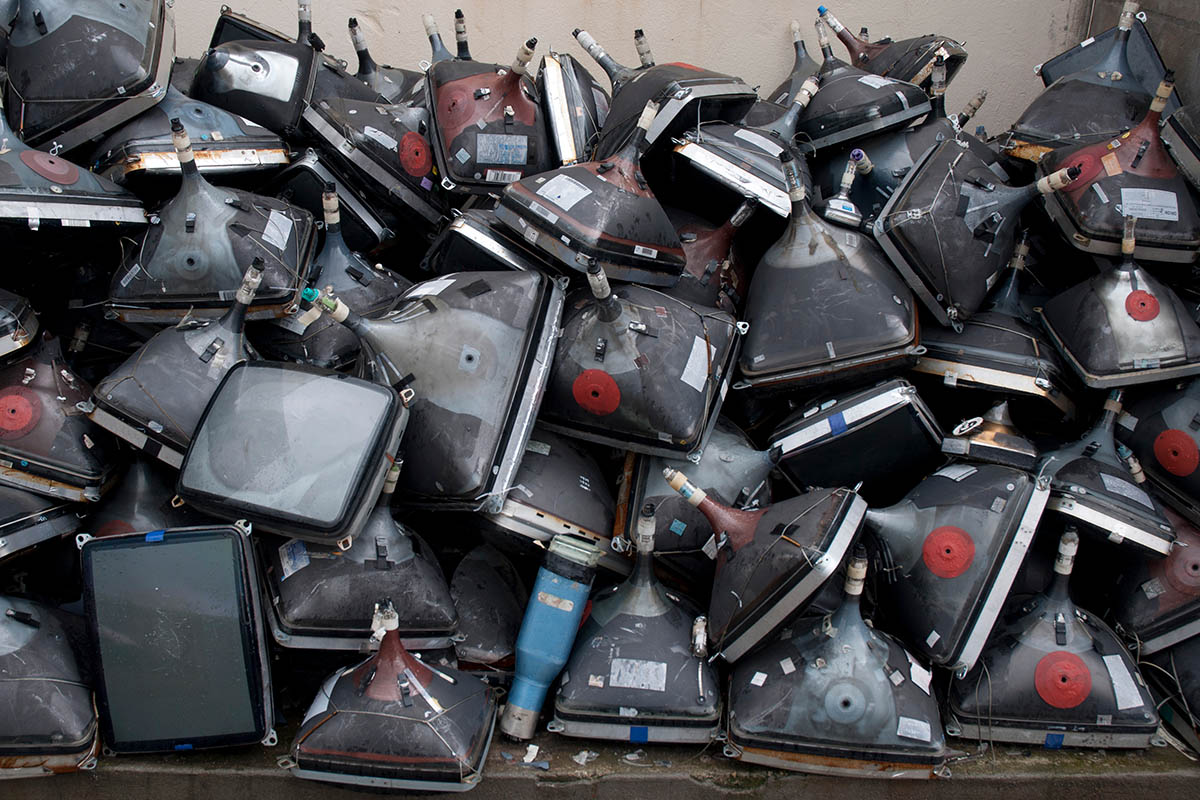
A pile of CRTs gathered for recycling.

Electronics manufacturers are proposing a nationwide point-of-sale fee to fund recycling of CRT devices, an industry group announced last week.

The Consumer Technology Association (CTA) has developed a program that would charge consumers a point-of-sale fee on new televisions and monitors. Money collected would be used to fund recycling efforts for problematic legacy devices. Federal elected leaders would need to pass and sign legislation into law to establish the program.

During a session at the Resource Recycling Conference last week, Walter Alcorn, vice president of environmental affairs and industry sustainability at CTA, said the program would target CRT devices. The advanced fee model is different from the extended producer responsibility (EPR) programs in place in many states, Alcorn said, describing those systems as producing “kind of a hidden tax” because producers are forced to internalize the costs of program management.

Further, Alcorn noted at the Resource Recycling Conference, customers in states without electronics recycling programs may be paying for OEMs’ recycling obligations in other states due to the higher costs of products.

“The idea is to make that visible, to have everybody across the country see that they’re actually paying for recycling whenever they’re buying a new television, a new computer monitor, and then make sure that folks across the country actually would be able to access those services,” Alcorn said.

Checkoff model utilized

CRTs were targeted because of the difficulties associated with recycling them. They are occasionally stockpiled and abandoned, leaving a mess for government agencies and landlords to clean up.

“Typically what happens is a recycler gets in over their head and then walks away from the site and leaves a warehouse full of old gaylords of CRT televisions and monitors,” Alcorn explained. “That continues to be an issue.”

The stockpiling problem creates expensive cleanups. But proper recycling of CRT devices is an expensive process as well. CTA has been looking into how it could tax consumer electronics products to pay for recycling costs, Alcorn said. But in the U.S., there aren’t very many ways that industry can tax itself legally, he noted.

“As a matter of fact, typically we’re restricted from doing that by antitrust laws. It’s called collusion and price fixing,” Alcorn said. The industry can’t go out and say it’s going to raise the price of everybody’s TVs by $10, for example. “We just can’t do that.”

So the consumer electronics industry has put together a proposal that mirrors the U.S. Department of Agriculture’s “checkoff” programs. These programs collect fees from all producers of a specific commodity product. The collected funds are used to research and promote that product generally, without referencing individual brands. The goal is for each company to contribute to an effort that benefits them all. The “Got Milk” ad campaign was funded in this manner.

Fee mechanics

Under the CTA proposal, in any state that does not already have an advanced recycling fee on monitors and TVs – in other words, any state other than California – this program would charge a point-of-sale fee of $10 or less per unit. That fee, Alcorn explained, “would go to paying for the recycling of the old technology televisions and computer monitors.”

The money could be routed through the Department of Commerce, Alcorn said. Once collected, the funds would go to pay for recycling service providers, including processors and collectors.

“The idea, also, is to help take care of those abandoned warehouses of CRTs and other places where CRTs have been dumped and abandoned,” Alcorn noted, although he stressed that this effort would secure financing, but would not be a regulatory activity. Regulations would still be up to state laws and the U.S. EPA’s Resource Conservation and Recovery Act (RCRA).

Furthermore, although the funds could go toward cleanups, this wouldn’t relieve any financial or cleanup liability on the recycling company for stockpiling. And the funding program would not change anything about RCRA, the Comprehensive Environmental Response, Compensation, and Liability Act (CERCLA, also called Superfund law) or any state cleanup liability laws.

Wheels in motion

CTA is actively proposing the fee concept to lawmakers on Capitol Hill, Alcorn said, noting that a program as big as this can’t be done without a law. It’s moving into the lobbying stage currently.

“So, we’ll see,” he said to applause in the room at the Resource Recycling Conference. “I mean, you’ve got to try. If you don’t try, it’s never going to happen.”

Alcorn said the CTA thinks the proposal has a shot at passing, although he noted it might be a long shot.

As CTA is proposing it, the program would go on for seven years. The manufacturers of the products would start the program and could end it early if it’s not working as planned. A multi-stakeholder board would oversee the program, determining fee amounts, standards for recycling operators receiving the funding and distributions of money.

Photo credit: Drazah/Shutterstock

 

Tags: CRTsIndustry GroupsLegislation

TweetShare
Colin Staub

Colin Staub

Colin Staub was a reporter and associate editor at Resource Recycling until August 2025.

Related Posts

Recycling education needs consistency, simplicity 

byBrian Clark Howard
February 25, 2026

Several members of Circular Action Alliance team shared insights during a workshop at the 2026 Resource Recycling Conference in San...

Minnesota publishes prelim EPR assessment

Minnesota publishes prelim EPR assessment

byAntoinette Smith
February 20, 2026

The report will inform recommendations featured in the next report to develop the state's EPR program for packaging.

Vermont’s battery stewardship law targets fire risk

byStefanie Valentic
February 20, 2026

The state's new law gives residents more options to safely dispose of everything from single-use alkaline batteries to medium-format e-bike...

SWANA, Fire Rover partner on reporting tool

byAntoinette Smith
February 19, 2026

Industry stakeholders can use the new site to report fires occurring at their facilities or in vehicles, to help support...

Carton recycling reaches 63% of US households

byScott Snowden
February 17, 2026

Carton recycling access rose to 63% of US households in 2025 after 2.5M homes gained service, with 86% of recycling...

UN trade data, tools aim to shape plastics treaty talks

UN trade data, tools aim to shape plastics treaty talks

byAntoinette Smith
February 17, 2026

UN agencies aim to use the harmonized trade data and a statistical framework to improve outcomes for the global negotiations,...

Load More
Next Post
A pile of electronic scrap ready for recycling.

Sims' higher earnings came from fewer pounds

More Posts

WM opens new $90m MRF in south Florida 

WM opens new $90m MRF in south Florida 

February 23, 2026
PET bales stacked for recycling.

Evergreen closing RPET plants in Ohio, New York

February 24, 2026
Battery fire risk isn’t going away. Insurance is responding

Battery fire risk isn’t going away. Insurance is responding

February 24, 2026
Study links tagging tactics to lower contamination rates

Arizona, Reynolds reach settlement on Hefty bag lawsuit

February 23, 2026
Minnesota publishes prelim EPR assessment

Minnesota publishes prelim EPR assessment

February 20, 2026
How will 2026 unfold for plastics recycling?

How will 2026 unfold for plastics recycling?

February 19, 2026
Chinese processing group details goals for US visit

AMP lays out vision of next-generation, AI-driven MRFs

July 24, 2024
Recycled plastic lumber firms report diverging results

Trex CEO to retire after 23-year run

February 25, 2026
Polyolefins producer provides PCR updates

Economic downturn forces LyondellBasell to trim sustainability goals

February 23, 2026
Where textile MRFs fit in a global recovery system

Where textile MRFs fit in a global recovery system

February 19, 2026
Load More

About & Publications

About Us

Staff

Archive

Magazine

Work With Us

Advertise
Jobs
Contact
Terms and Privacy

Newsletter

Get the latest recycling news and analysis delivered to your inbox every week. Stay ahead on industry trends, policy updates, and insights from programs, processors, and innovators.

Subscribe

Welcome Back!

Login to your account below

Forgotten Password?

Retrieve your password

Please enter your username or email address to reset your password.

Log In

Add New Playlist

No Result
View All Result
  • The Latest
  • Analysis
  • Recycling
  • E-Scrap
  • Plastics
  • Policy Now
  • Conferences
    • E-Scrap Conference
    • Plastics Recycling Conference
    • Resource Recycling Conference
    • Textiles Recovery Summit
  • Magazine
  • About Us
  • Advertise
  • Archive
  • Jobs
  • Staff
Subscribe
This website uses cookies. By continuing to use this website you are giving consent to cookies being used. Visit our Privacy and Cookie Policy.