
Advertisement Header Ad
Resource Recycling
  • The Latest
  • Analysis
    • All
    • Certification Scorecard
    • Industry Announcements
    • Opinion

    Certification scorecard for Dec. 18, 2025

    Industry announcements for the week of Dec. 15

    Certification scorecard for December 10, 2025

    Industry Announcements for Week of December 8

    Certification Scorecard for December 3, 2025

    Industry Announcements for Week of December 1

    News from Dynamic Lifecycle Innovations, Precision E-Cycle

    News from Northeast Recycling Council, Plastipak and more

    News from Northeast Recycling Council, Sortera Technologies and more

  • Conferences
  • Publications

    Other Topics

    Textiles
    Organics
    Packaging
    Glass
    Brand Owners

    Metals
    Technology
    Research
    Markets
    Grant Watch

    All Topics

Subscribe
No Result
View All Result
Resource Recycling
  • The Latest
  • Analysis
    • All
    • Certification Scorecard
    • Industry Announcements
    • Opinion

    Certification scorecard for Dec. 18, 2025

    Industry announcements for the week of Dec. 15

    Certification scorecard for December 10, 2025

    Industry Announcements for Week of December 8

    Certification Scorecard for December 3, 2025

    Industry Announcements for Week of December 1

    News from Dynamic Lifecycle Innovations, Precision E-Cycle

    News from Northeast Recycling Council, Plastipak and more

    News from Northeast Recycling Council, Sortera Technologies and more

  • Conferences
  • Publications

    Other Topics

    Textiles
    Organics
    Packaging
    Glass
    Brand Owners

    Metals
    Technology
    Research
    Markets
    Grant Watch

    All Topics

Subscribe
No Result
View All Result
Resource Recycling
No Result
View All Result
Home Plastics

How the use of robotics is evolving at sorting facilities

Colin StaubbyColin Staub
January 13, 2021
in Plastics
Ikea works with supplier to develop recycled PET foil
Share on XLinkedin

A recycling facility operator and a robotics company say artificial intelligence is providing materials recovery firms with much-needed data to analyze changes in the recycling stream. That’s in addition to sortation improvements.

Representatives from AMP Robotics and GFL Environmental spoke about the benefits of robotics during a recent presentation hosted by Greenbiz, a business sustainability media and events company.

The event was tied to an announcement from AMP and Keurig Dr Pepper (KDP), which recently redesigned its K-Cup coffee pods to produce them in a polypropylene format that is recyclable in many U.S. programs, though not all.

After the product redesign, KDP and AMP Robotics worked together to equip AMP’s robotic sorting systems with the tools to properly identify and sort the cups in a materials recovery facility (MRF). The project partners hailed the collaboration as an example of how producers, equipment/technology companies and other recycling stakeholders can work together to improve sortation.

“It really shows how artificial intelligence can help these facilities adapt quickly and really take advantage of these valuable material streams,” said Matanya Horowitz, founder and CEO of AMP Robotics.

Mitigating workforce and data challenges

The use of robots has grown exponentially in recent years. In 2019, Plastics Recycling Update tallied nearly 100 in use in North America from providers AMP, Bulk Handling Systems (BHS), Machinex and ZenRobotics. Since then, others have entered the market, including Bollegraaf (Van Dyk Recycling Solutions is selling the robot in North America). In November, AMP announced it signed a deal with Waste Connections to deploy two dozen robots to MRFs across the country.

Horowitz of AMP Robotics said artificial intelligence has changed how robotics can be incorporated into MRFs. Machine learning allows robots to, over time, identify more and more items within the recycling stream. That includes materials that are smashed up, moldy, dirty and “generally inconsistent,” he said.

“This is largely what’s kept robots from being used in the recycling industry already,” Horowitz added. His company this month announced it raised $55 million from a number of investment sources.

During the Greenbiz event, Brent Hildebrand, vice president of recycling for GFL, spoke on behalf of the Canadian-headquartered hauler and MRF operator, which is one of the largest in North America. Hildebrand previously worked in positions at AMP, as well as Alpine Waste & Recycling, which was acquired by GFL.

The Denver-area Alpine Waste & Recycling MRF was an early adopter of robotics technology. One factor that led the facility to install robotic sorting systems was the rising cost of running a MRF, Hildebrand said.

“Part of those rising costs is rising labor cost,” Hildebrand said. “And on top of that, it’s just finding labor for these sites.”

The company found robotics to be a promising alternative when the company can’t find enough manual sorting personnel to staff its facilities.

Another driver is the evolving material stream, Hildebrand said. He pointed to PET bottles and aluminum cans as two significant examples of recyclable products that have been made with less and less material over the years.

“That changes the dynamic for what we can produce from a volume standpoint,” Hildebrand said.

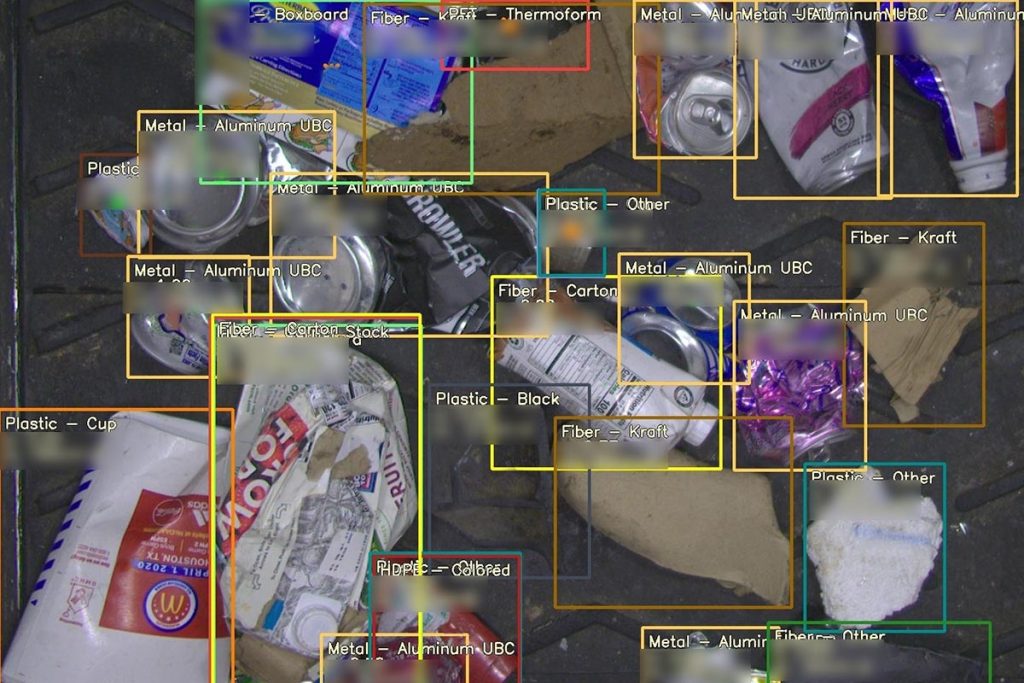
Artificial intelligence can help the company respond to these changes in inbound material, he noted. For one, it can help a MRF determine exactly how the material stream is changing, by giving MRF operators the data to perceive changes. Beyond providing efficient material sorting, the artificial intelligence in robots is “really closely tied to a challenge in the industry of extracting information about the process,” Horowitz said.

“Really a core problem for recycling is that there hasn’t been a sensor that would let you tell what’s going on in the material stream, so identify how many bottles, identify whose bottles, identify what bottles are high quality and things like that,” Horowitz said. “And now with artificial intelligence, you sort of have this core capability that you can take advantage of in different ways.”
AMP Robotics - AI on material stream
View of the AMP’s AI material identification at work on a sorting line.

Precision and customization

In addition to collecting data to develop a baseline of information, the artificial intelligence can help MRFs adapt quickly when new materials are introduced into packaging

“What’s powerful about this technology is that it can provide a new level of identification,” Horowitz said. “Pretty much anything you can teach a person to identify, you can teach our systems to identify as well.”

Robots can learn to identify different packaging from specific brands, types of material, shapes of packaging and more.

These expanded identification abilities have significant practical applications for MRF operators, particularly when it comes to producing higher-value commodities. As an example, Horowitz pointed to the common MRF practice of producing bales of mixed plastics Nos. 3-7, which are sold for typically low prices. But greater sorting can change that equation.

“When you start to do things like separate out the No. 5 plastics, the polypropylene, that can actually have significant value,” Horowitz said. “There are similar patterns in paper. If you separate out the office paper and the newspaper, it’s also more valuable.”

Hildebrand added that this sorting ability even allows MRFs to produce customized commodities for specific end users.

“In our business, we have buyers of these materials and they want a certain specification,” Hildebrand said. For example, buyers might want a bit more OCC included in a mixed-paper bale, depending on the application. MRFs that can meet those custom specifications may fetch a premium for their bales.

“You can kind of tailor these recipes to what your buyers want,” Hildebrand said.

A version of this story appeared in Resource Recycling on January 12.

 

Tags: Technology
Colin Staub

Colin Staub

Colin Staub was a reporter and associate editor at Resource Recycling until August 2025.

Related Posts

Glacier AI at Penn Waste aims to improve PET, fiber output

Glacier AI at Penn Waste aims to improve PET, fiber output

byScott Snowden
October 8, 2025

Glacier, the Amazon-backed AI and robotics company, has installed its sorting technology at Penn Waste’s MRF in York County, Pennsylvania,...

APR launches recyclability assessment platform

APR launches recyclability assessment platform

byScott Snowden
October 1, 2025

The Association of Plastic Recyclers will launch a new digital platform to help brands and packaging suppliers evaluate the recyclability...

Closed Loop invests $10M in recycler GreenMantra

Closed Loop invests $10M in recycler GreenMantra

byStefanie Valentic
September 24, 2025

As vulnerabilities intensify across European plastics recycling markets, Closed Loop Partners (CLP) has deployed a $10 million loan to Canadian...

How AI sorting tech can help meet emerging EPR needs

byAndrew Sposato
July 22, 2025

Emerging extended producer responsibility programs for packaging are creating demand for more accurate data, higher diversion rates and a flexible...

Project brings rare earth recovery into e-scrap facility

Project brings rare earth recovery into e-scrap facility

byColin Staub
July 10, 2025

A pilot project is demonstrating a bolt-on modular system that could make it logistically and economically feasible for e-scrap processors...

RIT researchers develop AI-based textile recycling system

RIT researchers develop AI-based textile recycling system

byAndrew Hawthorne
July 2, 2025

Researchers at the Rochester Institute of Technology are developing a high-speed automated system to disassemble and recycle clothing.

Load More
Next Post

New year brings higher bale prices

More Posts

ERI and ReElement partner on rare earth magnet recovery

ERI and ReElement partner on rare earth magnet recovery

November 26, 2025
Cyber risks confront ITAD work, contracts, coverage

Cyber risks confront ITAD work, contracts, coverage

November 26, 2025
Ohio start-up turns plastics into high-end furniture

Ohio start-up turns plastics into high-end furniture

November 24, 2025
WM adds PP and paper cups to curbside recycling lists

WM adds PP and paper cups to curbside recycling lists

November 24, 2025
Atlas acquisition boosts Circular Services’ organics reach

Atlas acquisition boosts Circular Services’ organics reach

November 24, 2025
Policy Now | December 2025 – Year-end nears, policy talks continue

Policy Now | December 2025 – Year-end nears, policy talks continue

December 1, 2025
WM rolling out curbside acceptance of PP cups 

WM rolling out curbside acceptance of PP cups 

November 25, 2025
Ohio startup creates end market for small challenging plastics

Ohio startup creates end market for small challenging plastics

November 25, 2025
Global recycling patent trends may reflect legislative push

Global recycling patent trends may reflect legislative push

November 25, 2025
Oregon’s Recycling Modernization Act faces injunction

Oregon’s Recycling Modernization Act faces injunction

December 2, 2025
Load More

About & Publications

About Us

Staff

Archive

Magazine

Work With Us

Advertise
Jobs
Contact
Terms and Privacy

Newsletter

Get the latest recycling news and analysis delivered to your inbox every week. Stay ahead on industry trends, policy updates, and insights from programs, processors, and innovators.

Subscribe

Welcome Back!

Login to your account below

Forgotten Password?

Retrieve your password

Please enter your username or email address to reset your password.

Log In

Add New Playlist

No Result
View All Result
  • The Latest
  • Analysis
  • Recycling
  • E-Scrap
  • Plastics
  • Conferences
    • E-Scrap Conference
    • Plastics Recycling Conference
    • Resource Recycling Conference
    • Textiles Recovery Summit
  • Magazine
  • About Us
  • Advertise
  • Archive
  • Jobs
  • Staff
Subscribe
This website uses cookies. By continuing to use this website you are giving consent to cookies being used. Visit our Privacy and Cookie Policy.