
Resource Recycling
  • The Latest
  • Analysis
    • All
    • Certification Scorecard
    • Industry Announcements
    • Opinion

    Certification Scorecard — Week of April 13, 2026

    EV Battery Pack - Sergii Chernov-Shutterstock

    Redwood, Rivian deal fuels US infrastructure plans

    Bloom ESG and e-Stewards roll out critical metals metric

    Colorado regulators suggest mid-range EPR scenario

    Why collaboration on plastic waste still matters

    Battery processors lay out latest moves

    Battery recycler Ascend Elements files for bankruptcy

    EPR fees are a market signal. Here’s what they’re telling you.

    EPR fees are a market signal. Here’s what they’re telling you.

    Wolframite ore, the primary ore of tungsten from Altai, Russia

    Tungsten scrap export controls draw industry attention

    Certification Scorecard — Week of April 6, 2026

    Closed Loop Partners acquires Sutter Metals, connecting electronics disposition to metals recovery

  • Conferences
  • Publications

    Other Topics

    Textiles
    Organics
    Packaging
    Glass
    Brand Owners

    Metals
    Technology
    Research
    Markets
    Grant Watch

    All Topics

Subscribe
No Result
View All Result
Resource Recycling
  • The Latest
  • Analysis
    • All
    • Certification Scorecard
    • Industry Announcements
    • Opinion

    Certification Scorecard — Week of April 13, 2026

    EV Battery Pack - Sergii Chernov-Shutterstock

    Redwood, Rivian deal fuels US infrastructure plans

    Bloom ESG and e-Stewards roll out critical metals metric

    Colorado regulators suggest mid-range EPR scenario

    Why collaboration on plastic waste still matters

    Battery processors lay out latest moves

    Battery recycler Ascend Elements files for bankruptcy

    EPR fees are a market signal. Here’s what they’re telling you.

    EPR fees are a market signal. Here’s what they’re telling you.

    Wolframite ore, the primary ore of tungsten from Altai, Russia

    Tungsten scrap export controls draw industry attention

    Certification Scorecard — Week of April 6, 2026

    Closed Loop Partners acquires Sutter Metals, connecting electronics disposition to metals recovery

  • Conferences
  • Publications

    Other Topics

    Textiles
    Organics
    Packaging
    Glass
    Brand Owners

    Metals
    Technology
    Research
    Markets
    Grant Watch

    All Topics

Subscribe
No Result
View All Result
Resource Recycling
No Result
View All Result
Home Recycling

How the use of robotics is evolving at MRFs

Colin StaubbyColin Staub
January 12, 2021
in Recycling
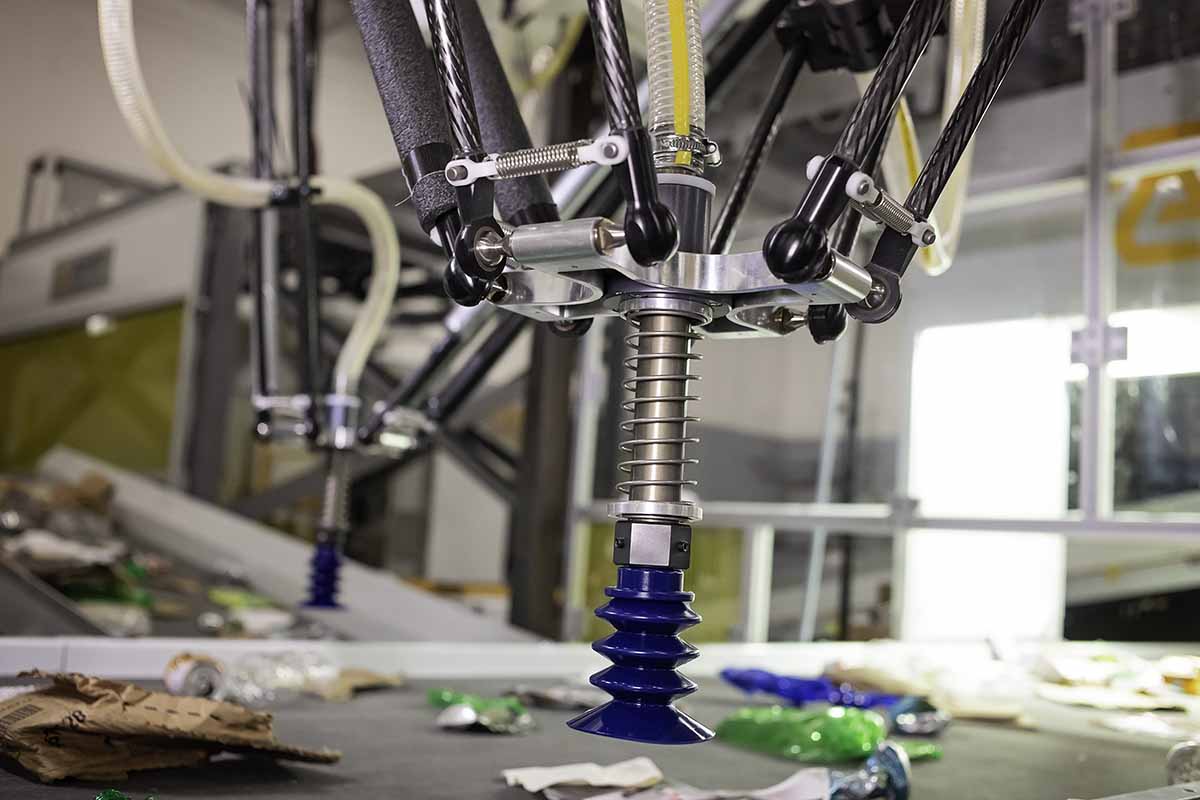
A leader with AMP Robotics says artificial intelligence has changed how robotics can be incorporated into MRFs. | Courtesy of AMP Robotics.

A recycling facility operator and a robotics company say artificial intelligence is providing materials recovery firms with much-needed data to analyze changes in the recycling stream. That’s in addition to sortation improvements.

Representatives from AMP Robotics and GFL Environmental spoke about the benefits of robotics during a recent presentation hosted by Greenbiz, a business sustainability media and events company.

The event was tied to an announcement from AMP and Keurig Dr Pepper (KDP), which recently redesigned its K-Cup coffee pods to produce them in a polypropylene format that is recyclable in many U.S. programs, though not all.

After the product redesign, KDP and AMP Robotics worked together to equip AMP’s robotic sorting systems with the tools to properly identify and sort the cups in a MRF. The project partners hailed the collaboration as an example of how producers, equipment/technology companies and other recycling stakeholders can work together to improve sortation.

“It really shows how artificial intelligence can help these facilities adapt quickly and really take advantage of these valuable material streams,” said Matanya Horowitz, founder and CEO of AMP Robotics.

Mitigating workforce and data challenges

The use of robots has grown exponentially in recent years. In 2019, Resource Recycling tallied nearly 100 in use in North America from providers AMP, Bulk Handling Systems (BHS), Machinex and ZenRobotics. Since then, others have entered the market, including Bollegraaf (Van Dyk Recycling Solutions is selling the robot in North America). In November, AMP announced it signed a deal with Waste Connections to deploy two dozen robots to MRFs across the country.

Horowitz of AMP Robotics said artificial intelligence has changed how robotics can be incorporated into MRFs. Machine learning allows robots to, over time, identify more and more items within the recycling stream. That includes materials that are smashed up, moldy, dirty and “generally inconsistent,” he said.

“This is largely what’s kept robots from being used in the recycling industry already,” Horowitz added. His company this month announced it raised $55 million from a number of investment sources.

During the Greenbiz event, Brent Hildebrand, vice president of recycling for GFL, spoke on behalf of the Canadian-headquartered hauler and MRF operator, which is one of the largest in North America. Hildebrand previously worked in positions at AMP, as well as Alpine Waste & Recycling, which was acquired by GFL.

The Denver-area Alpine Waste & Recycling MRF was an early adopter of robotics technology. One factor that led the facility to install robotic sorting systems was the rising cost of running a MRF, Hildebrand said.

“Part of those rising costs is rising labor cost,” Hildebrand said. “And on top of that, it’s just finding labor for these sites.”

The company found robotics to be a promising alternative when the company can’t find enough manual sorting personnel to staff its facilities.

Another driver is the evolving material stream, Hildebrand said. He pointed to PET bottles and aluminum cans as two significant examples of recyclable products that have been made with less and less material over the years.

“That changes the dynamic for what we can produce from a volume standpoint,” Hildebrand said.

Artificial intelligence can help the company respond to these changes in inbound material, he noted. For one, it can help a MRF determine exactly how the material stream is changing, by giving MRF operators the data to perceive changes. Beyond providing efficient material sorting, the artificial intelligence in robots is “really closely tied to a challenge in the industry of extracting information about the process,” Horowitz said.

“Really a core problem for recycling is that there hasn’t been a sensor that would let you tell what’s going on in the material stream, so identify how many bottles, identify whose bottles, identify what bottles are high quality and things like that,” Horowitz said. “And now with artificial intelligence, you sort of have this core capability that you can take advantage of in different ways.”

Precision and customization

In addition to collecting data to develop a baseline of information, the artificial intelligence can help MRFs adapt quickly when new materials are introduced into packaging

“What’s powerful about this technology is that it can provide a new level of identification,” Horowitz said. “Pretty much anything you can teach a person to identify, you can teach our systems to identify as well.”

Robots can learn to identify different packaging from specific brands, types of material, shapes of packaging and more.

These expanded identification abilities have significant practical applications for MRF operators, particularly when it comes to producing higher-value commodities. As an example, Horowitz pointed to the common MRF practice of producing bales of mixed plastics Nos. 3-7, which are sold for typically low prices. But greater sorting can change that equation.

“When you start to do things like separate out the No. 5 plastics, the polypropylene, that can actually have significant value,” Horowitz said. “There are similar patterns in paper. If you separate out the office paper and the newspaper, it’s also more valuable.”

Hildebrand added that this sorting ability even allows MRFs to produce customized commodities for specific end users.

“In our business, we have buyers of these materials and they want a certain specification,” Hildebrand said. For example, buyers might want a bit more OCC included in a mixed-paper bale, depending on the application. MRFs that can meet those custom specifications may fetch a premium for their bales.

“You can kind of tailor these recipes to what your buyers want,” Hildebrand said.

 

Tags: MRFsTechnology
TweetShare
Colin Staub

Colin Staub

Colin Staub was a reporter and associate editor at Resource Recycling until August 2025.

Related Posts

EV Battery Pack - Sergii Chernov-Shutterstock

Redwood, Rivian deal fuels US infrastructure plans

byStefanie Valentic
April 15, 2026

Batteries that are no longer ideal for powering a vehicle still have substantial capacity left. Automobile manufacturer Rivian and battery...

TOMRA rolls out updated FINDER with AI tools

byScott Snowden
April 14, 2026

TOMRA introduced an updated FINDER metal sorting system with modular sensors and AI tools, aiming to improve separation of complex...

Amazon, DOE partner on critical materials recovery

byScott Snowden
April 13, 2026

DOE and Amazon will study recovery of graphite from textiles and gallium from IT hardware, aiming to strengthen US supply...

WM opens new $60m MRF in Indy

byAntoinette Smith
April 10, 2026

The newest recycling facility has annual capacity of 200,000 tons and will send all mixed paper to Pratt Industries for...

Plastics Recyclers Have the Capacity to Recycle More. Now Let’s Use It.

Study finds most recycling occurs within 30 miles of access

byBrian Clark Howard
April 8, 2026

Researchers at the University at Buffalo also found that Americans produce similar volumes of plastic package waste regardless of economic...

Packaging sector sees shift from AI pilots to wider use

byScott Snowden
April 1, 2026

AI adoption is expanding across packaging operations as costs fall and use cases widen, though concerns around accountability, ROI and...

Load More
Next Post
Slew of food-contact PET approvals issued

Slew of food-contact PET approvals issued

More Posts

EPR fees are a market signal. Here’s what they’re telling you.

EPR fees are a market signal. Here’s what they’re telling you.

April 10, 2026
Wolframite ore, the primary ore of tungsten from Altai, Russia

Tungsten scrap export controls draw industry attention

April 9, 2026

WM opens new $60m MRF in Indy

April 10, 2026

Trafigura signs $1.1b deal for recycled battery metals

April 8, 2026
Solarcycle starts up Georgia recycling plant

S3399 signals a shift in how states are tackling solar panel waste

April 6, 2026
Battery processors lay out latest moves

Battery recycler Ascend Elements files for bankruptcy

April 13, 2026

GFL acquires SECURE Waste for $6.4bn

April 13, 2026
Colorado regulators suggest mid-range EPR scenario

Why collaboration on plastic waste still matters

April 13, 2026
End markets, policy key to RPET viability

End markets, policy key to RPET viability

April 8, 2026
Industry group: Help us find the plastic bale volumes we need

PET bales sink further as other grades firm 

April 15, 2026
Load More

About & Publications

About Us

Staff

Archive

Magazine

Work With Us

Advertise
Jobs
Contact
Terms and Privacy

Newsletter

Get the latest recycling news and analysis delivered to your inbox every week. Stay ahead on industry trends, policy updates, and insights from programs, processors, and innovators.

Subscribe

Welcome Back!

Login to your account below

Forgotten Password?

Retrieve your password

Please enter your username or email address to reset your password.

Log In

Add New Playlist

No Result
View All Result
  • The Latest
  • Analysis
  • Recycling
  • E-Scrap
  • Plastics
  • Policy Now
  • Conferences
    • E-Scrap Conference
    • Plastics Recycling Conference
    • Resource Recycling Conference
    • Textiles Recovery Summit
  • Magazine
  • About Us
  • Advertise
  • Archive
  • Jobs
  • Staff
Subscribe
This website uses cookies. By continuing to use this website you are giving consent to cookies being used. Visit our Privacy and Cookie Policy.