




Resource Recycling
  • The Latest
  • Analysis
    • All
    • Certification Scorecard
    • Industry Announcements
    • Opinion

    Closed Loop Partners acquires Sutter Metals, connecting electronics disposition to metals recovery

    Certification Scorecard — Week of March 30, 2026

    Certification scorecard – Week of March 23, 2026

    Certification Scorecard – Week of March 16, 2026

    Groups identify recovered plastics users in the Northeast

    Bale pricing for recycled plastics diverges

    Why global ITAD is stranded in the Gulf

    Why global ITAD is stranded in the Gulf

    Certification scorecard for the week of March 9, 2026

    Diversion Dynamics: Secondhand exports slow down fast fashion

    Certification scorecard for the week of March 2, 2026

  • Conferences
  • Publications

    Other Topics

    Textiles
    Organics
    Packaging
    Glass
    Brand Owners

    Metals
    Technology
    Research
    Markets
    Grant Watch

    All Topics

Subscribe
No Result
View All Result
Resource Recycling
  • The Latest
  • Analysis
    • All
    • Certification Scorecard
    • Industry Announcements
    • Opinion

    Closed Loop Partners acquires Sutter Metals, connecting electronics disposition to metals recovery

    Certification Scorecard — Week of March 30, 2026

    Certification scorecard – Week of March 23, 2026

    Certification Scorecard – Week of March 16, 2026

    Groups identify recovered plastics users in the Northeast

    Bale pricing for recycled plastics diverges

    Why global ITAD is stranded in the Gulf

    Why global ITAD is stranded in the Gulf

    Certification scorecard for the week of March 9, 2026

    Diversion Dynamics: Secondhand exports slow down fast fashion

    Certification scorecard for the week of March 2, 2026

  • Conferences
  • Publications

    Other Topics

    Textiles
    Organics
    Packaging
    Glass
    Brand Owners

    Metals
    Technology
    Research
    Markets
    Grant Watch

    All Topics

Subscribe
No Result
View All Result
Resource Recycling
No Result
View All Result
Home Recycling

In Our Opinion: Policy leaders should embrace the Zero Waste Hierarchy

byGary Liss and Jamie Kaminski
July 29, 2025
in Recycling
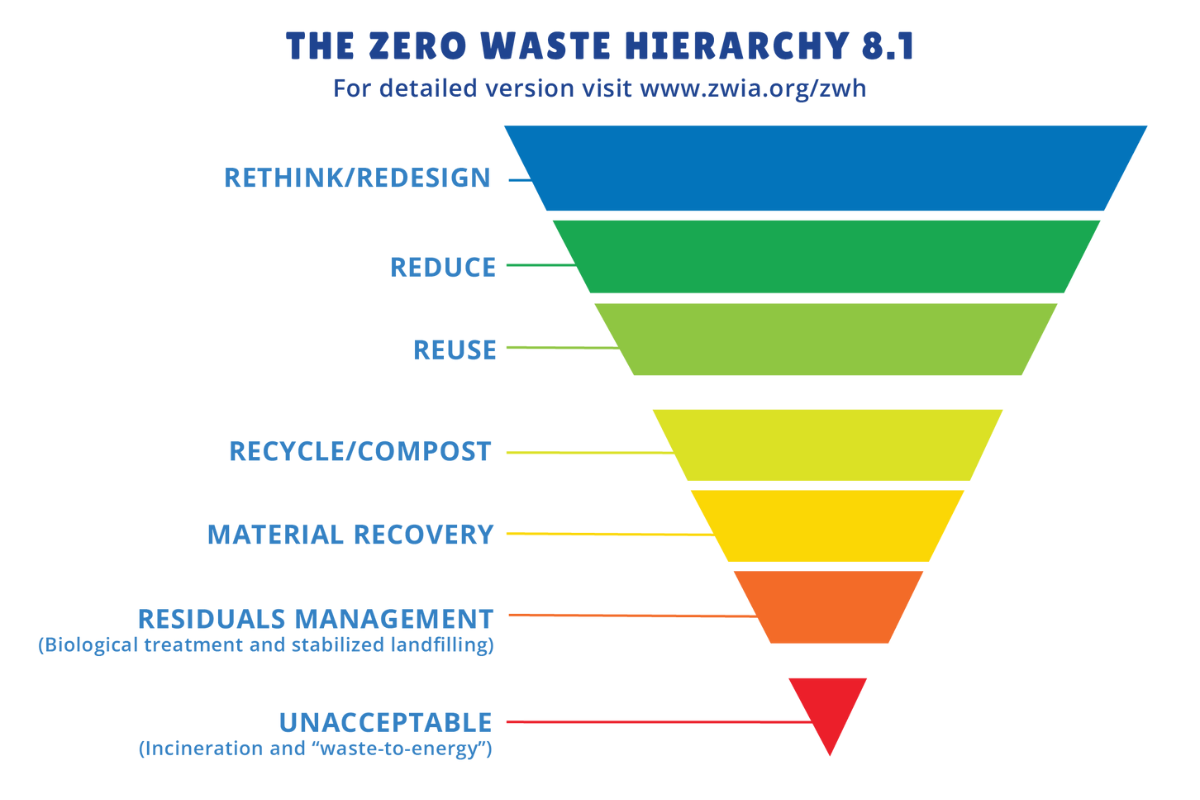
The Zero Waste Hierarchy was recently updated with refined definitions, a new guiding principle and more. | Photo courtesy Zero Waste International Alliance

Waste hierarchies have become essential tools for setting policy direction at every level of government. By clearly communicating which strategies are most environmentally and socially preferable, they help guide decisions on infrastructure investment, program design, and regulatory priorities.

The USEPA’s 2023 Wasted Food Scale is a recent example of this approach in action. For the first time, the EPA placed incineration (with or without energy recovery) on the same level as landfilling, a notable departure from earlier hierarchies that often ranked energy recovery above disposal. This change aligns with findings in the EPA’s 2023 report, From Field to Bin: The Environmental Impacts of U.S. Food Waste Management Pathways, which concluded that landfilling, incineration, and sending food waste down the drain have the largest environmental impacts and offer the least potential for circularity.
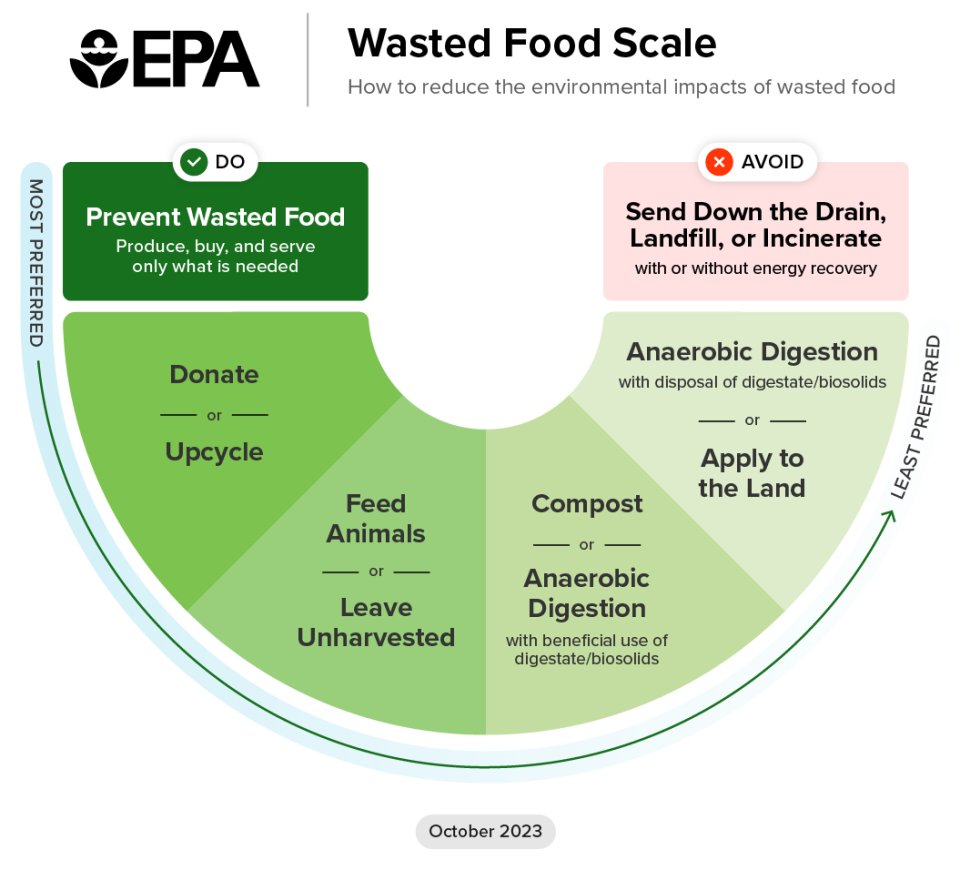
By recognizing that waste prevention, food donation, and upcycling as far more beneficial, the EPA has taken a meaningful step toward more accurate and effective policy direction. The Wasted Food Scale, as EPA notes, “reflects the latest science and changes in technologies and operational practices for wasted food management pathways.”

This kind of recalibration, one that clarifies what truly supports environmental progress, is exactly what’s needed more broadly in waste policy. And it’s why a growing number of governments, organizations, and institutions are now turning to the Zero Waste Hierarchy.

Recently updated as Version 8.1, the Zero Waste Hierarchy offers a comprehensive framework for managing all discarded materials, in a way that aligns with the latest environmental, economic, and health priorities. It places emphasis on rethinking, redesigning, and reducing waste upstream, and provides detailed guidance on acceptable and unacceptable practices throughout the lifecycle of materials.

The Zero Waste Hierarchy makes a clear break from frameworks that still include energy recovery technologies like incineration, pyrolysis, and gasification. These practices are fundamentally at odds with Zero Waste principles because they destroy resources, generate harmful emissions, and undermine efforts to build truly circular systems. By explicitly rejecting these approaches, the hierarchy reinforces the need to invest in solutions that preserve material value and prevent waste at the source.

By expanding its focus beyond materials to include equity and lifecycle considerations, the Zero Waste Hierarchy offers governments and institutions a more complete framework for decision-making.

The Zero Waste Hierarchy Version 8.1 strengthens the Hierarchy’s practical value for policymakers, institutions, and communities by incorporating clearer terminology, deeper ethical guidance, and thoughtful flexibility for regional implementation.

Key updates in the Zero Waste Hierarchy Version 8.1 include:

  • Refined Definitions: Updated terminology for circular economy, composting, and closed-loop systems to ensure consistency and support clear implementation.
  • New Guiding Principle – Do No Harm: This principle encourages organizations to evaluate the full lifecycle impacts of materials and prioritize choices that reduce harm to people and the environment.
  • Stronger Language for Do Not Export Harm: Expanded language ensures materials aren’t sent to regions with weaker health or environmental standards or where they are unwanted.

The Zero Waste Hierarchy and its updates were developed through the collective input and expertise of Zero Waste organizations and leaders worldwide, including Zero Waste Canada, Zero Waste British Columbia, Zero Waste USA, Zero Waste Europe, the Global Alliance for Incinerator Alternatives, and the Energy Justice Network. Additionally, the draft update was shared with the global Zero Waste network for review and comments to ensure comprehensive insights and enhancement, including over 500 Zero Waste International Alliance (ZWIA) members and 60 ZWIA affiliates worldwide.

ZWIA is a global organization committed to advancing Zero Waste principles through the development of tools, policies, and networks that promote sustainability and social justice. ZWIA leads the evolution of Zero Waste definitions and standards, offering resources to guide communities and organizations toward meaningful change.

Just as the EPA’s Wasted Food Scale reflects the agency’s responsiveness to current research and operational realities, the Zero Waste Hierarchy reflects where the broader field of sustainable materials management and circular economy are headed. These frameworks represent complementary steps along the same path.

ZWIA is calling on all levels of government to build on this momentum by updating their waste hierarchies to follow or align with the Zero Waste Hierarchy. This shift enables more strategic policymaking, steers investment away from systems with limited long-term value, and accelerates the transition to approaches that conserve resources, protect public health, and reduce emissions. As more jurisdictions update their approaches to strengthen circular economy outcomes, many are recognizing that the Zero Waste Hierarchy provides greater clarity and precision.  

The full 14-page Version 8.1 of the Zero Waste Hierarchy can be found at zwia.org/zwh.

Gary Liss is Chair of the Zero Waste Certifications Committee of ZWIA, Vice President of Zero Waste USA, Lifetime Honorary Board Member of the National Recycling Coalition, and Principal of Zero Waste Associates.

Jamie Kaminski is Chair of the Zero Waste Hierarchy Working Group at ZWIA, a Board Member of Zero Waste Canada, and President of HSR Zero Waste. He leads work for ZWIA on policy development and implementation of the Zero Waste Hierarchy, helping guide communities, businesses, and institutions toward more effective waste prevention and materials management strategies.


TweetShare
Gary Liss and Jamie Kaminski

Gary Liss and Jamie Kaminski

Related Posts

WM rolling out curbside acceptance of PP cups 

APR releases first semiannual Design Guide update

byBrian Clark Howard
April 3, 2026

The Association of Plastic Recyclers (APR) has published the first semiannual APR Design Guide for Plastics Recyclability. Now in its...

PCA closing Richmond plant

byKeith Loria
April 2, 2026

Packaging Corporation of America is closing a corrugated products plant in Virginia, in a move emblematic of industry trends.

Maryland PaintCare launch press conference in Annapolis

Maryland’s paint recycling program opens

byBrian Clark Howard
April 2, 2026

The state is the latest to launch a stewardship program with PaintCare.

Apparel retailer organization challenges SB 707 textile PRO selection

byStefanie Valentic
April 2, 2026

With the July 1 deadline looming, the American Apparel & Footwear Association has filed a petition questioning CalRecycle's selection of...

With RPET in crisis, focus turns to solutions

With RPET in crisis, focus turns to solutions

byAntoinette Smith
April 2, 2026

Stakeholders from across the RPET value chain share concrete solutions for the short term to help prevent further loss of...

Closed Loop Partners acquires Sutter Metals, connecting electronics disposition to metals recovery

byDavid Daoud
April 2, 2026

The acquisition completes a deliberate chain from enterprise device collection through disposition to raw material recovery, positioning PE capital to...

Load More
Next Post

Women in Circularity: Charlotte Boesch

More Posts

Quebec PRO reflects on first year of packaging EPR

March 30, 2026

ReElement, Mitsubishi partner on rare earth supply chains

March 31, 2026

PCA closing Richmond plant

April 2, 2026
Waste Connection recycling cart in The Dalles, Oregon

First Oregon community expands curbside recycling with EPR funding

April 1, 2026
With RPET in crisis, focus turns to solutions

With RPET in crisis, focus turns to solutions

April 2, 2026
Belgian and Flemish flags fly against a backdrop of an ocean beach

PureCycle receives €40m EU grant for new plant

March 26, 2026
URT builds alliance to remake electronics plastics at scale

Less premium smartphone inventory is reaching recyclers

March 30, 2026
Flexibles players push for collaboration, balance

Flexibles players push for collaboration, balance

March 31, 2026

Report pegs fire losses at $2.5b in US and Canada recycling industry

March 27, 2026
#ESC2025 Speaker Spotlight: Matthew Young

From bootstrap to boom: EVR poised for growth after capital injection

March 26, 2026
Load More

About & Publications

About Us

Staff

Archive

Magazine

Work With Us

Advertise
Jobs
Contact
Terms and Privacy

Newsletter

Get the latest recycling news and analysis delivered to your inbox every week. Stay ahead on industry trends, policy updates, and insights from programs, processors, and innovators.

Subscribe

Welcome Back!

Login to your account below

Forgotten Password?

Retrieve your password

Please enter your username or email address to reset your password.

Log In

Add New Playlist

No Result
View All Result
  • The Latest
  • Analysis
  • Recycling
  • E-Scrap
  • Plastics
  • Policy Now
  • Conferences
    • E-Scrap Conference
    • Plastics Recycling Conference
    • Resource Recycling Conference
    • Textiles Recovery Summit
  • Magazine
  • About Us
  • Advertise
  • Archive
  • Jobs
  • Staff
Subscribe
This website uses cookies. By continuing to use this website you are giving consent to cookies being used. Visit our Privacy and Cookie Policy.