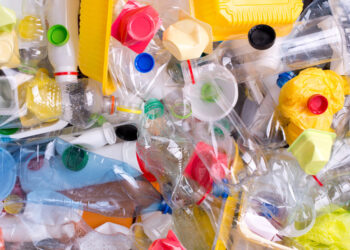







A deadline coming up in a California labeling bill is causing concern among some manufacturers of compostable products, who say it could threaten the wider U.S. and global compostable packaging industry.
Under AB 1201, a product cannot be labeled “compostable” or “home compostable,” “biodegradable,” “degradable” or “decomposable” unless it is an allowable agricultural organic input under the requirements of the U.S. Department of Agriculture National Organic Program beginning on Jan. 1, 2026.
Currently, that definition would exclude compostable and biodegradable plastics.
The bill contains an extension clause: The director of the California Department of Resources Recycling and Recovery may grant a five-year extension on compliance if the product has or will soon be included as an allowable organic input for compost under federal law, as determined by the director.
Alex Truelove, legislation and advocacy manager at the Biodegradable Products Institute, worked on AB 1201 since its development, and he says there’s much about the bill that is positive – but there’s also “this little wrinkle that was added such that by 2026, if a product that claims to be compostable isn’t an allowable input for organic agriculture, you can’t call it compostable.”
“There’s sort of this poison pill in an otherwise pretty good bill that we’re now facing pretty soon,” he said.
While Jan. 1 is months away, companies need lead time to change labels, and Truelove said the companies BPI represents are feeling that it’s “a five-alarm fire.”
“There’s a lot of stress right now,” he said.
Industry argues federal definition is outdated
Allowable inputs for organic agriculture are set at the federal level as part of the National Organic Program under the USDA. Truelove said he and other groups have been working for the past five years to update the rule determining what is and is not allowable, as it’s more than two decades old.
“One of the many frustrations about the situation is that that rule I’m speaking to, it’s 25-plus years old, so it was written before any of these products were out there,” he said. “It basically said you can only put plant and animal material in your compost if you want to call it organic. I suppose that made sense at the time, but these rules need to desperately be updated with all the innovative materials out there,” such as biodegradable or compostable plastics.
BPI submitted an official petition for the updated rule in 2023, but with the transition to a new federal administration, and all the changes President Donald Trump has enacted, “there are a lot of priorities with this new administration” that may stall or derail the work BPI has been pushing for, Truelove added, including staff cuts.
“We need California to take action by either removing that requirement or giving us an extension so that we can ultimately resolve the rule at the federal level,” he said.
The five-year extension was built into AB 1201 “specifically because it takes a long time to change things at the federal level,” Truelove said, and BPI would like to see CalRecycle use it.
If the law’s timeline moves forward without the extension, it would “basically crater a burgeoning billion-dollar industry,” Truelove said, as companies would likely change the labeling for all packaging, not just packaging going into California.
“I can’t overstate the impact, not just in California, but the ripple effects it would have across the country and the world,” he said. “Everyone’s sort of watching to see what’s going to happen over the next few weeks and months.”
BPI has submitted a formal request to CalRecycle for the extension.
“We think our arguments are pretty strong,” Truelove said, but “of course, when you’re talking about legal language, folks can interpret it in different ways. We feel like we’ve more than met the criteria” by making “appropriate progress for the time frame.”
Composters urge staying the course, citing plastics in compost facilities
Neil Edgar is executive director at the California Composter Coalition, which represents compost facility operators. He said he doesn’t believe the conditions set in statute that would trigger an extension have been met, especially for products like compostable plastics and bio-plastics.
However, part of the challenge is that compostable products are not a monolith, he added, though they are often discussed as such.
For example, California has largely allowed compostable products made of wood, bamboo or paper fiber to be in organic compost – composters “have not been told to remove those from their composting operations” – but compostable plastics and bio-plastics are another story, Edgar said.
“Composters don’t have the ability or the bandwidth to separate noncompostable plastics from compostable plastics; it’s too much of a burden,” he said. “Even if the situation changes and the (National Organic Program) allows it – which might happen, there’s potential action coming out of the federal government – composters here are still not going to want plastics.”
Edgar said he wishes there were more options for replacing disposable plastic packaging, but the composters he represents “just can’t take any more plastics.”
Interactions with other state laws
There are also outstanding questions about how AB 1201 will interact with other California composting and recycling laws, including SB 54, which sets up extended producer responsibility law for packaging, and SB 343, which covers labeling.
Regarding SB 54, Truelove said that while compostable packaging is a small overall part of the packaging market, “to the extent that our members and other compostable product makers are paying into that system and that pot of money, we want that money to get redistributed towards increasing collection and education programs and facilities and equipment and all the stuff that can help with composting in California.
“Much like if you’re making recyclable products, of course, you’d want to see that money go towards helping with recycling,” he said.
AB 1201 and SB 54 are intertwined, Truelove said, because of the goal in SB 54 that all packaging must be reusable, recyclable or compostable by 2032.
“There’s a pretty significant list of products that aren’t really feasibly recyclable and aren’t designed to be reusable, so we need all three of those compliance pathways in order to make it work,” he said. “Part of the reason we’re fighting for 1201 is also if we lose this fight of 1201, then all of a sudden you’re removing one of the three legs of the stool for SB 54.”
In addition, SB 1383 mandates organics recycling in the state, which means “you have these tsunamis of organic waste that are coming to composters and they’re trying to figure out what to do with it. They’re trying to move material fast,” he said.
Truelove noted that additional support from EPR would be helpful, and he hopes that “as the market grows both for composting and compostable products, then we’ll grow together.”
Edgar said it’s clear under SB 343 and SB 54 that materials that are deemed recyclable and put on the Covered Material Categories list must be collected, but it’s less clear if compostable materials put on the same list are also going to be required to be collected and accepted at composting facilities.
“That has been a significant concern, and we have not been able to get clarity on if that’s true,” he said, adding that “we don’t want to be forced to take any of the materials, let alone be forced to take plastics.”
SB 54 also requires compostable products to meet AB 1201, “and that’s pretty clearly spelled out, so I think the outcome is that plastic products that are bioplastic resins polymers are not going to be able to be called compostable on Jan. 1 of 2026. It’s not as clear on the other materials – like paper or fiber – given the lack of clarity from the NOP, which is debating this,” he said.
“It’s a challenging space,” Edgar added. “I wish there was an easy answer, but I represent the composters, and the composters say they can’t tolerate any more plastics.”