





In conjunction with America Recycles Day, the U.S. EPA on Nov. 15 released a roadmap for improving municipal recycling across the country. Officials say materials recovery is an important component of materials management, but it is not the entire story.
The EPA published the National Recycling Strategy, subtitled “Part one of a series on building a circular economy for all.” The strategy has been in the works for multiple years, after being set in motion during the 2018 America Recycles Day Summit. That event, which drew stakeholders from across the recycling sector, was held in part as a response to the market upheaval of 2017 and 2018.
The strategy lays out how the U.S. can work toward the EPA’s National Recycling Goal of a 50% recycling rate by 2030. The most recent EPA figures indicate a current national recycling rate of 32%.
In a statement announcing the finalized strategy, EPA Administrator Michael Regan said the plan will help reduce the climate impacts associated with using raw materials. And he said the strategy will complement investments in recycling that were included in the infrastructure package signed by President Biden Nov. 15.
The EPA also stressed that the strategy has a firm focus on delivering environmental justice along with climate impact reductions. Sacoby Wilson, a member of the EPA’s National Environmental Justice Advisory Council, said a strategy to address recycling must also “address where these products come from, where they go, and how they’re impacting the health, sustainability and quality of life in communities of color.”
The Institute of Scrap Recycling Industries (ISRI) hosted an event commemorating America Recycles Day and laying out details of the strategy. The event featured two members of Congress who have been active in recycling issues. Tom Carper, D-Del., who serves as co-chair of the Senate Recycling Caucus, spoke to how recycling is just one part of the waste management solution nationwide.
“Recycling is not a silver bullet solution to our waste management problem, we must also incorporate solutions that help us reduce and reuse materials as well,” Carper said.
John Boozman, R-Ariz., also co-chair of the recycling caucus, spoke to the range of different interests that must be a part of improving materials management across the country.
“It will take a team effort to get where we want to be when it comes to recycling,” he said. “Corporations, manufacturers and leaders from all sectors have a role to play to develop best ways to be a global leader in this important industry.”
A number of industry groups, including ISRI, the Solid Waste Association of North America (SWANA), and the American Chemistry Council (ACC), issued statements in support of the strategy.
EPA official introduces strategy
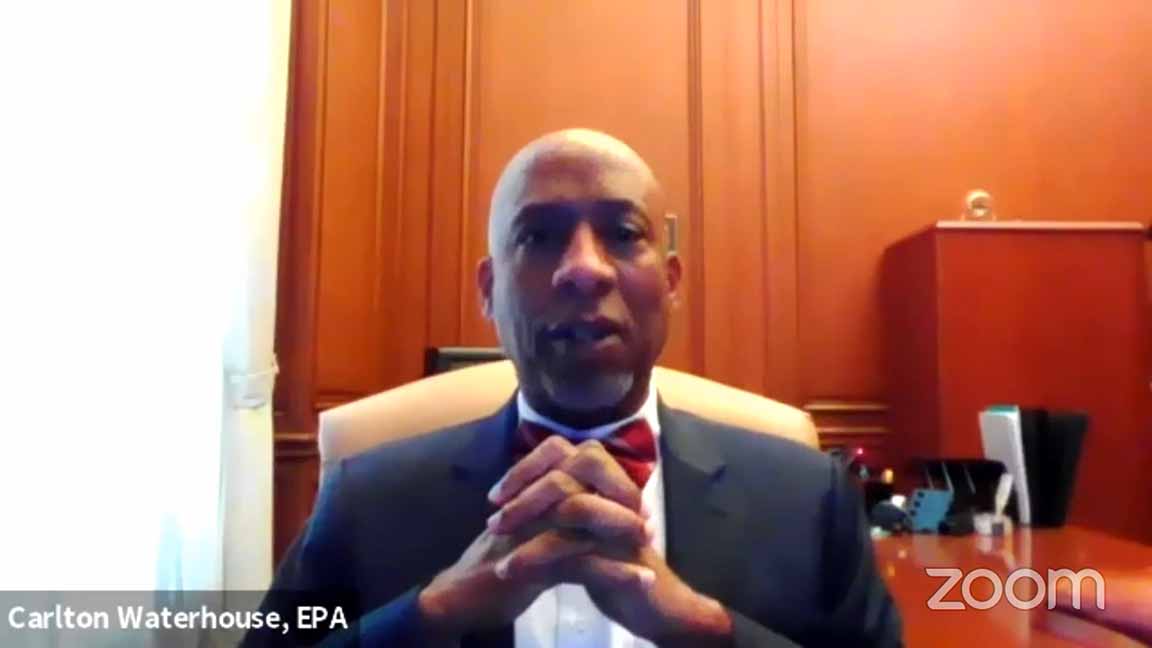
During the ISRI event, Carlton Waterhouse, deputy assistant administrator for the EPA’s Office of Land and Emergency Management, spoke on the strategy and how it places recycling within a larger focus on addressing climate change.
He noted that about half of all greenhouse gas emissions are associated with natural resource extraction, and that efficient use of resources is a “key component” of reducing such emissions.
“Reducing, reusing and recycling the materials that we use reduces our need to extract raw natural resources and mitigates the related climate impacts of that extraction,” he said.
Waterhouse also defined how EPA thinks about a circular economy. Under such a system, “material use is reduced, materials are redesigned to be less resource intensive, and waste is recaptured as a resource for new products.”
The National Recycling Strategy is centered on five objectives, and a number of actions are associated with each: “improve markets for recycled commodities; increase collection and improve materials management infrastructure; reduce contamination in the recycled materials stream; enhance policies and programs to support circularity; and standardize measurement and increase data collection.”
Focusing on these goals will help address a handful of challenges impacting U.S. materials recovery, according to the strategy. These include “confusion about what materials can be recycled, recycling infrastructure that has not kept pace with today’s diverse and changing waste stream, reduced markets for recycled materials, and varying methodologies to measure recycling system performance.”
The finalized strategy has a few differences from the October 2020 draft strategy. For instance, the draft identified three priority areas: reducing contamination, increasing processing efficiency, and developing domestic markets. Measurement and policy have been added as objectives in the finalized strategy, increasing collection has been more clearly articulated as a goal, and market development is given top billing as an objective.
One of many strategies to come
Waterhouse also stressed that the National Recycling Strategy is not the only component of improving materials management in the U.S. Recycling is a piece of the solution but will not achieve the desired environmental impacts related to materials use.
“Moving forward, we’re going to develop additional strategies to help us achieve a circular economy,” Waterhouse said.
These include a strategy specific to plastics and other marine debris pollution, he explained.
“This is really important because plastics are a distinct challenge that really need their own particular solution to address them as a problem,” he said. The National Recycling Strategy “doesn’t really go deep into dealing with that, and I want folks to know that it’s not because it’s not a priority. It’s because we have to take this one step at a time towards reaching our solution.”
That strategy will be a “critical, critical advancement” in U.S. plastics waste management, Waterhouse said.
Other strategies will address food waste management to reduce food waste by 50% by 2030, and a strategy to address end-of-life electronics and critical minerals recovery.
Waterhouse spoke about how environmental justice is integral to a circular economy during the Northeast Recycling Council conference in October.
Actions tied to objectives
Each of the strategy’s five objectives contain a handful of actions that could help achieve those goals.
Potential actions to improve recycling markets include promoting market development, taking steps to increase manufacturers’ use of recycled material, producing analyses that could help spur investment in recycling markets, and more.
Among the market development initiatives is exploring ratification of the Basel Convention, which would bring the U.S. in line with scrap material trade policies of most other countries. However, the strategy notes that the lack of U.S. ratification, which has complicated the trade of scrap plastic with Basel-party countries of late, has provided an incentive to bolster domestic markets. Similar to the domestic market expansion that took place in the wake of China’s import restrictions, the export complications associated with the U.S. Basel non-party status could open the door for domestic processors to take in more material.
Actions to increase collection and improve infrastructure include increasing awareness of public and private funding and other economic incentives; funding research and development of new recycling technologies; promoting design for recyclability; optimizing sorting processes at MRFs; and more.
Contamination reduction actions include enhancing education and outreach to the public on proper recycling, and providing resources to help promote such education and outreach initiatives.
Actions to enhance policies include conducting an analysis of numerous policies that address recycling challenges (including extended producer responsibility (EPR), container deposits, recycled-content mandates, virgin material taxes, and more); increasing awareness of public-private partnerships (EPA gives the example of its WasteWise program); and more.
Finally, actions to standardize measurement and increase data collection include developing national recycling definitions, measures, targets and performance indicators; increasing data availability and transparency about materials generation and demand; exploring recycled-content measures and third-party specifications for recycled material; and more.