






Several years ago, the Georgia Recycling Coalition worked with a film crew to produce a short video called “Made in Georgia.”
Highlighting the various ways materials-recovery efforts were boosting businesses in the state, the production team recorded interviews with executives at paper manufacturer and MRF operator Pratt Industries, aluminum company Novelis, plastic end user Rehrig Pacific, and other corporate recycling players.
Once all the footage was captured, the crew had plenty of examples of big processors and manufacturers leveraging locally collected material.
But something important was missing, recalled Michelle Wiseman, a Black woman who worked for SP Recycling Southeast at the time and was president of the Georgia Recycling Coalition: “The producer said to me, ‘We have to include you in the video. There is no diversity.'”
That project showcasing top-level recycling executives in one region is, in many ways, emblematic of the sector as a whole. This is a business built around collecting material from communities and companies that span the demographic spectrum. But, typically, the leaders of recycling-oriented businesses are white.
“Our industry is not reflective of the country as a whole, and that’s a problem,” said Keefe Harrison, CEO of The Recycling Partnership, the corporate-backed nonprofit organization that works to improve municipal recycling infrastructure.
Amid the racial reckoning that has erupted in America in the months since the killing of George Floyd, diversity and inclusion has become a major talking point in many business sectors, including the world of recycling.
Last fall, for instance, The Recycling Partnership launched a program called the Recycling Inclusion Fund to try to address inequities in recycling, and part of its focus is bringing more people of color to industry leadership. “We’re eager to use The Partnership as a fulcrum to pull young, diverse people to the field,” noted Harrison, who is white.
Other industry stakeholders, including Waste Management and Republic Services, have publicly stated their intentions to engage more deeply on issues of race in the workforce.
But the push for such progress also raises critical questions: What are the steps to meaningful change on a complex issue rooted deep within the foundations of American society? And how do companies hold themselves accountable along the way?
A world of white executives
As is the case in many industries, there is little comprehensive data on the racial breakdown of decision-makers at the upper ranks of recycling. However, as some companies and organizations have recently outlined plans to address inequities, they’ve also disclosed relevant staffing statistics.
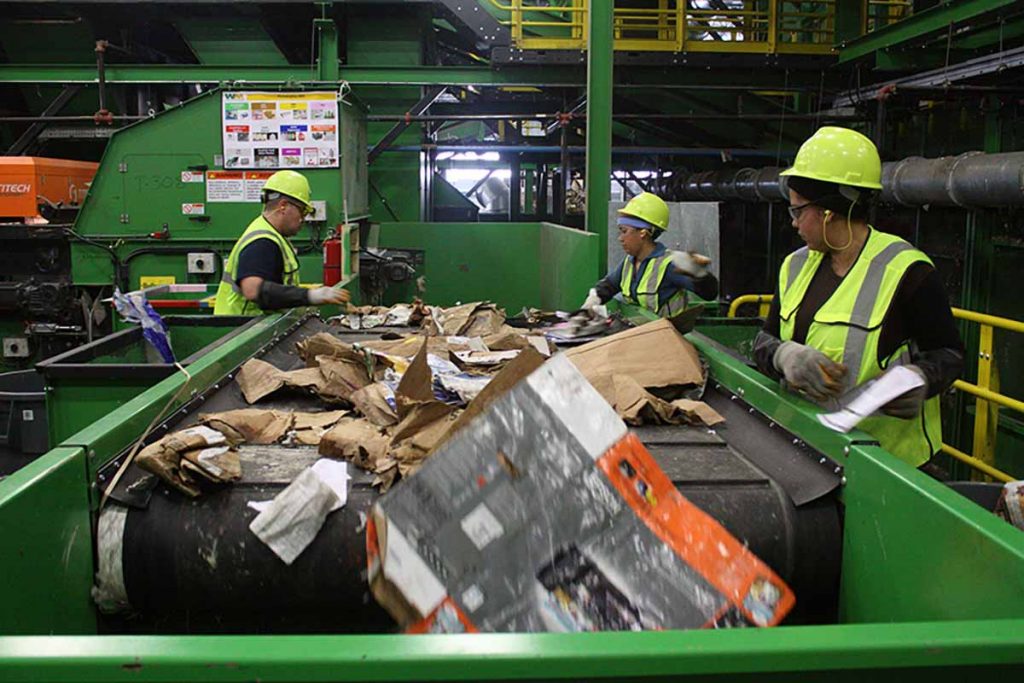
Waste Management, which is North America’s largest publicly traded hauler and processor in terms of annual revenue, noted in its 2020 sustainability report that 13% of its executive-level employees in 2019 were non-white. That compared with 45% non-white personnel across Waste Management’s 45,000-person workforce, which includes many collection truck operators, material sorters and other “front line” staffers.
Casella Waste Systems, the fifth-largest hauler in North America, in its 2020 sustainability report stated that as of Sept. 30, 2020, 5% of its management positions were held by ethnic minorities. Across the company’s non-management workforce, minorities made up 13% of staff.
“It is a known fact that the waste industry has been predominantly white and male dominated.”- Tiana Carter, Waste Management’s senior director of culture and engagement
Meanwhile, white males currently hold the top recycling executive position at each of the five largest publicly traded haulers: Brent Bell at Waste Management, Pete Keller at Republic Services, Brent Hildebrand at GFL Environmental, Dan Kurtz at Waste Connections, and Bob Cappadona at Casella.
It should also be noted that Oregon-based Resource Recycling, which has been covering the recycling sector for 40 years, has never had a person of color as editor.
“It is a known fact that the waste industry has been predominantly white and male dominated,” Tiana Carter, Waste Management’s senior director of culture and engagement, wrote in an email response to questions from Resource Recycling (Carter is Black). “There is opportunity for the industry to be more open to backgrounds outside of the waste industry in their hiring processes if they are looking to diversify their employee demographics to be representative of the customers and communities their business serves.”
In many ways, the racial reality of recycling can be quickly determined by a look at the crowd at any conference bringing sector decision-makers together.”I’ll walk into a room of 100 or more people and see maybe one other Black or brown person,” said Wiseman, who has worked in recycling in both the public and private sectors in Georgia over the past 12 years. “Especially in Atlanta, I should never walk into a room talking about sustainability and recycling and be the only [person of color].”
Melissa Craig, who is Black and is senior manager for packaging sustainability North America at brand owner Unilever, described similar experiences at recycling gatherings.
“When I attend conferences or meetings, it is not unusual for someone to ask me, ‘How did you get into this? I really don’t see many Black people here,'” Craig said. “It does not bother me because they have approached me in the right way – and it’s a true observation.”Of course, recycling is hardly the only business sector that has struggled to bring racial diversity to its leadership circles. One recent human resources survey indicated that across corporate America, 85% of executive positions are held by white people. And according to the U.S. Bureau of Labor Statistics, of the 18.6 million management-level positions in American companies in 2020, 83% were occupied by white professionals.
Yet while business sectors such as media and Big Tech have for years felt pressure to address racial inequities at the executive level, the discussion around race and recycling has generally been muted.
“The recycling industry is no different than corporate America. It is just a smaller subset, so it is not in the spotlight and is not being held accountable,” said Craig. “If the industry wants to do something, companies need to level up and be held accountable just like everyone else.”
Trying to lay out pathways to change
Some industry entities in the last year have taken initial steps to move toward increasing diversity among top decision-makers.
In May 2020, the Waste Management board of directors approved a company goal “to achieve ethnic diversity in each segment of our workforce, with emphasis on leadership, that is greater than or equal to that of the U.S. workforce standards.” Carter, the Waste Management culture and engagement executive, noted that the company uses U.S. Equal Employment Opportunity Commission data to determine those standards.
In its 2020 sustainability report, Waste Management compared its ethnic diversity at different employee tiers to those of “peer industries.” The company stated its staff diversity was on par with peers at the “professional” and “operative and craft worker” levels.
In the manager category, however, 22% of Waste Management employees in 2019 were ethnic minorities, compared with 26% at peers, according to the sustainability report. And the 13% of company executives who were classified as minorities compared with 16% at peer industries.
Carter added that this system of charting racial progress is still being worked out within the company.
“We opted to pilot percentage-based goals to start,” she wrote in her email to Resource Recycling. “However, we are continuing to evaluate the best way to track and measure goals that are very fluid ⦠year-over-year.” She noted, for example, the Bureau of Labor Statistics will occasionally alter how it is tabulating data from one year to another, potentially making it tricky for Waste Management to chart how it stacks up to peer industries over time.
Representatives of The Recycling Partnership say their work to improve racial equity within the group and wider industry does not yet have numerical goals attached to it.
“When we consider diversity, equity and inclusion, we don’t want it to just be another pillar; it’s not an addition,” said Jessica Levine, who is strategic engagement coordinator at The Recycling Partnership and is leading the Recycling Inclusion Fund program. “We want it to be embedded in the essence of who we are moving forward.”
Levine, who is Black, joined The Recycling Partnership in 2018 several months after graduating from college, connecting with the organization through an internship in Coca-Cola’s sustainability department.The hiring of Levine brought The Recycling Partnership headcount to 22, but she was the first person of color to join the staff. (According to the group, it now has 49 employees, and five are people of color.)
The Recycling Inclusion Fund, which is expected to start rolling out formal initiatives this year, is on one hand geared toward improving recycling access and participation among minority populations across America. In that way, it is continuing an already-established equity focus for the group. “Since our inception, nearly 50% of our initiatives to transform recycling by improving and expanding convenient access have been implemented into communities of color,” said Harrison, the group’s CEO.
But the Inclusion Fund also has the goal of helping to advance the careers of people of color who enter the industry.
A key component of that objective, Levine said, will be a fellowship program that offers individuals a paid one-year internship in which they will work with staff from The Recycling Partnership to learn about the sector. They’ll also have opportunities to connect with leaders at the processors, brands and other organizations that support the group.”We want to create a streamlined opportunity for them to connect with our funding partners,” Levine said. “We’re creating that pipeline for us but also for that corporate sector as well.”
Fundamental shifts on hiring and promoting
As stakeholders develop their efforts to achieve greater diversity among leadership, they will be working against powerful currents of corporate culture that have led to the racial disparity in executive circles that we see today.
Jean Francois is head of the Global Anti-Racism Task Force for Ingram Micro, a large distributor of corporate computing and networking equipment. The company is also one of the biggest IT asset disposition (ITAD) providers in the world, working with clients to remove old electronics from offices and data centers and channeling that material into the reuse and recycling streams.
Francois, who is Black, said that the George Floyd killing sparked immediate action on the part of Ingram Micro’s top-level leaders. The task force he manages was launched within a week of Floyd’s death “to make sure we are providing a diverse, inclusive environment for our associates,” Francois said. (Ingram Micro’s global headcount is roughly 35,000.)
Francois said that Ingram Micro has strong workforce equity numbers through much of the company, but “when we get into executives, we see our diversity drop and that’s true for virtually every large company in this space.”
He noted that addressing that issue requires a deep dive into the structure of the business.
“It’s not like saying, ‘Hey, we’re just going to bring in some executives,'” he said. “It’s literally fixing our promotion pipeline and hiring practices. It’s incorporating inclusivity and diversity and belonging into [those practices] so that you have executives that reflect the population that they manage.”
“This is the time. This is it. If you are not tuned in, you are missing a chance to make positive change.” – Melissa Craig, senior manager for packaging sustainability North America at Unilever
According to Francois, progress on this front will only materialize if directives come straight from the top. He said that the death of George Floyd had a significant emotional impact on top executives at Ingram Micro and that their emphasis on race has been felt through the ranks.
Without the executive push, “I don’t know that we would have had as much put into this action plan, to be frank,” said Francois. “Getting people to take action is incredibly difficult.”
Seizing a fleeting moment
Though many companies and organizations throughout corporate America have had their goal-setting and priorities shifted by today’s conversations around race, another calamity or cultural awakening will surely grab the attention of CEOs soon enough.
That means recycling professionals who want to effect racial change within their organizations should not wait to push forward.
“I don’t know how you can close an eye or turn a head from it – it is in the news almost every day,” said Craig of Unilever. “This is the time. This is it. If you are not tuned in, you are missing a chance to make positive change.”
It’s also true some consumers, government officials and businesses are making decisions with equity in mind, meaning those companies showing how they’re working to reduce disparities may hold a competitive advantage.
“Customers are seeing Black bodies being murdered in the streets, and they’re thinking about how that affects them at work,” said Francois. “That’s just a blanket reality that we see, and there’s no escaping it.”
How will businesses in the recycling sector respond to society’s wider concerns about racial progress? Ultimately, the trajectory will be set by those who wield the most industry power.
“People of color are not owners, not managers, not the HR department, not the people that make decisions,” said Georgia recycling leader Wiseman. “It would have to come from the top of the recycling industry, if they were serious about making a change.”