Resource Recycling
  • The Latest
  • Analysis
    • All
    • Certification Scorecard
    • Industry Announcements
    • Opinion

    Certification scorecard for the week of March 9, 2026

    Diversion Dynamics: Secondhand exports slow down fast fashion

    Certification scorecard for the week of March 2, 2026

    Industry announcements for January 2026

    Industry Announcements for March 2026

    HP receives ocean plastics certification

    HP Inc. earnings point to memory inflation challenge

    Certification scorecard for the week of Feb. 23, 2026

    Umicore highlights strength in recycling, catalysis

    Apto, Tusaar partner on rare earths recovery

    Apto, Tusaar partner on rare earths recovery

    Certification scorecard for the week of Feb. 16, 2026

  • Conferences
  • Publications

    Other Topics

    Textiles
    Organics
    Packaging
    Glass
    Brand Owners

    Metals
    Technology
    Research
    Markets
    Grant Watch

    All Topics

Subscribe
No Result
View All Result
Resource Recycling
  • The Latest
  • Analysis
    • All
    • Certification Scorecard
    • Industry Announcements
    • Opinion

    Certification scorecard for the week of March 9, 2026

    Diversion Dynamics: Secondhand exports slow down fast fashion

    Certification scorecard for the week of March 2, 2026

    Industry announcements for January 2026

    Industry Announcements for March 2026

    HP receives ocean plastics certification

    HP Inc. earnings point to memory inflation challenge

    Certification scorecard for the week of Feb. 23, 2026

    Umicore highlights strength in recycling, catalysis

    Apto, Tusaar partner on rare earths recovery

    Apto, Tusaar partner on rare earths recovery

    Certification scorecard for the week of Feb. 16, 2026

  • Conferences
  • Publications

    Other Topics

    Textiles
    Organics
    Packaging
    Glass
    Brand Owners

    Metals
    Technology
    Research
    Markets
    Grant Watch

    All Topics

Subscribe
No Result
View All Result
Resource Recycling
No Result
View All Result
Home Recycling

Public action’ essential for successful curbside programs, experts say

Colin StaubbyColin Staub
May 31, 2017
in Recycling

If a municipal recycling program wants to increase its performance, local government engagement is needed. Several program leaders made that clear during a discussion hosted by the U.S. EPA last week.

The discussion was framed around The Recycling Partnership’s 2016 curbside program report, which looked at 465 cities in the country. In the webinar, municipal program leaders from Madison, Wis., Portland, Ore. and Florence, Ala. described their diverse experiences boosting diversion in their cities.

The study examined a range of components in each curbside program, including container type and size, frequency of collection, materials accepted, sorting infrastructure and method of financing. Then, it examined results in each city and looked for patterns in the areas with high diversion. Single-stream, carts and automatic enrollment in recycling were all associated with the most successful programs.

“All of the highest-performing cities had something called a ‘public action,'” explained Dylan de Thomas, The Recycling Partnership’s vice president of industry collaboration (de Thomas is former editorial director for Resource Recycling). That means a local government had some sort of action to trigger recycling at the household level. “The key is the municipality, the city or town, is connecting to residents to be able to increase recycling and they really see that it’s very effective, as the study showed.”

The public action can be any number of outreach or participation-boosting initiatives. A program with no public action essentially leaves it up to residents to seek out recycling collection. There might not be a website or any kind of outreach, and residents would have to really take the initiative to receive collection service.

Households in programs with a public action recycled on average about 100 pounds more per month than those in areas with no public action, de Thomas said.

Making it mandatory

One form of public action is the local government requiring recycling service.

“People shy away from the word ‘mandatory’ recycling,” said George Dreckmann, former recycling coordinator for Madison, Wis. “I would tell you that if you’re going to do something, make it mandatory.”

It’s worked for Madison, a city of 250,000 that has achieved a 58.4 percent diversion rate. That figure includes all materials collected, including yard waste, bulky items and electronics. The program has always had a contamination rate of less than 10 percent, Dreckmann said.

Madison’s curbside recycling has longevity on its side, with curbside newspaper collection beginning back in 1968. The city has had a great deal of public action over the years, including an outreach budget that was once up to $200,000 per year.

“Recycling has been a big part of the community for years,” said Bryan Johnson, current recycling coordinator for the city. “We have a lot of the buy-in from the public.”

Dreckmann pointed to mandatory recycling as a key component of the program’s success, and he advised other communities to take similar measures.

“The ‘draconian’ part of mandatory recycling comes in as to how you enforce it,” Dreckmann said. “It’s not the word ‘mandatory’ that automatically makes something bad and incites that segment of the population that’s always incited by anything government does.”

In Madison, he said, if a resident doesn’t put out their recycling cart, they get a warning that their trash will stop being collected in two weeks. That system is very effective, Dreckmann said.

Leveraging receptacle sizes and organics

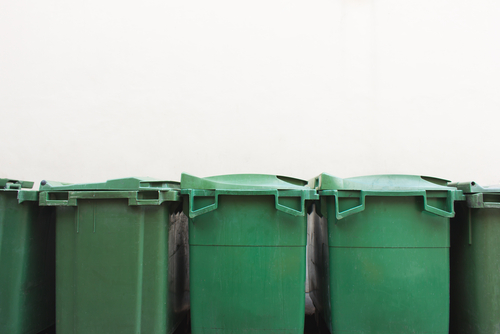
Once a single-family household in Portland, Ore. signs up for collection service, it receives four bins, explained Pete Chism-Winfield, materials and waste specialist with the city’s Bureau of Planning and Sustainability. The standard configuration is a 32-gallon garbage container, 60-gallon recycling cart, 60-gallon organics cart and 20-gallon glass bin. Garbage is picked up every other week, and the other three receptacles are collected weekly.

Commercial and multi-family properties are required to offer recycling service and education, haulers are required to provide collection service, and businesses generating food scraps must use an organics-collection service. Portland also has a ban on plastic bags and EPS food-service items.

Portland has a diversion rate of 64 percent, including yard debris and food scraps collected for composting. The city has a contamination rate of about 9 percent in the single-family stream and double that in the multi-family stream. Chism-Winfield added that according to city rules, contamination is technically “not allowed.”

With its robust recycling measures in place, the city has looked to the U.S. EPA’s waste management hierarchy for direction on future initiatives.

“We’re really trying to move up with our outreach into the realm of reuse and waste prevention,” Chism-Winfield said.

He pointed to a recent ordinance requiring deconstruction (dismantling for salvage) rather than demolition for houses built in 1916 or earlier.

‘That really is having a ripple effect, not only environmentally but also economically, and also with workforce development,” he said.

Talk it up

Florence, a city of about 40,000 in northern Alabama, is in a quite different situation than Madison and Portland both population-wise and in terms of regulations. But through its own public action and community buy-in, the city’s recycling program has also increased its performance.

Florence began its curbside program in 1988 with bins, and it switched to carts in 2015 with help from The Recycling Partnership.

“We just don’t have money to do a whole lot, so we have to make it go a long way,” said Rachel Mansell, Florence’s education and outreach coordinator. The program uses social media, school events, tours, news coverage and more.

“The goal is to get people talking and say, ‘Hey, what can I do?'” she explained.

In the past, the city attached a variety of tags to contaminated carts, telling residents they were recycling incorrectly. But program leaders quickly received feedback that approach was not popular with residents. It switched to a message thanking residents for recycling and asking for their help to improve the program.

 

SSI Van Dyk

Tags: CollectionContaminationIndustry GroupsLocal ProgramsOrganics
TweetShare
Colin Staub

Colin Staub

Colin Staub was a reporter and associate editor at Resource Recycling until August 2025.

Related Posts

Landfill

Oregon DEQ issues $3.1 million fine to Republic Services subsidiary

byStefanie Valentic
March 12, 2026

Valley Landfills Inc., a Republic Services subsidiary, must pay $3.1 million in penalties and take corrective actions following a multi-year...

EPS foam recycling grants open for applications

byAntoinette Smith
March 11, 2026

The Foodservice Packaging Institute’s Foam Recycling Coalition will award grants of up to $50,000 to expand US recycling access for...

Machinex debuts organics co-collection system

Coastal partners with Machinex on four Florida MRF projects

byStefanie Valentic
March 10, 2026

Coastal Waste & Recycling is accelerating its MRF upgrade strategy as it partners with Machinex on four projects.

Trade flow shifts, volatility require varied responses

Trade flow shifts, volatility require varied responses

byAntoinette Smith
March 9, 2026

Both long- and short-term solutions including policy, localization can help support the industry, panelists said during the 2026 Plastics Recycling...

RecycleDat! collects nearly 197,000 cans at Mardi Gras

RecycleDat! collects nearly 197,000 cans at Mardi Gras

byScott Snowden
March 9, 2026

The coalition diverted more than 61,000 pounds of material in New Orleans, including nearly 197,000 aluminum beverage cans.

Common goal of responsible end markets: transparency 

Common goal of responsible end markets: transparency 

byAntoinette Smith
March 5, 2026

Panelists from state government, Circular Action Alliance and a reclaimer explored the particulars of REMs at the 2026 Plastics Recycling...

Load More
Next Post
Vancouver, B.C. area weighing foam disposal ban

Vancouver, B.C. area weighing foam disposal ban

More Posts

Chinese processing group details goals for US visit

AMP lays out vision of next-generation, AI-driven MRFs

July 24, 2024
ERI sues Revivn alleging raid on staff and trade secrets

ERI sues Revivn alleging raid on staff and trade secrets

March 10, 2026
E-scrap export pause urged to keep rare earth scrap in US

E-scrap export pause urged to keep rare earth scrap in US

March 11, 2026
How rising fuel and memory prices are impacting ITAD’s margins

How rising fuel and memory prices are impacting ITAD’s margins

March 10, 2026
Northeast recycled commodity values hit 5-year lows

Northeast recycled commodity values hit 5-year lows

March 6, 2026

AI servers reshape ITAD sector, recyclers brace for new wave

March 9, 2026
Ex-Glencore chief starts Valor to refine critical metals

Ex-Glencore chief starts Valor to refine critical metals

September 18, 2025
Greenway now takes e-scrap from Midwest businesses

Greenway now takes e-scrap from Midwest businesses

March 11, 2026
Emerging US EPR programs spark harmonization talks

Washington designates CAA to lead EPR implementation

March 4, 2026
RecycleDat! collects nearly 197,000 cans at Mardi Gras

RecycleDat! collects nearly 197,000 cans at Mardi Gras

March 9, 2026
Load More

About & Publications

About Us

Staff

Archive

Magazine

Work With Us

Advertise
Jobs
Contact
Terms and Privacy

Newsletter

Get the latest recycling news and analysis delivered to your inbox every week. Stay ahead on industry trends, policy updates, and insights from programs, processors, and innovators.

Subscribe

Welcome Back!

Login to your account below

Forgotten Password?

Retrieve your password

Please enter your username or email address to reset your password.

Log In

Add New Playlist

No Result
View All Result
  • The Latest
  • Analysis
  • Recycling
  • E-Scrap
  • Plastics
  • Policy Now
  • Conferences
    • E-Scrap Conference
    • Plastics Recycling Conference
    • Resource Recycling Conference
    • Textiles Recovery Summit
  • Magazine
  • About Us
  • Advertise
  • Archive
  • Jobs
  • Staff
Subscribe
This website uses cookies. By continuing to use this website you are giving consent to cookies being used. Visit our Privacy and Cookie Policy.