











Resource Recycling
  • The Latest
  • Analysis
    • All
    • Certification Scorecard
    • Industry Announcements
    • Opinion
    HP receives ocean plastics certification

    HP Inc. earnings point to memory inflation challenge

    Certification scorecard for the week of Feb. 23, 2026

    Umicore highlights strength in recycling, catalysis

    Apto, Tusaar partner on rare earths recovery

    Apto, Tusaar partner on rare earths recovery

    Certification scorecard for the week of Feb. 16, 2026

    Sims Lifecycle leverages hyperscale decommissioning

    Sims Lifecycle leverages hyperscale decommissioning

    The electronics recycling industry is undergoing a transformation from labor-intensive manual operations to highly automated, AI-driven facilities that use advanced robotics, cleaner chemistry and digital tracking systems to extract critical materials.

    The cyber-physical MRF: AI and robotics reshape e-waste recovery

    Certification scorecard for the week of Feb. 9, 2026

    Meta-Corning deal signals IT hardware retirement wave

    Meta-Corning deal signals IT hardware retirement wave

  • Conferences
  • Publications

    Other Topics

    Textiles
    Organics
    Packaging
    Glass
    Brand Owners

    Metals
    Technology
    Research
    Markets
    Grant Watch

    All Topics

Subscribe
No Result
View All Result
Resource Recycling
  • The Latest
  • Analysis
    • All
    • Certification Scorecard
    • Industry Announcements
    • Opinion
    HP receives ocean plastics certification

    HP Inc. earnings point to memory inflation challenge

    Certification scorecard for the week of Feb. 23, 2026

    Umicore highlights strength in recycling, catalysis

    Apto, Tusaar partner on rare earths recovery

    Apto, Tusaar partner on rare earths recovery

    Certification scorecard for the week of Feb. 16, 2026

    Sims Lifecycle leverages hyperscale decommissioning

    Sims Lifecycle leverages hyperscale decommissioning

    The electronics recycling industry is undergoing a transformation from labor-intensive manual operations to highly automated, AI-driven facilities that use advanced robotics, cleaner chemistry and digital tracking systems to extract critical materials.

    The cyber-physical MRF: AI and robotics reshape e-waste recovery

    Certification scorecard for the week of Feb. 9, 2026

    Meta-Corning deal signals IT hardware retirement wave

    Meta-Corning deal signals IT hardware retirement wave

  • Conferences
  • Publications

    Other Topics

    Textiles
    Organics
    Packaging
    Glass
    Brand Owners

    Metals
    Technology
    Research
    Markets
    Grant Watch

    All Topics

Subscribe
No Result
View All Result
Resource Recycling
No Result
View All Result
Home Resource Recycling Magazine

Community Spotlight: How one SoCal beach town takes on diversion challenges

Colin StaubbyColin Staub
September 4, 2017
in Resource Recycling Magazine

It’s known for its laid back surfing and skating culture, but Santa Monica, Calif. has been serious when it comes to recycling.

The Southern California community, which started its program 26 years ago, has notched a 79 percent diversion rate. And it’s pushing for 95 percent by 2030. That lofty goal is one component of a wider sustainability strategy Santa Monica has adopted to reduce its environmental impact.

But the coastal community is surrounded by Los Angeles on three sides and draws millions of tourists each year, which means it also faces some daunting outreach and education challenges when it comes to pushing for further diversion.

City hauls all streams

Recycling in Santa Monica dates back to 1991, when leaders divided the city into more than 100 recycling zones and deposit points were established in each neighborhood. Back in the early days, Santa Monica followed a source-separation model with residents sorting newspaper, plastics, metals and glass.
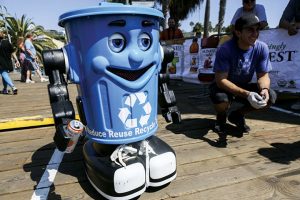
Santa Monica’s recycling mascot, Curby, helps on outreach.

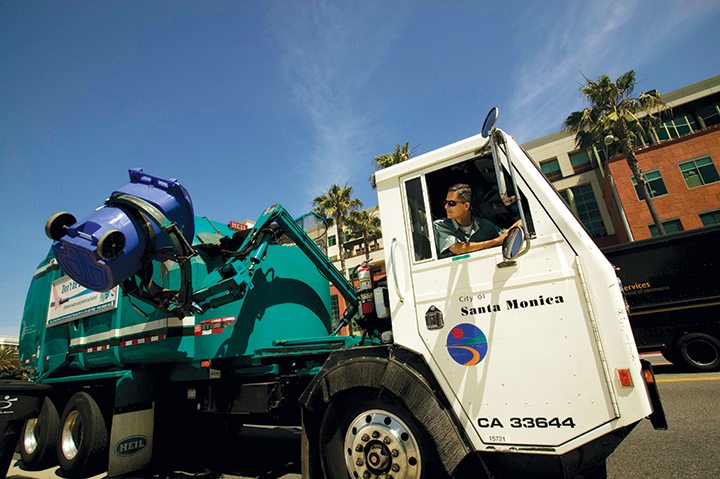
Single-family homes separated each material into buckets, which recycling truck drivers would collect by hand. In 1999, the recycling trucks became automated and the program switched to blue recycling containers, with the recycling zones still in place. Four years later, the municipality switched to a single-stream program, which is the mechanism in place today.

The recycling zones, however, were eliminated in favor of city-operated collection from all properties. Now, employees of the Public Works Department collect recyclables from all single-family homes, multi-family buildings and commercial businesses.

“It’s kind of a unique structure,” acknowledged Chanel Kincaid, zero waste coordinator for the city.

Residents receive curbside carts that accept plastics Nos. 1-5 and 7, as well as aluminum, glass, paper, cardboard and even bundled plastic bags. Recycling is collected weekly and is funded through the utility fees residents pay for garbage collection. Recyclables are transported directly to a MRF in the area while compost and waste go to a transfer station.

Influx challenges lead to innovative thinking

The program has encountered some difficulties. Outreach, in particular, poses problems due to the city’s popularity as a tourist attraction and economic center. The city’s contamination rate runs an average of 17.5 percent, taking all the streams into account.

Santa Monica has about 50,000 households, three-quarters of which are designated as multi-family. All told, nearly 93,000 people live in the city – but that doesn’t tell the whole story as far as recycling collection goes. Thousands of people commute into Santa Monica for work each day, and even more come to visit.

Public education is tackled through a broad range of platforms. The city sends a quarterly newsletter, posts social media updates, publishes an e-newsletter and hosts monthly waste reduction events. It also dispatches “Curby,” the city’s recycling mascot, to community events.

“We try to make it fun for the residents, and also informational,” Kincaid explained.

And then there’s the Santa Monica Pier, which brings in millions of visitors and tourists each year. This means a lot of attendees who don’t know the city’s recycling rules and could damage diversion through contamination.

“The pier is tricky, to be honest,” Kincaid said. Collection is problematic as many trucks can’t drive directly onto the pier, so materials must be transported back to the shore using other means.

Kincaid said the city is working to come up with innovative methods of recovery, given the location constraints and high traffic.

“To meet our diversion goals we need to get that material and divert as much as possible,” she said.

Off the pier, organics recovery is an area of particular focus in multiple pilot programs, since more than 40 percent of the material being landfilled is organics, Kincaid said.

Thanks in part to its bustling pier, Santa Monica welcomes 8.4 million tourists annually, which can lead to inconsistencies in what ends up in recycling bins.

One pilot program, titled “To Rot or Not,” was based on a wet-dry program but aimed to recover a cleaner organics stream than what is usually generated by a mixed-waste collection. Another initiative is a multi-family organics collection pilot program and includes establishing resident liaisons who will have a role in managing the programs for the buildings they live in.

Local ordinances

California often leads the way in regulation, imposing restrictions and bans that eventually work their way into laws in other states and municipalities. But within California there are cities that are early adopters of ordinances that are later widened into state laws. Santa Monica was among the early implementers of a polystyrene (PS) food-service packaging ban, which was passed in 2007, the same year San Francisco and Oakland adopted similar measures.

Santa Monica was early in implementing a wider sustainability plan as well, bringing one into effect in 1994. The plan sets sustainability benchmarks, some of which are recycling-related, that the city will strive to hit by certain dates. Right now, the plan aims for 85 percent diversion by 2020.

More recently, the city has enacted a solid-waste-specific zero waste plan, which aims for 95 percent diversion by 2030. The effort is multi-pronged, touching on reuse, outreach, extended producer responsibility, the EPA waste management hierarchy and more.

This article originally appeared in the August issue of Resource Recycling. Subscribe today for access to all print content.

Tags: Community Spotlight
TweetShare
Colin Staub

Colin Staub

Colin Staub was a reporter and associate editor at Resource Recycling until August 2025.

Related Posts

Community Spotlight: Atlanta’s recycling still improving

byAndrew Hawthorne
July 8, 2025

The recycling program in Atlanta, Georgia, is a work in progress that has seen significant successes, including doubling its recycling...

Community Spotlight: L.A. planners juggle goals, markets and huge volumes of material

byColin Staub
July 15, 2019

The second-largest city in the country also has a very ambitious waste diversion goal: 90% by 2025. That means Los...

Community Spotlight: Industry-funded system boosts Canadian metropolitan program

byColin Staub
January 14, 2019

In Vancouver, British Columbia, private-sector backing for recycling collection has freed up resources to tackle ambitious initiatives from local leaders....

Community Spotlight: Curbside audits drive quality in California town

byColin Staub
July 25, 2018

Although it’s often called the strawberry capital of the world, Watsonville, Calif. has some recycling initiatives that set it apart...

Community Spotlight: Economic incentive brings high diversion for Colorado city

byColin Staub
June 25, 2018

A mid-sized Colorado municipality has achieved enviable diversion results as its program has progressed for the past 25 years. One...

Community Spotlight: City tackles plastic film stream with industry partner

byColin Staub
April 25, 2018

Municipal programs are often short on funds, and it’s easy for recycling outreach to fall on the back burner amid...

Load More
Next Post
Meet the Speakers: Linda Li, Re-Teck

Meet the Speakers: Linda Li, Re-Teck

More Posts

PET bales stacked for recycling.

Evergreen closing RPET plants in Ohio, New York

February 24, 2026
WM opens new $90m MRF in south Florida 

WM opens new $90m MRF in south Florida 

February 23, 2026

Rising containerboard demand comes as OCC prices taper

November 5, 2024

Paper giants foresee continuing rise in OCC prices

August 28, 2023
Battery fire risk isn’t going away. Insurance is responding

Battery fire risk isn’t going away. Insurance is responding

February 24, 2026

North American paper mills discuss demand, OCC pricing

May 15, 2023
Recycled plastic lumber firms report diverging results

Trex CEO to retire after 23-year run

February 25, 2026
Study links tagging tactics to lower contamination rates

Arizona, Reynolds reach settlement on Hefty bag lawsuit

February 23, 2026
Chinese processing group details goals for US visit

AMP lays out vision of next-generation, AI-driven MRFs

July 24, 2024
How will 2026 unfold for plastics recycling?

How will 2026 unfold for plastics recycling?

February 19, 2026
Load More

About & Publications

About Us

Staff

Archive

Magazine

Work With Us

Advertise
Jobs
Contact
Terms and Privacy

Newsletter

Get the latest recycling news and analysis delivered to your inbox every week. Stay ahead on industry trends, policy updates, and insights from programs, processors, and innovators.

Subscribe

Welcome Back!

Login to your account below

Forgotten Password?

Retrieve your password

Please enter your username or email address to reset your password.

Log In

Add New Playlist

No Result
View All Result
  • The Latest
  • Analysis
  • Recycling
  • E-Scrap
  • Plastics
  • Policy Now
  • Conferences
    • E-Scrap Conference
    • Plastics Recycling Conference
    • Resource Recycling Conference
    • Textiles Recovery Summit
  • Magazine
  • About Us
  • Advertise
  • Archive
  • Jobs
  • Staff
Subscribe
This website uses cookies. By continuing to use this website you are giving consent to cookies being used. Visit our Privacy and Cookie Policy.