





This story originally appeared in the June 2016 issue of Resource Recycling.
Subscribe today for access to all print content.
At a typical commercial shopping center, businesses generate a full range of material types.
Retail shops may end each day with bins of corrugated cardboard boxes, plastics, metal, junk mail and damaged products. Banks and realtors, meanwhile, generate office paper and used office supplies. And restaurants and markets produce food scraps, food packaging and cardboard boxes.
Clearly, these environments offer up loads of valuable recyclables and prime feedstock for composting and other organics operations. But once the materials from multiple collection bins are mixed together in a packer truck, it is difficult to separate them into high-quality recyclable commodities and compostable organics at a processing facility. As a result, much of the mixed materials become residue and may end up in the landfill.
The concept of selective routing can help haulers and other stakeholders overcome this commercial-stream conundrum by organizing a system that keeps wet and dry materials separate while also maintaining low collection costs. The basic idea is to identify categories of businesses that generate similar loads of material and to schedule routes around those categories, instead of simply combining all materials from businesses just because they are located near one another.
This article will lay out the specifics of setting up such a system.
Focusing on goals, not status quo
In 2002, the consultancy For Sustainability Too was selected to design a project for the Santa Clara County government in California. [Editor’s note: One of the authors of this story owns For Sustainability Too.] The aim was to increase the efficiency of the waste management collection system for county-operated sites, including parks, jails, roads and airports, maintenance yards, hospitals, social services, and food-service operations – in all, almost 100 locations.
The county wanted a plan that would make materials management easier for employees, increase material recovery rates to at least 75 percent and reduce the county’s overall costs for these services.
This certainly seemed like a tall order when the consultancy took on the project, but by thinking in terms of our goals instead of in terms of the program that was then in place, we were able to come up with a quality solution that satisfied all objectives. This was the beginning of the concept of selective wet/dry routing, which was eventually adopted by the City of San Jose.
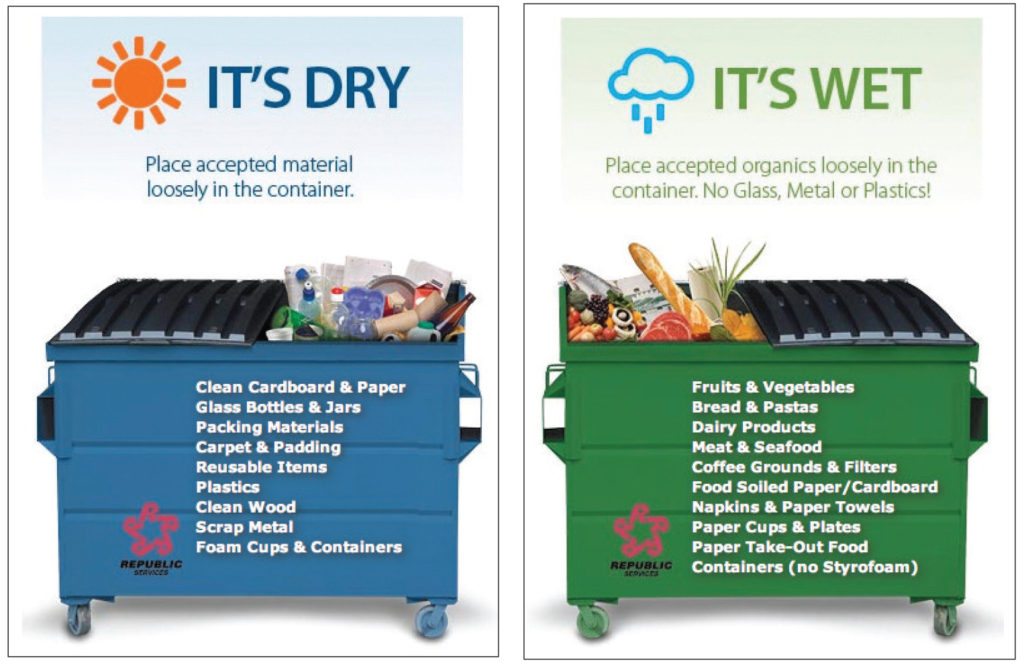
To set up the materials collection system for county sites, a few steps were taken. The properties with cafeterias and employee eating areas were provided separate bins for wet wastes (food scraps, food soiled paper and compostable plates and other service items). In addition, in office environments, three types of collection containers were provided throughout – one each for recyclables, compostables and trash.
Finally, clear plastic bags were used to line the compostables collection containers and waste containers in restrooms. Black bags were used for trash, and recycling was kept loose in collection receptacles.
The janitors at county properties were instructed to tie off the plastic compostables bags and load them into same the collection receptacles as the dry recyclables and trash.
When collected in this way, the wet materials did not contaminate the dry materials. The collected material was hauled to a mixed-waste materials recovery facility (MRF) instead of the landfill, and the clear plastic bags with compostables were pulled off the sort line, leaving dry materials that were mostly recyclables to be sorted for market.
Once Republic Services (the county’s contractor) fully rolled out the wet/dry collection system, the diversion rate for all county properties reached 78 percent.
Two actions guided project success. The first was keeping the food scraps separate from dry, mostly recyclable materials. The second was having access to a processing facility with sufficient capacity to receive and sort the additional materials. The added cost of recovering recyclable and compostable materials was mitigated by eliminating separate recycling routes – all material could be collected together.
Bringing the approach to other areas
The careful routing of an entire commercial collection system similar to the one outlined above can lead to recovery of clean recyclable materials with minimal impact to the offices and other establishments being served. And it can be replicated in other jurisdictions, often without asking much of customers.
There are four primary steps to implementing a selective routing system.
Phase 1 involves evaluating the types of businesses on each existing collection route and assigning each business to a route load based on the business type. To start, review your current route lists and evaluate each customer on each route. Banks, real estate offices, and other office businesses would be assigned to the office route. Restaurants, markets, delis, and groceries would be assigned to both the food-service route and the dry recyclables route. Retail stores and other non-food generating shops would be assigned to the dry recyclables route. Once assigned, the business type should be confirmed by the route supervisor and truck driver. If it is unclear which route a business should be assigned to, an on-site visual assessment of the contents of the garbage and recycling containers should be conducted.
In phase 2, coordinators calculate the number of bin lifts and cubic yards of service for each of the business categories for each route to confirm that a single collection vehicle has sufficient capacity in each load. In calculating the volume to be collected, it is important to remember to adjust for the density of the different material types. A bin full of food scraps will be much heavier than the same bin full of mixed dry retail wastes. If needed, collection services can be re-routed to make the new routing work. The calculations should also adjust for the volume of recycling services currently being provided separately, because the recyclables will be moved into the dry route truck load (even if the recycling bin is left on site).
Phase 3 focuses on evaluating the contents of each collected load when it is tipped at the processing facility and reassigning businesses as appropriate. One nice feature of commercial collection is that almost all loads contain material, such as mail and delivery labels, that identifies business name and address printed on mail and delivery labels. If contamination is an issue, the business associated with the dirty load can be provided educational outreach material and an opportunity to clean up the material in their container.
Finally, in phase 4, coordinators conduct on-site visual waste assessments at businesses that do not fall into one of the primary business categories, or those who do not properly participate in the program. To increase the quality of the recovered materials, the collector or jurisdiction could offer technical assistance to individual businesses.
Establishing internal infrastructure
Once businesses are segmented into proper categories, program coordinators will need to help commercial sites ensure internal infrastructure will meet program needs. The good news is that except for businesses that prepare and serve food as a primary part of their operations, individual businesses are not expected to change the way they currently handle waste materials. In addition, the fee structure to the customer is not changed even though much of the collected materials are no longer hauled directly to the landfill.
Food-service businesses should be provided one bin for clean organics (mostly food scraps and food soiled paper) and a separate bin for dry, mostly recyclable materials (primarily food packaging). So rather than a traditional garbage receptacle and a recycling receptacle out back, food-service businesses will have a Dumpster for clean organics, a Dumpster for dry materials and no garbage container.
At non-food-service businesses, including offices and retailers, most non-recyclable wastes are generated in bathrooms (paper towels) and breakrooms (coffee grounds, lunch and party leftovers). For the most part, these non-recyclable wastes are put in plastic bags at the point of generation. Janitorial staff can take these materials out to garbage Dumpsters in the bags. Most other wastes from these businesses are dry recyclable materials, and they are often not bagged before disposal.
The bagged wet and dry wastes generated at businesses can be discarded in the same bin, and taken to a processing facility where the bagged wet wastes can easily be separated from the dry recyclables. The wet wastes can then be sent to a local compost facility, if there is one permitted to accept these materials, or to the local landfill. The dry materials can of course be sorted and prepared for market. In essence, the garbage bin becomes a recycling bin.
Service-industry businesses – such as landscapers, auto repair shops or cabinet and flooring contractors – generate special material types that should be collected in separate routes to not contaminate the recyclable materials loads.
The selective commercial routing system is particularly effective in servicing the three business types outlined above because the customer continues pays the hauler for all collection services provided, not just for garbage collected. This resolves the problem of reducing garbage revenues as more recycling services are provided. The revenue stream is retained as diversion is greatly increased. All of this without adding separate recycling routes and drivers.
Furthermore, the cost of processing these pre-selected materials in separate loads is lower than processing mixed loads, and the loads yield higher quality marketable commodities because the dry recyclables are not contaminated by wet garbage, so fewer recyclables are lost to landfill.
A shift from garbage to recovery
By following the simple procedures governing selective routing in the commercial space, it is possible to turn a high-disposal garbage collection system into a high-diversion recycling system, without incurring additional costs or losing collection revenue.
No longer will Dumpsters behind shopping plazas and other sites represent missed opportunity. Instead, these generators can sit at the center of thriving materials recovery programs.
Richard Gertman is the owner of For Sustainability Too in San Jose, Calif. He can be reached at [email protected]. Tracie Onstad Bills is the northern California director of sustainable materials management at SCS Engineers. She can be reached at [email protected].