









This story originally appeared in the April 2016 issue of Resource Recycling.
Subscribe today for access to all print content.
We all know it’s not easy to implement large-scale change in any area of business or life – just think back to your last few New Year’s resolutions for evidence. When the desired shift involves public programs or policy, the obstacles may seem even more insurmountable.
But that doesn’t mean we should stop striving for improvements and revamps in recycling programs across the country. With thoughtful and well-designed strategies in place, municipalities can build support for action among residents and local stakeholders.
This article explores two instances of transition in recycling in the City and County of Denver to illustrate several replicable strategies that can ease the pain of implementing large-scale changes in materials management programs.
Bringing regulation to haulers
Historically, Denver has taken a very hands-off approach to the commercial hauling sector (a common stance across the U.S.), and up until last year, Denver used a fully open market system with no licensing requirements. In order to increase public safety, better understand the service-provider landscape, and gather data on tons landfilled and diverted, Denver staff decided to pursue a hauler licensing program in 2015.
The following list outlines the lessons learned from a process that was certainly contentious but which eventually led to a regulation that was supported by all parties.
Do your homework. Prior to publicly embarking on any efforts to adopt the city’s first-ever hauler licensing policy, Denver staff spent months researching options, talking to peer cities and holding detailed internal discussions to review the potential impacts, barriers and options.
Knowing the policy details about what was being done in other leading cities in the U.S. was integral in building support among elected officials in Denver. This proved true both in public City Council meetings, as well as in one-on-one meetings with elected officials, haulers and city staff. Be sure to know the answers to the following: Is your city going to be the first to undertake a particular policy? If so, why haven’t others gone there yet? If not, what have others done to be successful?
Furthermore, if your regulations are more stringent than those in peer cities, be sure to know why, and vice versa. And you’ll also want to understand how your fees stack up with those in neighboring communities and the reasons behind any differences.
Make close connections. Getting to know the regulated industry on a personal level was key to Denver’s process. Denver staff and the city’s consultant made themselves available at public and private meetings with all the potentially impacted haulers to hear their concerns before the project moved far along. Staff also made sure to establish open lines of communication at all times, enabling the regulated industry and elected officials to reach out to city staff as needed.
Know the law. Denver staff worked with city attorneys very early in the process. There is no reason to waste a lot of time pursuing ordinance language that will not make it through the legal process.
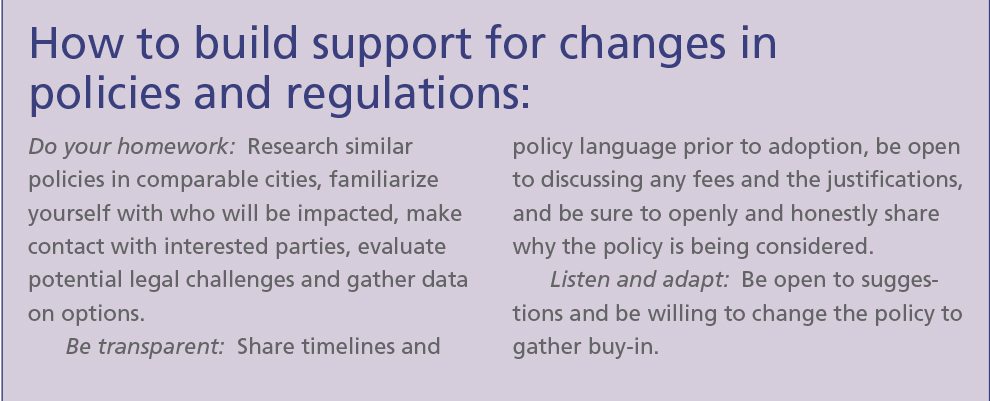 Be transparent. Businesses, citizens and elected officials tend to be more willing to support something when they understand why the language is being enacted. And of course, sensible and useful regulations are much less likely to result in stiff opposition. In Denver, city staff began the process of regulating commercial haulers with a clear explanation of why the regulation was being considered, noting the ways the policy could improve safety, create a level playing field, bolster data collection and boost access. Staff also shared the timeline and openly discussed what the fees would be.
Assuring industry that the effort wasn’t just another regulation to generate revenue was integral in gaining support. In Denver, the fees will not cover the full costs of administering the program – instead, they will be used to offset administrative costs and provide legitimacy to the program. Denver staff reached out multiple times to every potential impacted hauler via mail, phone and email. Staff also hosted public meetings with the haulers and made sure to share drafts of the ordinance language with any interested party. Sharing drafts of the ordinance language helped assure the haulers that no “surprises” would show up when the ordinance was passed.
Listen and adapt. While Denver staff had an idea about what the ordinance would look like prior to the stakeholder process, the fine details were left open for discussion. Instead of holding stakeholder meetings that are little more than information sharing for an already-decided program, Denver took into account the views of the haulers and modified policy language to address some of the hauler concerns.
For example, Denver adopted a hybrid fee structure based on the fleet size, as opposed to a strict per-truck or per-business fee. Another example of flexibility was seen in the decision to not require haulers to place external stickers on each truck, instead allowing them to keep a copy of the registration in the cab. In addition, the City adjusted the reporting dates to meet other hauler reports in the state. The bottom line is to truly adopt a collaborative approach where concerns are not just listened to but actually acted upon.
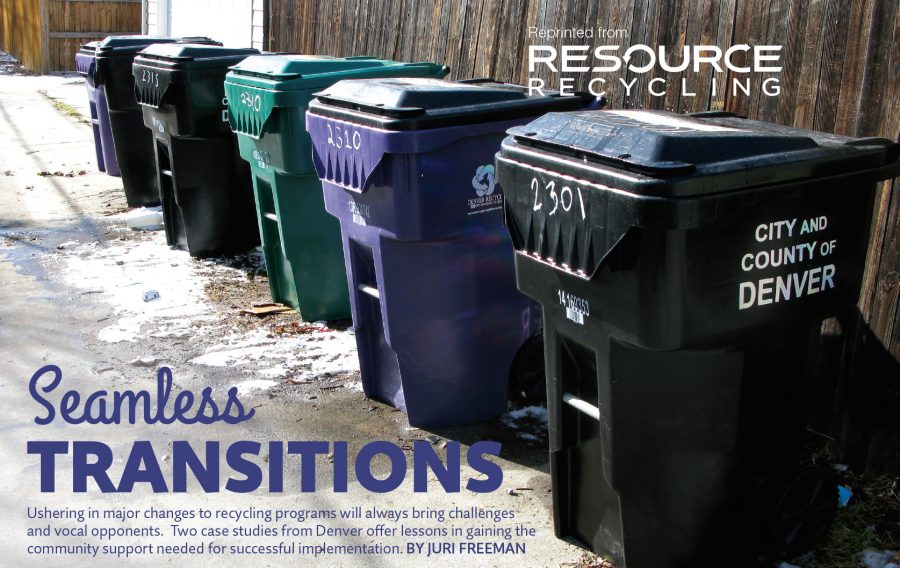
Moving 110,000 households to carts
The second example of implementing a large-scale change came in 2014 when Denver began the arduous task of transitioning the city to a cart-based collection system for refuse.
Prior to the transition, only about one-third of city households had carts for collection of trash and recyclables. The other two-thirds (roughly 110,000 homes) had either shared Dumpsters in alleys or manual collection for trash. While transitioning to carts may seem like something that would be met with general support, there were a large number of people who were opposed. In fact, at one of the early meetings, an attendee approached the author of this story and said that she had spent a decade in the oil and gas industry – and the meeting in question was by far the most contentious she had ever attended. Despite these challenges, over the past two years the City successfully transitioned more than 60,000 households to carts, gained widespread support among residents, and secured funding from City Council to finish the remainder of the city by 2017.
Once again, Denver staff’s messaging focused on communicating the “why” behind the program. Transitioning to trash carts was a major change, and many of the affected households felt that their collection system worked well and no change was needed. While this was true in some portions of the city, in others it was definitely not the case.
The City wanted to move to carts for a number of reasons, including increased efficiency, reduced illegal dumping, increased diversion, cleaner alleys, equity and safety. Having clear, understandable messages helped build support among neighborhood groups and individuals. Denver made sure to highlight all of the potential justifications for the change as the reasons for support differed among the various audiences. For example, some neighborhoods embraced the increased diversion resulting from the switch, but others liked the idea that removing the Dumpsters would make their alleys feel safer.
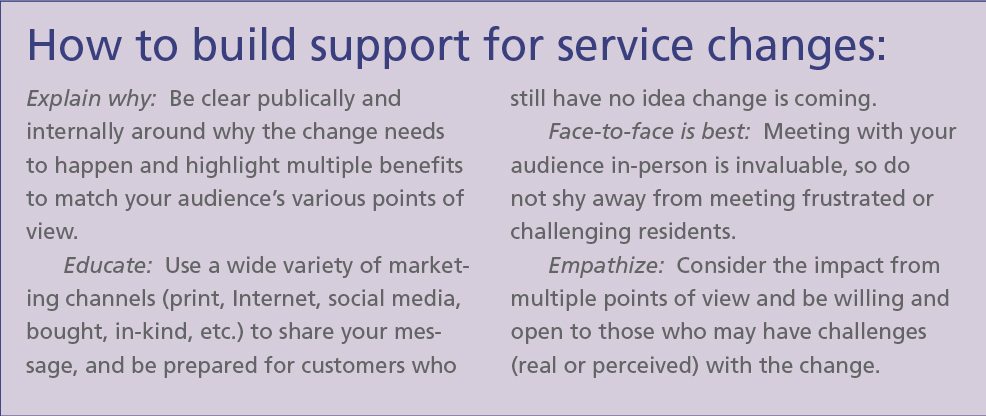 Denver staff took six months prior to program roll-out to conduct its education campaigns, and it was a full staff effort that included administrative staff, customer-service representatives and collection crews. The City conducted a wide variety of outreach efforts to ensure any impacted resident knew what was coming. The communication came through social media blasts, website notifications, emails and purchased online advertising. In addition, a mailer sent to all households reviewed the program details, and four additional mailers went out to each impacted household. The effort also involved more than 30 in-person neighborhood meetings and scores of free press mentions in the paper and on television – all print messages appeared in both English and Spanish. Despite all of these “touches,” a significant number of residents still had questions when the new carts showed up, and some households reported they never even knew the change was coming.
The lesson here is that no matter how much outreach you do around the new program, it is never too much. Be sure to use a wide variety of marketing channels and know that some of your audience will like email, others will like the local paper, and still others will like to hear about it through the grapevine. Diversify your outreach and be sure to include the costs of outreach (in Denver it was $2 to $3 per household) and the staff time needed to conduct the outreach in your program budget.
Still, nothing beats face-to-face meetings. Denver staff reached out to every impacted neighborhood and got on neighborhood organization meeting agendas to speak. Additionally, Denver staff shared their office phone numbers or, in some cases, cellphone numbers with citizens, offered to go out to people’s homes to talk about cart set-out and storage, and worked hard to put a face on a large city program.
Finally, it’s important to empathize with those going through the shift to their daily habits. From a macro perspective, switching to cart-based collection is a no-brainer. However, from an individual household point of view, in some instances it truly was a hardship. Some of the residents going through the transition are elderly people that use oxygen tanks or walkers and have no neighbors or family to help with trash and recycling. Other households sit on very dense streets with alley collection where the cart set-out could potentially take away a parking space. Further, some households must navigate narrow fence openings, step downs or other physical barriers.
In order to help these customers, Denver worked with all collection and customer-service staff to project an attitude of understanding. Staff were instructed to collaborate with affected households and assure upset customers that their frustrations were legitimate. Staff were also willing to meet individuals at their homes to find solutions and they made sure to acknowledge the frustration and not brush it off as unreasonable.
Evolving is integral
Navigating the landscape of public programs and policies is challenging, and for the most part, people and businesses gravitate to routines and resist change. Yet, adopting new policies and implementing improved services is integral to providing efficient and effective materials management services in an ever-evolving marketplace. By taking your time and following a methodical and conscientious process, achieving significant change can be supported and embraced by the community.
Juri Freeman is a senior consultant at the consultancy firm Resource Recycling Systems (RRS). Prior to his role at RRS, he was the recycling program manager for the City and County of Denver. He can be reached at [email protected].