


Resource Recycling
  • The Latest
  • Analysis
    • All
    • Certification Scorecard
    • Industry Announcements
    • Opinion
    Intel sign outside of company building.

    What Intel’s blockbuster quarter means for ITAD

    Feds to develop repairable computer donation program

    The whitebox blind spot in PC recycling

    Analysis: circular design still elusive in laptops

    PC shipments grew in Q1, but questions remain

    The independent ITAD at a crossroads

    The independent ITAD at a crossroads

    Certification Scorecard — Week of April 20, 2026

    Apple Watch on product box.

    Wearables are coming and ITAD isn’t ready

    Certification Scorecard — Week of April 13, 2026

    EV Battery Pack - Sergii Chernov-Shutterstock

    Redwood, Rivian deal fuels US infrastructure plans

    Bloom ESG and e-Stewards roll out critical metals metric

  • Conferences
  • Publications

    Other Topics

    Textiles
    Organics
    Packaging
    Glass
    Brand Owners

    Metals
    Technology
    Research
    Markets
    Grant Watch

    All Topics

Subscribe
No Result
View All Result
Resource Recycling
  • The Latest
  • Analysis
    • All
    • Certification Scorecard
    • Industry Announcements
    • Opinion
    Intel sign outside of company building.

    What Intel’s blockbuster quarter means for ITAD

    Feds to develop repairable computer donation program

    The whitebox blind spot in PC recycling

    Analysis: circular design still elusive in laptops

    PC shipments grew in Q1, but questions remain

    The independent ITAD at a crossroads

    The independent ITAD at a crossroads

    Certification Scorecard — Week of April 20, 2026

    Apple Watch on product box.

    Wearables are coming and ITAD isn’t ready

    Certification Scorecard — Week of April 13, 2026

    EV Battery Pack - Sergii Chernov-Shutterstock

    Redwood, Rivian deal fuels US infrastructure plans

    Bloom ESG and e-Stewards roll out critical metals metric

  • Conferences
  • Publications

    Other Topics

    Textiles
    Organics
    Packaging
    Glass
    Brand Owners

    Metals
    Technology
    Research
    Markets
    Grant Watch

    All Topics

Subscribe
No Result
View All Result
Resource Recycling
No Result
View All Result
Home Recycling

Robotics provider begins operating its own facilities

Dan LeifbyDan Leif
May 10, 2022
in Recycling
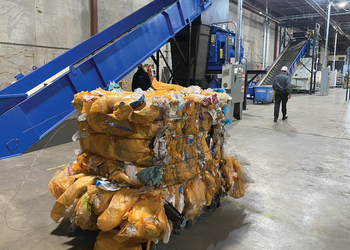
Secondary-sortation sites run by AMP Robotics are targeting a wide variety of materials that come from MRFs and other sources. | Courtesy of AMP Robotics

AMP Robotics is now breaking and sorting MRF residual bales at secondary-sortation operations in Colorado, Georgia and Ohio.

AMP, a provider of AI-powered robotics, started testing the secondary-sort concept in Denver, where the company is headquartered. AMP transitioned that pilot project into a commercial-scale facility in early 2021.

It added an additional site in Atlanta in late 2021 and then brought a Cleveland facility on-line earlier this year.

“There is value in clamshells, there is value in the PP, there is value in opaque PET,” AMP CEO Matanya Horowitz told Resource Recycling on the sidelines of this week’s Waste Expo conference in Las Vegas. “All this stuff fundamentally is a resource and the world should be taking advantage of it.”

The three sites, which range between 50,000 square feet and 120,000 square feet in size, each take in between 2,000 and 3,000 tons of material from MRFs, plastics reclaimers and other suppliers each month, Horowitz noted.

The facilities employ workers to maintain equipment, feed material into the system and move bales. But all of the actual sortation is done by the company’s robotic units.

Horowitz declined to share the total investment in the secondary-sort project.

In a press release, the company said it plans to introduce additional secondary-sorting facilities in the latter half of this year. AMP is looking to establish supply relationships to accept or buy residual bales from other waste management companies.

Pricing continuum on supply

Horowitz said AMP is currently partnering with dozens of MRFs and a smaller number of plastics reclaimers to garner supply.

He said AMP will pay for bales of mixed plastics and other materials. For some loads of residuals, AMP charges a tipping fee that is lower than what the supplier would pay to send the material to disposal.

“We have a whole continuum based on our end markets and also the innate value of the materials,” Horowitz said.

Over the last decade, a handful of ventures have experimented with the secondary-sortation model, but most have fizzled. Titus MRF Services in 2020 closed down its Los Angeles-area secondary sorting facility, citing difficult commodity markets. QRS ran plastic recovery facilities in the eastern half of the U.S. but closed them starting in 2016, culminating in the January 2021 sale of QRS’s St. Louis plastics recycling company Re-Poly.

Horowitz said he believes AMP can succeed in the space because the robotic technology allows the operations to create very specific product blends for different end markets. The company’s sites are also sorting out fiber grades, whereas previous secondary-sort facilities targeted plastics primarily.

AMP is also entering the sort game at a time when brand goals and recycled-content mandates are driving new levels of demand for recycled commodities.

“We would argue that AI and robotics are particularly well-suited to secondary sorting,” Horowitz said. “[The line] can be adapted quickly to commodity pricing.”

Horowitz also said he sees growing opportunity to work with chemical recycling operators, which turn recovered plastics to a variety of chemical products. Many such projects have been announced, and only a handful are operating at scale. But Horowitz said AMP’s facilities have been able to deliver loads at the proper spec for the different processes.

“We’re excited about capacity that’s being built up right now,” Horowitz said of chemical recycling. “Some of them can be very particular about the particular resins they need, and we can teach that to the AI.”

‘Introduces market certainty’

Although robots can’t perform nearly as many sorts per minute as optical sorters can, they’re able to perform a bigger variety of sorts on lower-volume streams, generally with less capital investment. At MRFs, they’re frequently used on last-chance lines to recover saleable commodities that were missed by earlier screens, magnets and optical sorters and may otherwise head to landfills.

AMP’s press release noted the company’s secondary sortation business model also “introduces market certainty, lower disposal costs, and new revenue streams for established MRFs by creating a destination for residue that they would otherwise have to pay to landfill, as well as demand for mixed or impure plastic streams that may not have strong end markets.”

Robotic sorting technologies have exploded since lab testing refined the technology enough for use in real-world MRFs starting in 2016. Today, in addition to AMP, a number of recycling equipment providers are selling robotic sorting systems, including Bollegraaf, Bulk Handling Systems (BHS), EverestLabs, Green Machine, Machinex, Waste Robotics and ZenRobotics.

For its part, AMP disclosed that it has deployed about 230 sorting systems in over 80 facilities on three continents. The AI recognition abilities are now supported by a catalog of images of over 50 billion containers and other packaging types. The company’s release notes that it’s working to improve the ability to identify particularly challenging packaging types.

“These advancements in material recognition continuously improve performance for our customers and open the door to other categories of packaging that have been historically challenging to identify, such as plastic films and flexible packaging – an area we’re heavily focused on in new product development,” Amanda Marrs, senior director of product, stated in the release.

Associate Editor Jared Paben contributed to this report.

 

Tags: Hard-to-Recycle MaterialsMRFsPlastics
TweetShare
Dan Leif

Dan Leif

Dan Leif is the managing editor at Resource Recycling, Inc., which publishes Resource Recycling, Plastics Recycling Update and E-Scrap News. He has been with the company since 2013 and has edited different trade publications since 2006. He can be contacted at [email protected].

Related Posts

Data erasure firm expands wearable device capabilities

Apple hits 30% recycled content, debuts new recovery tech

byStefanie Valentic
April 17, 2026

Apple hit a record 30% recycled content across all 2025 products while debuting two new recovery technologies it's now sharing...

WM opens new $60m MRF in Indy

byAntoinette Smith
April 10, 2026

The newest recycling facility has annual capacity of 200,000 tons and will send all mixed paper to Pratt Industries for...

Plastics Recyclers Have the Capacity to Recycle More. Now Let’s Use It.

Study finds most recycling occurs within 30 miles of access

byBrian Clark Howard
April 8, 2026

Researchers at the University at Buffalo also found that Americans produce similar volumes of plastic package waste regardless of economic...

Independents complement primary PRO in state EPR

byAntoinette Smith
April 6, 2026

Separate producer responsibility organizations for specialized packaging such as petroleum products can help ensure success for everyone, according to the...

Maryland PaintCare launch press conference in Annapolis

Maryland’s paint recycling program opens

byBrian Clark Howard
April 2, 2026

The state is the latest to launch a stewardship program with PaintCare.

Mike Whitney led the group through the CP Group plant.

A look inside a MRF equipment factory

byBrian Clark Howard
March 25, 2026

The Plastics Recycling Conference’s facility tour went to San Diego-based CP Group, a leading supplier of equipment for MRFs.

Load More
Next Post

EPR and packaging-reduction bill introduced in New York

More Posts

Birch Plastics gets FDA green-light for post-industrial PP

LyondellBasell upgrade to PreZero assets on hold

April 23, 2026
The independent ITAD at a crossroads

The independent ITAD at a crossroads

April 22, 2026
Towfiqu ahamed barbhuiya

Before the Bin: Breaking down food date labeling

April 20, 2026

Google pilots reuse kits to extend device life

April 21, 2026
EPR fees are a market signal. Here’s what they’re telling you.

Oregon DEQ flags 250 producers for RMA noncompliance

April 21, 2026
Industry group: Help us find the plastic bale volumes we need

PET bales sink further as other grades firm 

April 15, 2026

What Netflix’s ‘Plastic Detox’ gets wrong – and right

April 23, 2026
What is EPR and why it matters

What is EPR and why it matters

April 22, 2026

NERC launches hub to promote PCR demand 

April 15, 2026
Growth challenges drive M&A for packaging

Growth challenges drive M&A for packaging

April 20, 2026
Load More

About & Publications

About Us

Staff

Archive

Magazine

Work With Us

Advertise
Jobs
Contact
Terms and Privacy

Newsletter

Get the latest recycling news and analysis delivered to your inbox every week. Stay ahead on industry trends, policy updates, and insights from programs, processors, and innovators.

Subscribe

Welcome Back!

Login to your account below

Forgotten Password?

Retrieve your password

Please enter your username or email address to reset your password.

Log In

Add New Playlist

No Result
View All Result
  • The Latest
  • Analysis
  • Recycling
  • E-Scrap
  • Plastics
  • Policy Now
  • Conferences
    • E-Scrap Conference
    • Plastics Recycling Conference
    • Resource Recycling Conference
    • Textiles Recovery Summit
  • Magazine
  • About Us
  • Advertise
  • Archive
  • Jobs
  • Staff
Subscribe
This website uses cookies. By continuing to use this website you are giving consent to cookies being used. Visit our Privacy and Cookie Policy.