Resource Recycling
  • The Latest
  • Analysis
    • All
    • Certification Scorecard
    • Industry Announcements
    • Opinion
    Apple Watch on product box.

    Wearables are coming and ITAD isn’t ready

    Certification Scorecard — Week of April 13, 2026

    EV Battery Pack - Sergii Chernov-Shutterstock

    Redwood, Rivian deal fuels US infrastructure plans

    Bloom ESG and e-Stewards roll out critical metals metric

    Colorado regulators suggest mid-range EPR scenario

    Why collaboration on plastic waste still matters

    Battery recycler Ascend Elements files for bankruptcy

    Battery recycler Ascend Elements files for bankruptcy

    EPR fees are a market signal. Here’s what they’re telling you.

    EPR fees are a market signal. Here’s what they’re telling you.

    Wolframite ore, the primary ore of tungsten from Altai, Russia

    Tungsten scrap export controls draw industry attention

    Certification Scorecard — Week of April 6, 2026

  • Conferences
  • Publications

    Other Topics

    Textiles
    Organics
    Packaging
    Glass
    Brand Owners

    Metals
    Technology
    Research
    Markets
    Grant Watch

    All Topics

Subscribe
No Result
View All Result
Resource Recycling
  • The Latest
  • Analysis
    • All
    • Certification Scorecard
    • Industry Announcements
    • Opinion
    Apple Watch on product box.

    Wearables are coming and ITAD isn’t ready

    Certification Scorecard — Week of April 13, 2026

    EV Battery Pack - Sergii Chernov-Shutterstock

    Redwood, Rivian deal fuels US infrastructure plans

    Bloom ESG and e-Stewards roll out critical metals metric

    Colorado regulators suggest mid-range EPR scenario

    Why collaboration on plastic waste still matters

    Battery recycler Ascend Elements files for bankruptcy

    Battery recycler Ascend Elements files for bankruptcy

    EPR fees are a market signal. Here’s what they’re telling you.

    EPR fees are a market signal. Here’s what they’re telling you.

    Wolframite ore, the primary ore of tungsten from Altai, Russia

    Tungsten scrap export controls draw industry attention

    Certification Scorecard — Week of April 6, 2026

  • Conferences
  • Publications

    Other Topics

    Textiles
    Organics
    Packaging
    Glass
    Brand Owners

    Metals
    Technology
    Research
    Markets
    Grant Watch

    All Topics

Subscribe
No Result
View All Result
Resource Recycling
No Result
View All Result
Home Recycling

Recycled pulp mill planned in Northeast US

Colin StaubbyColin Staub
June 30, 2020
in Recycling
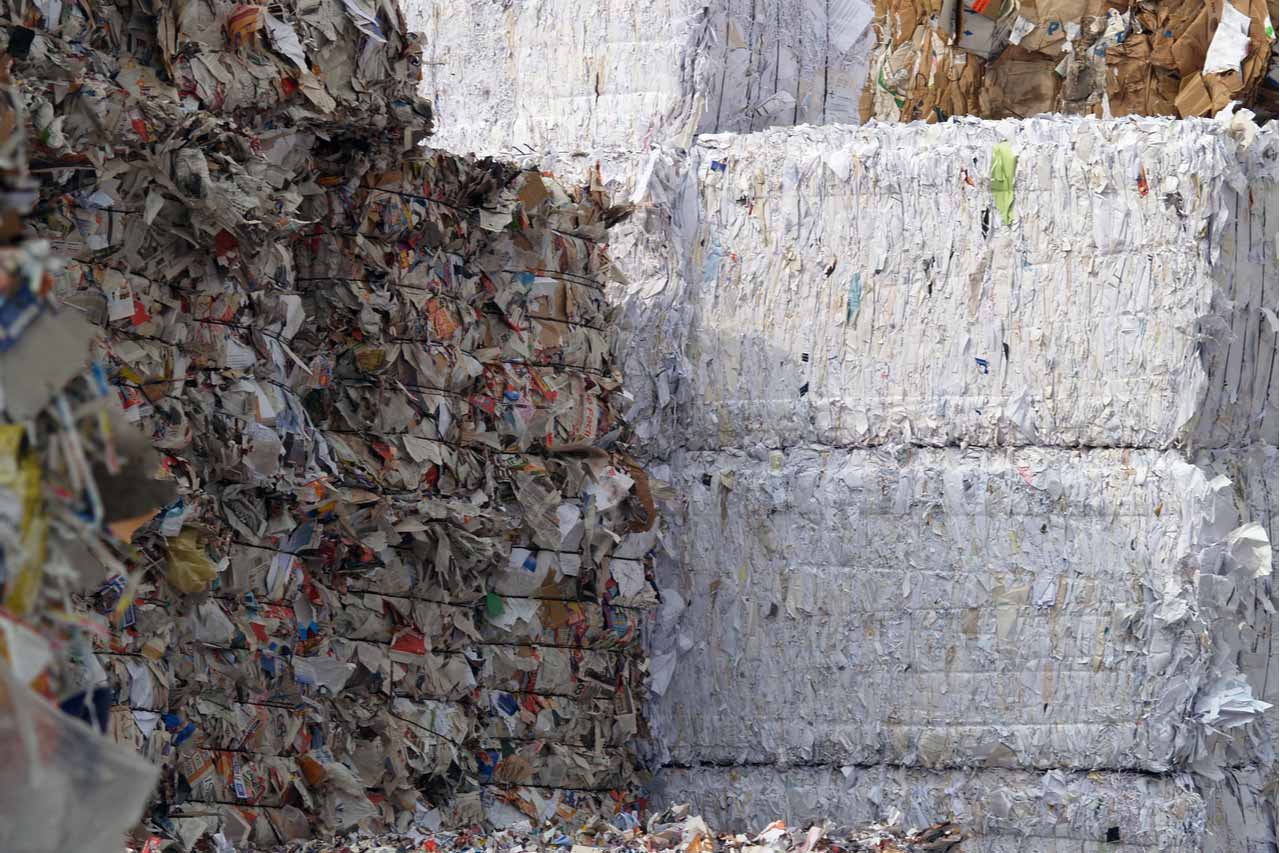
Once operational, the Empire Recycled Fiber mill will produce 440,000 tons per year of recycled paper pulp. | Luis M. Seco/Shutterstock

A $125 million recycled paper pulp mill in Pennsylvania will source more than 500,000 tons per year of mixed paper and OCC. The facility will ship its product to China.

The Empire Recycled Fiber mill is in development in Fairless Hills, Pa., on the site of a decommissioned steel mill complex. The facility will be looking to bring in 505,000 tons per year of recovered fiber from nearby regions, said Bill Moore of Moore & Associates. He presented on behalf of the project team during a recent virtual meeting of the Association of New Jersey Recyclers.

That feedstock will be 70% OCC and 30% mixed paper, Moore said.

The mill’s output will be 440,000 tons per year of recycled paper pulp, which paper manufacturers will use as a raw material. The mill will use “state-of-the-art” processing technology, Moore explained, to produce and dry the pulp to 10% moisture content. Then, the material will be wrapped, baled and exported to China.

The recycled pulp mill will fill a market void left in the wake of China’s National Sword import restrictions. Recovered fiber has become far more difficult to ship into China due to the policy actions, but pulp made from recovered fiber does not face the same import scrutiny.

Empire Recycled Fiber has a Chinese paper producer as an equity partner, and that same company signed a 20-year offtake agreement for the pulp. The project team has not publicly named the partner company, which holds a majority ownership in the Pennsylvania facility.

“You’ve always got to start out with a customer,” Moore said.

Empire will source scrap material primarily from eastern and central Pennsylvania, as well as New Jersey. The facility will also look to Maryland, Delaware and New York as secondary sourcing areas, Moore added.

The Pennsylvania mill is looking for long-term supply contracts, and it will begin buying recovered paper in late 2021 as the facility gears up for a 2022 startup.

Early work on the mill project began about a year ago, Moore said, and the team plans to close on financing during the third quarter of 2020. Full construction work is planned to start this fall and take a year to 14 months.

Once operating, the plant will employ roughly 110 full-time manufacturing employees.

Project leaders are already working with numerous recovered paper suppliers, including Waste Management, Canusa Corp. and more. The mill is looking for long-term supply contracts, Moore explained, and will begin buying recovered paper in late 2021 as the facility gears up for a 2022 startup.

Market shift drives opportunity

Substantial disruption in recovered paper markets contributed to the development of the Empire project.

Moore pointed to the ongoing decline in Chinese recovered fiber imports and the likelihood that the country completely closes the door to recovered fiber imports next year. These restrictions, Moore explained, have led to an unsustainable situation for the Chinese paper industry.

“They don’t have enough fiber to run their mills,” Moore said. As alternatives, the Chinese industry’s sourcing options are to increase domestic fiber collection, use more virgin pulp, use finished products such as linerboard, or import recycled paper pulp.

The first three options are taking place to some extent but are either not supplying enough material or are financially challenging. Domestic collection can only increase so much, Moore noted, because a substantial portion of containerboard boxes produced in China end up getting shipped abroad. And using virgin pulp and finished products carries significantly higher costs than raw recovered paper or recycled pulp.

The latter option is becoming more and more popular. China’s import restrictions do not extend to processed material made from recovered fiber, and in recent tariff talks the Chinese government lifted import duties on U.S. recycled pulp.

Chinese imports of this material from all countries quadrupled from 2016 to 2019, Moore noted, hitting nearly 1 million tons. Next year, he estimated, the country could import 3 million tons of the material.

Last year, a paper processing equipment supplier reported receiving numerous orders for recovered fiber processing plants outside China. Many of these operations have been located in Southeast Asia, where the proximity to China means fewer logistical hurdles. Pulp can be shipped in its wet form from Southeast Asian producers because the trip is short enough to avoid moisture-related damage to the material. Pulp originating further from China needs to be dried before transit.

Despite the greater distance, the U.S.-to-China model is taking off, as well. Pulp exports from the U.S. to China jumped from 16,000 short tons in 2018 to 239,000 short tons in 2019, according to U.S. export data. During the first four months of 2020, the U.S. shipped 94,000 short tons of recycled pulp to China.

U.S. mill operator Sonoco Products recently reported it shifted some of its recycled paperboard production capacity to instead produce recycled pulp, and the company has been shipping that material to China. Nine Dragons, the largest paper company in China, has purchased multiple U.S. recycled fiber mills in part to ship recycled pulp to the company’s manufacturing operations in China. Earlier this year, a separate recycled pulp facility project was announced in Chesapeake, Va.
 

Tags: AsiaPaper FiberTrade & Tariffs
TweetShare
Colin Staub

Colin Staub

Colin Staub was a reporter and associate editor at Resource Recycling until August 2025.

Related Posts

Volatility reshapes outlook for US metals businesses

byScott Snowden
April 15, 2026

Panelists at the ReMA conference in Las Vegas said tariffs, reshoring and geopolitical tension are remaking trade flows, lifting US...

Industry group: Help us find the plastic bale volumes we need

PET bales sink further as other grades firm 

byRecyclingMarkets.net Staff
April 15, 2026

Pricing for HDPE and PP bales rose again, while PET bales remained low, film grades have steadied, and paper and...

Matium raises $8m, adds buyer financing

byAntoinette Smith
April 14, 2026

A trade finance facility from the new Erebor Bank will help bridge the gap between buyer and seller payment terms...

WM opens new $60m MRF in Indy

byAntoinette Smith
April 10, 2026

The newest recycling facility has annual capacity of 200,000 tons and will send all mixed paper to Pratt Industries for...

Paper giant closes Texas containerboard mill

International Paper plans $225m Mississippi plant

byScott Snowden
March 31, 2026

International Paper plans a $225m box plant in Mississippi to replace an aging facility, with reported capacity of 1.8 billion...

Unilever shifting focus to flexibles targets

Unilever shifting focus to flexibles targets

byAntoinette Smith
March 23, 2026

The global brand hit its target of 25% PCR use in packaging last year, but will increase work on substituting...

Load More
Next Post
E-scrap processor dives deeper into plastics sortation

Study explores southeast state's contamination rate

Leading the Charge in Safe Battery Recycling
Sponsored

Leading the Charge in Safe Battery Recycling

byThe Battery Network
April 13, 2026

We’re connecting people, brands, and communities through one nationwide network built to make battery recycling safer, simpler, and more accessible...

Read moreDetails

More Posts

EPR fees are a market signal. Here’s what they’re telling you.

EPR fees are a market signal. Here’s what they’re telling you.

April 10, 2026

Recycling Partnership CEO stepping down

April 15, 2026
Battery recycler Ascend Elements files for bankruptcy

Battery recycler Ascend Elements files for bankruptcy

April 13, 2026
Industry group: Help us find the plastic bale volumes we need

PET bales sink further as other grades firm 

April 15, 2026
Colorado regulators suggest mid-range EPR scenario

Why collaboration on plastic waste still matters

April 13, 2026

GFL acquires SECURE Waste for $6.4bn

April 13, 2026

WM opens new $60m MRF in Indy

April 10, 2026

Amazon, DOE partner on critical materials recovery

April 13, 2026

Bloom ESG and e-Stewards roll out critical metals metric

April 15, 2026
Solarcycle starts up Georgia recycling plant

S3399 signals a shift in how states are tackling solar panel waste

April 6, 2026
Load More

About & Publications

About Us

Staff

Archive

Magazine

Work With Us

Advertise
Jobs
Contact
Terms and Privacy

Newsletter

Get the latest recycling news and analysis delivered to your inbox every week. Stay ahead on industry trends, policy updates, and insights from programs, processors, and innovators.

Subscribe

Welcome Back!

Login to your account below

Forgotten Password?

Retrieve your password

Please enter your username or email address to reset your password.

Log In

Add New Playlist

No Result
View All Result
  • The Latest
  • Analysis
  • Recycling
  • E-Scrap
  • Plastics
  • Policy Now
  • Conferences
    • E-Scrap Conference
    • Plastics Recycling Conference
    • Resource Recycling Conference
    • Textiles Recovery Summit
  • Magazine
  • About Us
  • Advertise
  • Archive
  • Jobs
  • Staff
Subscribe
This website uses cookies. By continuing to use this website you are giving consent to cookies being used. Visit our Privacy and Cookie Policy.